
Golden Silk Orb-weaver
Nephila
Description
How to identify
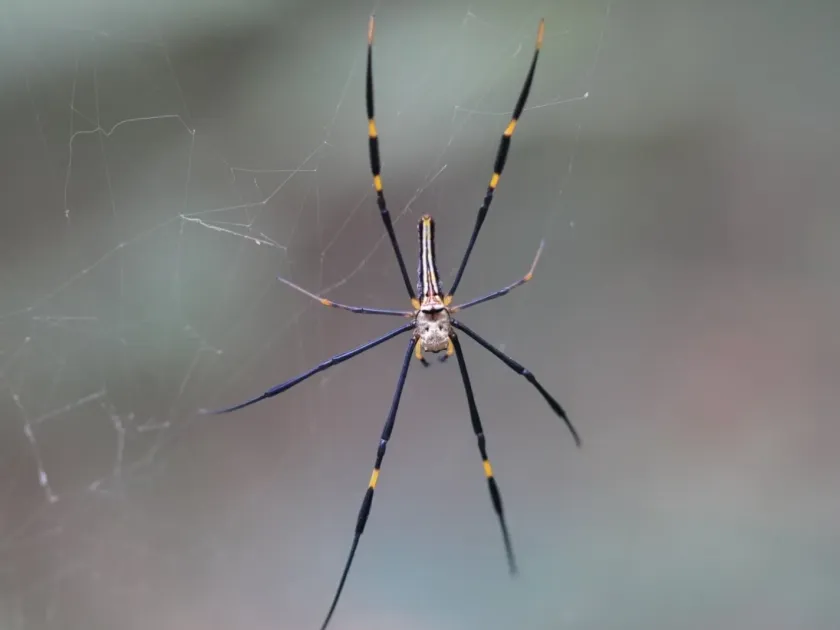
The Golden Silk Orb-weaver, belonging to the genus Nephila (family Nephilidae), is widely recognized for its large size and its ability to weave expansive, durable webs with a distinct golden hue.
Females are significantly larger than males and possess long legs with characteristic tufts of hair, often appearing imposing to casual observers. Their bodies can range in color from bright yellow to dark brown.
These spiders prefer building their vertical webs in areas with minimal wind and high prey availability, such as tree canopies, orchards, or thick hedge rows within agricultural settings.
Although they are large, they are strictly predatory and hunt flying insects. They do not feed on plant tissues, making their direct impact on crop health minimal compared to traditional agricultural pests.
The species is identifiable by its complex web structure, which remains intact for long periods, often spanning several meters between branches or structures in the garden.
What it damages
While Nephila is not a plant parasite, its physical presence can cause indirect damage. Large, dense webs can weigh down young, flexible shoots, causing them to bend or become distorted over time.
Prolonged shading caused by multiple layered webs can reduce the amount of light reaching the leaf surface, which may slightly hinder the photosynthetic efficiency of the host plant in dense foliage.
Accumulated debris, including dust and insect carcasses within the webs, can serve as a substrate for secondary pathogens, such as sooty mold, which can eventually impact the health of the plant bark or leaves.
The extensive webbing can significantly obstruct routine agricultural operations, such as manual harvesting, pruning, or the application of liquid fertilizers and pesticides, by clogging equipment nozzles.
In extreme cases, the structural tension created by a large spider web can cause minor mechanical injury to tender new buds if the web is forcefully pulled or disturbed during plant growth.
When it appears
The life cycle of the Golden Silk Orb-weaver is highly seasonal, peaking during warm, humid months when prey populations are most abundant. Activity usually begins in late spring.
As temperatures rise during the summer, the spiders grow rapidly and increase their web-building activity, leading to a noticeable presence in gardens and agricultural fields by mid-season.
The reproductive phase occurs in late summer or early autumn, after which the adults eventually die off as temperatures begin to drop, ending their annual cycle of activity.
Overwintering occurs exclusively in the egg stage. These eggs are protected within sturdy, weather-resistant cocoons that remain hidden in the bark or crevices until the next spring.
The timing of their presence is predictable, making it easier for growers to plan any necessary management strategies around their most active periods of growth and web construction.
Control measures
In most scenarios, Golden Silk Orb-weavers are considered beneficial predators that help control pest populations. Therefore, aggressive eradication is rarely necessary or recommended for general gardening.
If web accumulation becomes a nuisance, mechanical removal using a high-pressure water spray is the most effective and eco-friendly method, as it preserves beneficial predatory insects.
Preventive management through proper pruning and canopy thinning reduces the availability of suitable anchor points for the spiders, naturally encouraging them to relocate to non-crop areas.
Avoid the use of broad-spectrum insecticides, as these chemicals often eliminate beneficial spiders and other predators, which can result in a secondary surge of true plant-damaging pests.
Maintaining a clean garden environment by removing overgrown weeds near the trunks of trees limits the web-building capacity of these spiders, keeping them away from valuable fruit-bearing branches.
Taxonomy
- Latin name
- Nephila
- Family
- Araneidae
- EPPO code
- NEPLSP
Discussion
No discussions yet — be the first.