
Neoscona adianta
Neoscona adianta
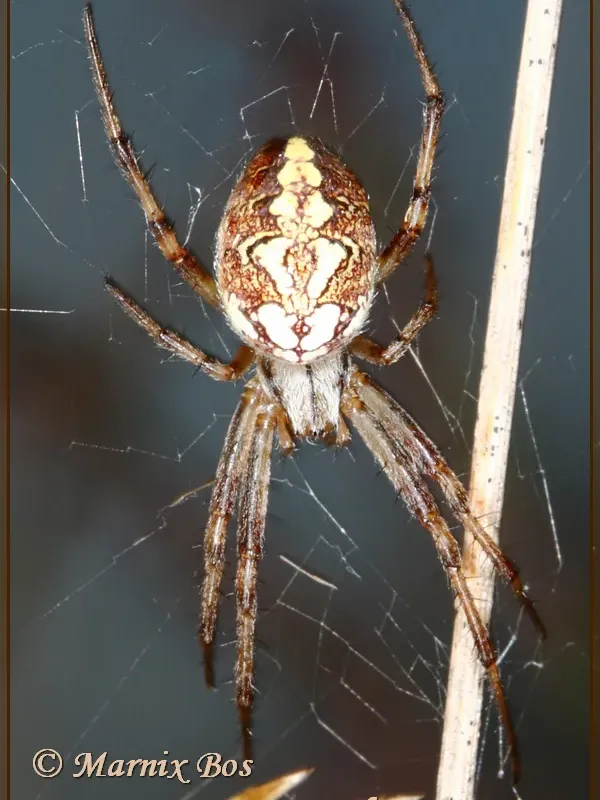
Description
How to identify
Neoscona adianta is a spider species belonging to the Araneidae family, commonly known as orb-weavers. It is widely distributed across various habitats, including meadows and agricultural borders.
Adult spiders have a distinctive pattern on their abdomen, often featuring complex shades of brown, beige, and white. This coloring provides excellent camouflage against tree bark and dried vegetation.
The body length typically ranges from 7 to 15 millimeters. Females are generally larger and more robust than males, which is a common trait among many spider species in this region.
They construct intricate orb-shaped webs that are remarkably symmetrical. These webs are highly efficient at capturing small flying insects during the night when the spiders are most active.
During the day, they often retract into a retreat made of leaves or twigs connected by silk, making them difficult to spot without careful observation of the habitat.
What it damages
Neoscona adianta does not cause any damage to crops or cultivated plants. It is a strictly carnivorous species and does not feed on plant tissues, sap, or fruits.
As a predatory species, it serves as a natural regulator of insect populations in the field. It consumes a variety of insects, including some that are considered pests in agricultural settings.
There is no evidence of this spider causing harm to agricultural production. Their presence is generally viewed as a positive sign of a healthy, biodiverse ecosystem.
Farmers are advised not to view the presence of these spiders or their webs as an infestation. They are natural allies in maintaining a balanced insect population.
Any damage associated with these spiders is non-existent. Their role in nature is to maintain ecological balance rather than to act as a threat to food supplies.
When it appears
The life cycle of Neoscona adianta is closely tied to the warm months. Adults typically appear in early summer and remain active until late autumn.
The peak of their activity usually occurs during mid-summer, when prey availability is at its highest, supporting the spider's growth and reproductive efforts.
Autumn is the period for reproduction, where females lay their eggs in protective silken cocoons. These cocoons are designed to withstand winter temperatures.
Spring marks the emergence of the next generation. Young spiderlings disperse and start building their first small webs to begin their own life cycles.
By synchronizing their life cycle with the growing season, these spiders contribute to insect control throughout the entire vegetation period of crops.
Control measures
Control measures against Neoscona adianta are neither required nor recommended. This species is considered beneficial for integrated pest management programs.
The use of broad-spectrum pesticides can negatively impact the population of these spiders, potentially removing a natural check on other harmful insects.
Maintaining hedge rows and patches of natural vegetation near farms can help sustain a healthy population of these and other beneficial predators.
If webs become an obstacle in mechanical operations, manual removal of the web is sufficient. There is no need for chemical intervention to control the spiders.
Focusing on preserving beneficial fauna like Neoscona adianta is an essential component of modern sustainable agricultural practices.
Taxonomy
- Latin name
- Neoscona adianta
- Family
- Araneidae
- EPPO code
- ARAUAD
Discussion
No discussions yet — be the first.