
Neoscona orb-weaver spider
Neoscona
Description
How to identify
Spiders of the genus Neoscona belong to the Araneidae family, commonly known as orb-weavers, characterized by their circular webs.
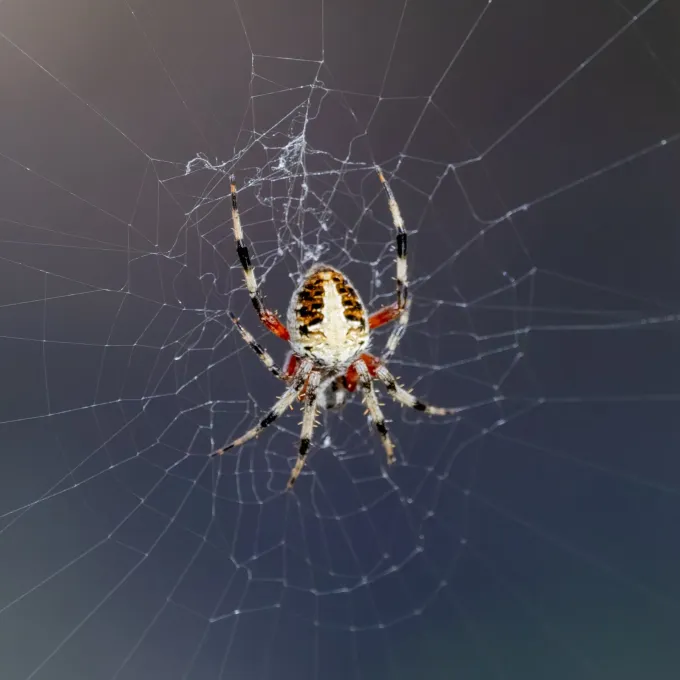
They possess a distinct globular abdomen, often adorned with cryptic patterns that allow them to blend into natural surroundings.
Adult Neoscona spiders typically range from 10 mm to 20 mm in length, with females being notably larger than males.
These spiders are primarily nocturnal, spending the daylight hours in retreat areas, such as folded leaves or crevices near their webs.
Their anatomy is well-adapted for nocturnal hunting, featuring sharp sensory hairs that detect even the slightest vibrations in their silk.
What it damages
Neoscona spiders are not agricultural pests; they do not consume plant matter or cause any damage to crops or foliage.
As dedicated predators, they provide a valuable service by capturing and consuming various insects that may otherwise damage plants.
Their webs function as natural insect traps, reducing the populations of aphids, moths, and other agricultural pests in the vicinity.
No chemical intervention is needed against them, as they contribute positively to the biodiversity of the agricultural ecosystem.
It is crucial to distinguish them from spider mites, which are microscopic pests that cause severe foliage damage, unlike these beneficial orb-weavers.
When it appears
The activity cycle of Neoscona begins in late spring and continues through the summer and into the early autumn months.
They are most frequently sighted in late summer, when their webs are at their largest and most conspicuous size.
The life cycle involves overwintering as eggs or juveniles in protective silk cocoons tucked away in sheltered locations.
Emergence occurs with rising temperatures, followed by a period of rapid growth and extensive web-building for hunting.
Mating occurs toward the end of the season, after which the females lay egg sacs to ensure the survival of the next generation.
Signs of infestation
The most prominent sign of their presence is a large, geometrically perfect radial web spun between plant stems or branches.
In the evenings, one can observe the spider sitting in the center of its web, waiting to intercept potential prey.
The presence of insect remains, such as empty chitinous shells trapped in the silk, indicates an active spider population.
Daytime sightings are less common, but one might find the spider hiding in a curled leaf held together by silk threads near the web.
Clusters of silken egg sacs attached to bark or stems are clear indicators that the species is established in the area.
Control measures
Management is generally unnecessary, as Neoscona spiders are considered beneficial arthropods in most agricultural settings.
If web accumulation becomes a nuisance in greenhouses or near building entrances, mechanical removal is the most effective solution.
The use of broad-spectrum insecticides should be avoided to protect these spiders, as they help suppress populations of true pests.
Encouraging the presence of these orb-weavers is a recommended practice in integrated pest management programs.
For sensitive areas where webs are undesirable, simple structural modifications or vegetation pruning can discourage spiders from anchoring their nets.
Taxonomy
- Latin name
- Neoscona
- Family
- Araneidae
- EPPO code
- NESCSP
Discussion
No discussions yet — be the first.