
Neochetina bruchi
Neochetina bruchi
Description
How to identify
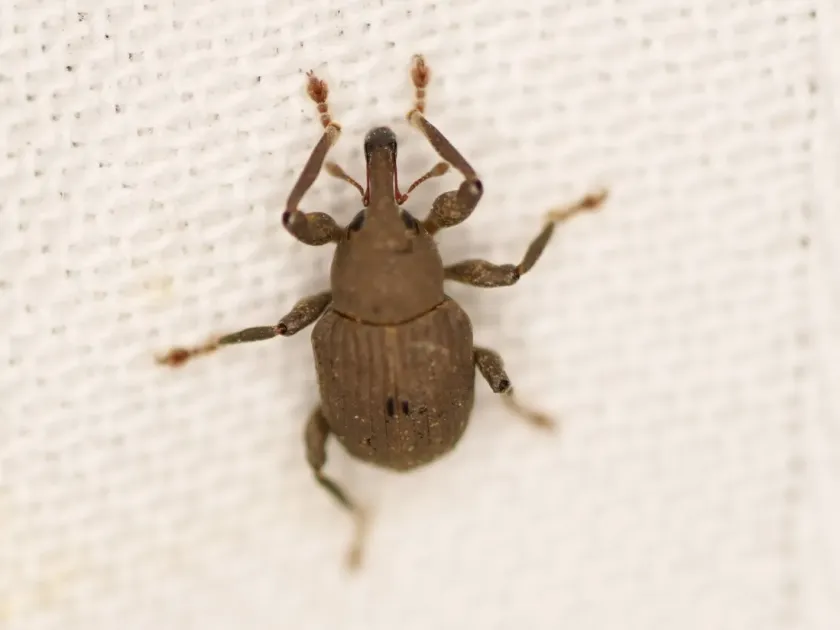
Neochetina bruchi is a species of weevil belonging to the Curculionidae family. Adult beetles are small, typically ranging from 3 to 4 mm in length, with a cryptic coloration that allows them to blend in with the leaves of their host plant.
The beetle’s body is robust, with a characteristic rostrum (snout) typical of the Curculionidae family. Their wings are functional, allowing adults to fly and locate new water hyacinth mats, which is crucial for the dispersal of the population.
Larvae are legless, cream-colored grubs that live endophytically, meaning they spend their entire life cycle hidden inside the tissues of the water hyacinth (Eichhornia crassipes). Their head capsules are darkened and well-developed for feeding.
Pupation occurs within specialized cocoons crafted by the larvae inside the stems or petioles of the plant. These cocoons are constructed from plant fibers combined with an adhesive secretion, providing a safe environment during metamorphosis.
The life cycle is strictly tied to the presence of water hyacinth. The rate of development is highly dependent on ambient temperatures, with tropical and subtropical regions providing the most suitable conditions for year-round breeding.
What it damages
Neochetina bruchi is a highly specialized herbivore that feeds exclusively on the water hyacinth, Eichhornia crassipes. This specificity makes it a valuable candidate for biological weed control programs.
Adults feed on the leaf surface, scraping away the epidermis and mesophyll tissues. This feeding activity creates distinct, light-colored circular feeding scars, which significantly reduce the photosynthetic capacity of the plant.
The larvae are responsible for the most severe damage. They tunnel through the petioles and stems, disrupting the vascular system and preventing the transport of water and nutrients to the leaf blades.
These tunnels also create entry points for opportunistic pathogens, such as fungi and bacteria, which can cause internal decay. This leads to the eventual collapse and death of the plant parts.
Heavy infestations reduce the overall buoyancy and reproductive vigor of water hyacinth mats, ultimately leading to a decrease in the density and surface coverage of the weed in infested waters.
When it appears
The population dynamics of Neochetina bruchi are heavily influenced by seasonal temperature changes. In warmer climates, breeding occurs throughout the year, with multiple overlapping generations.
In cooler regions, activity levels drop significantly during winter months. Adults may seek shelter in plant debris or protected areas near the water line to survive colder periods until temperatures rise again.
Increased activity is typically observed during the spring and summer when host plants are in their peak growth phase. This synchronization ensures that the beetle population has an abundant food source.
The duration of a single generation can vary from 40 to 90 days depending on the temperature. Higher temperatures generally result in faster life cycles and higher rates of population growth.
The peak impact on water hyacinth populations usually coincides with the end of the main growing season, when the cumulative effects of larval feeding have reached their maximum potential.
Signs of infestation
The most recognizable sign of infestation is the presence of small, circular feeding scars on the leaves. These white or light brown spots are clear indicators of adult feeding activity.
Upon closer inspection of the plant, small entry holes made by larvae can be found on the petioles. If an infested petiole is opened, internal tunnels filled with larval frass will be clearly visible.
Plants heavily affected by the weevils often show signs of stunted growth, leaf chlorosis, and general wilting. The structural integrity of the plant is compromised, causing it to lean or sink.
In high-density colonies, the overall color of the water hyacinth mat may change from vibrant green to a duller, mottled appearance due to the extensive feeding damage.
- Circular feeding scars on leaf surfaces.
- Larval entry holes on petioles and stems.
- Internal tunneling and decay in stems.
- Stunted growth and reduced leaf size.
- Loss of plant buoyancy and localized collapse.
Control measures
Neochetina bruchi is primarily managed as a beneficial organism used for the biological control of water hyacinth. Therefore, management focuses on its conservation and distribution rather than eradication.
Chemical control is generally avoided in aquatic ecosystems where this weevil is present to prevent negative impacts on water quality and non-target organisms.
If the weevil population needs to be introduced to new areas, it is done through carefully planned biological release programs, ensuring the strain is specific to the target weed.
Monitoring programs are used to assess the density of both the weed and the weevil. This data helps researchers understand the effectiveness of the control agent in suppressing the water hyacinth population.
Integrated management plans may include mechanical removal of dying mats to improve water flow, while allowing the weevil population to continue its suppressive work on the remaining colonies.
Taxonomy
- Latin name
- Neochetina bruchi
- Order
- Coleoptera (beetles)
- Family
- Brachyceridae
- EPPO code
- NEONBR
Discussion
No discussions yet — be the first.