
Nabis rugosus
Nabis rugosus
Description
How to identify
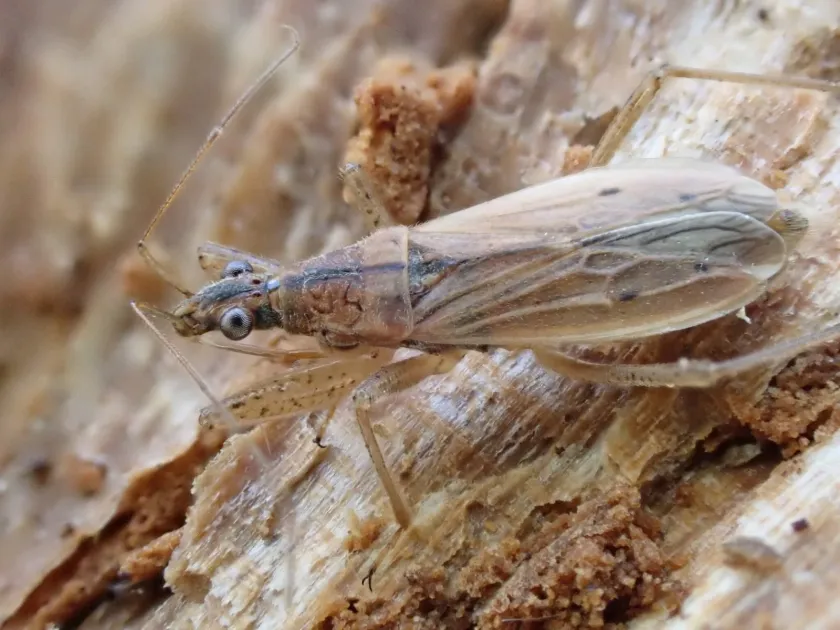
Nabis rugosus, commonly known as a damsel bug, is a species within the Nabidae family of the Hemiptera order. Adult specimens measure approximately 7–8 mm in length, possessing a grey-yellow to brownish coloration that provides excellent camouflage against crops and weeds.
The body is elongated with a highly mobile head equipped with a sturdy, curved rostrum. This specialized mouthpart is designed for piercing and sucking fluids, allowing the bug to function as an efficient predator, though it can become a minor pest under specific environmental conditions.
The eggs are elongated and whitish, typically inserted directly into the stem tissues of host plants by the female. Nymphs closely resemble adults but lack wings and are smaller, passing through several developmental stages before reaching maturity.
While often categorized as a beneficial entomophage in agricultural systems, Nabis rugosus can cause incidental damage to cereals when prey populations are low. Its presence is common in fields, meadows, and along roadsides throughout Europe and Asia.
Adults overwinter in plant debris or the upper layer of soil, emerging during early spring once temperatures are sufficiently high. Their survival strategy relies on selecting protected areas where they remain until the start of the new vegetation cycle.
What it damages
The primary damage occurs during periods when natural prey, such as aphids, are scarce, forcing the bug to feed on the sap of agricultural crops like wheat, barley, and rye. It pierces stems and leaves to extract vital cellular nutrients.
This feeding activity causes small, light-colored spots on the leaves, which eventually merge to form larger necrotic areas. In severe cases, the foliage becomes distorted, and plant development is significantly stunted due to metabolic disruption.
Heavy infestations can lead to premature wilting of plants across localized areas of a field. While the damage is usually indirect, the stress caused by the withdrawal of sap makes the crop more susceptible to environmental stressors and drought.
Furthermore, the piercing-sucking action provides an entry point for various plant pathogens, including fungi and bacteria. This secondary infection risk is often more damaging than the feeding process itself, potentially leading to widespread plant diseases.
Economic damage thresholds should be considered when monitoring populations, especially during the critical stages of grain filling and shoot elongation. Farmers must distinguish between the predator's presence for natural control and its status as a direct plant stressor.
When it appears
Adults emerge from overwintering sites in early spring as soon as temperatures rise above 10°C. They initially colonize weed species, gradually migrating into cereal fields as the vegetation grows and becomes more attractive.
The breeding season typically begins in late spring, with larval activity peaking during the early summer months. The insects remain active throughout the growing season until the onset of autumn cooling, which triggers the move to hibernation sites.
The duration of the life cycle depends on environmental conditions, with the possibility of one or two generations per season in warmer climates. This flexibility allows them to maintain a consistent presence in agricultural areas throughout the summer.
Autumn signals the end of the activity period as insects seek shelters, such as deep litter or soil crevices, to undergo diapause. Shortening photoperiods and decreasing temperatures are the main cues that drive this seasonal migration.
Effective monitoring requires regular inspections, particularly during the flowering and grain-forming stages of cereal crops. Utilizing sweep nets or sticky traps allows for an accurate estimation of population densities to determine if control actions are necessary.
Signs of infestation
Key indicators of infestation include the appearance of tiny necrotic spots on the foliage and deformed shoots. A close inspection of the underside of leaves often reveals adults or nymphs resting or feeding, as they tend to remain still to avoid detection.
If fields display signs of curling or wilting leaves in the absence of obvious disease outbreaks, the presence of damsel bugs should be investigated. Careful examination of leaf axils may reveal the bugs hiding from intense sunlight or predators.
Localized patches of chlorotic or yellowish tissue on cereal crops are classic signs of piercing-sucking insect activity. While aphids are a more common suspect, high populations of Nabis rugosus can produce similar, though usually less uniform, symptoms.
The use of an entomological sweep net is the standard method for identifying the bugs in a field. If several specimens are captured per sample, it indicates that the population warrants further observation regarding potential impact on crop vitality.
Inspections conducted in the cool early morning hours are often the most successful, as the insects are less mobile and easier to spot on the plant stems. Look for their distinct elongated shape and sharp rostrum when examining potentially damaged sections.
Control measures
Effective control strategies focus on cultural practices, such as rigorous weed management to remove secondary host plants. Post-harvest cultivation and deep plowing are crucial for destroying overwintering sites and reducing the population for the following season.
Biological control emphasizes the preservation of the bug's natural predators, such as parasitic wasps, which help maintain the balance. Selective insecticides should only be applied if population levels exceed the established economic threshold.
When chemical treatment is deemed necessary, insecticides with minimal impact on non-target beneficial species should be selected. Evening applications are recommended to reduce risk to pollinators and maximize the efficacy of the treatment against the active bugs.
Maintaining crop rotation and creating buffer zones of wild vegetation can help isolate cereal fields from meadows where these bugs thrive. These practices encourage a healthier ecosystem where the bug's population remains at manageable, non-harmful levels.
- Conduct weekly field monitoring during the growing season.
- Remove post-harvest crop residues to eliminate hibernation spots.
- Use selective insecticides only when strictly necessary.
- Maintain healthy crop stands to increase tolerance to minor damage.
- Utilize yellow sticky traps for population density assessments.
Taxonomy
- Latin name
- Nabis rugosus
- Order
- Hemiptera (bugs, aphids, leafhoppers)
- Family
- Nabidae
- EPPO code
- NABIRG
Discussion
No discussions yet — be the first.