
Mouse-tailed dormouse
Myomimus
Description
How to identify
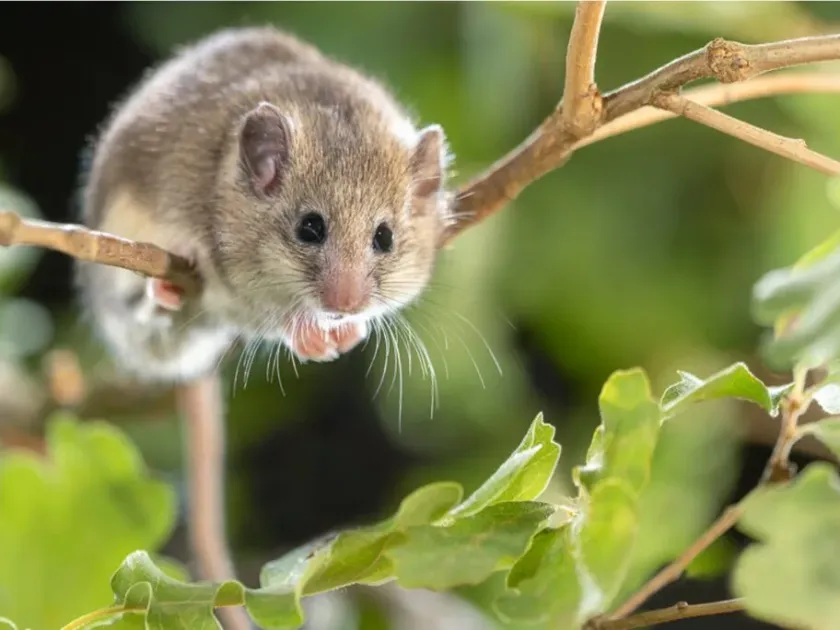
The mouse-tailed dormouse (Myomimus) is a small, rarely seen rodent belonging to the Gliridae family, known for its agile climbing abilities in trees and shrubs.
Physically, it resembles a house mouse, but it possesses a distinct, slightly bushy tail and specialized teeth adapted for a varied diet of plant matter.
Its fur is soft and typically gray-brown, providing excellent camouflage against the bark of trees and dense foliage during their active nocturnal hours.
These rodents are highly adapted to arboreal life, using their sharp claws to navigate branches and reach fruits that are inaccessible to ground-dwelling pests.
They usually inhabit hollows in old trees, rock crevices, or thick scrubland, making them particularly difficult to detect during daylight hours.
What it damages
The primary agricultural damage caused by the mouse-tailed dormouse includes the consumption of buds, flowers, and developing fruits on orchards.
By feeding on the bark of young saplings, they can disrupt nutrient transport, leading to the stunted growth or death of susceptible fruit tree species.
During the harvest season, they selectively feed on the pulp of fruits, often hollowing them out while they remain attached to the tree limbs.
This feeding behavior creates wounds that serve as entry points for mold, fungi, and bacterial infections, leading to the rapid spoilage of surrounding healthy fruit.
Their impact is most severe in localized areas where dense vegetation provides them with safe harbor, allowing for concentrated feeding sessions over multiple nights.
When it appears
Dormice emerge from hibernation in early spring, often coinciding with the budding of fruit trees, which serves as a critical food source after the winter rest.
Summer months are characterized by peak foraging activity, as individuals increase their caloric intake to build the fat reserves necessary for the coming cold season.
The most significant damage to fruit crops occurs from late summer through early autumn, corresponding with the ripening process of pomaceous and stone fruits.
As temperatures begin to drop significantly, they retreat into sheltered nesting sites to enter a period of hibernation, during which metabolic activity slows down.
The breeding cycle occurs annually, and population levels can fluctuate based on environmental factors and the availability of food resources within the orchard habitat.
Signs of infestation
One of the most noticeable signs is the presence of hollowed-out fruits hanging on trees, featuring small, precise bite marks typical of rodent activity.
Observations of chewed bark on branches, appearing as longitudinal or irregular grooves, indicate that dormice have been feeding on the tree's cambium layer.
Small, spherical nests constructed from leaves, grass, and woven twigs may be found tucked into the forks of branches or inside abandoned hollows.
Droppings found on branches or at the base of trees are another strong indicator of their presence and active feeding patterns within a specific area.
Early-season loss of flower buds or small green fruitlets, often unexplained by common insect pests, frequently suggests nocturnal rodent damage.
Control measures
Implementing physical barriers such as metal sleeves or smooth plastic bands around tree trunks effectively prevents the dormice from climbing to the canopy.
Sanitation practices, including the removal of dead wood and the sealing of tree cavities, reduce the number of potential nesting sites available to these rodents.
Maintaining a clear zone around the base of trees by removing tall grass and debris eliminates cover, making the area less hospitable for foraging.
In cases of significant infestation, the use of live-capture traps can serve as an effective and humane method for managing population levels in the garden.
- Install metal tree collars;
- Remove abandoned nesting materials;
- Seal tree hollows with safe materials;
- Clear brush and debris near orchards;
- Monitor trees during fruit ripening.
Taxonomy
- Latin name
- Myomimus
- Order
- Rodents
- Family
- Gliridae
- EPPO code
- MYOMSP
Discussion
No discussions yet — be the first.