
Hazel dormouse
Muscardinus
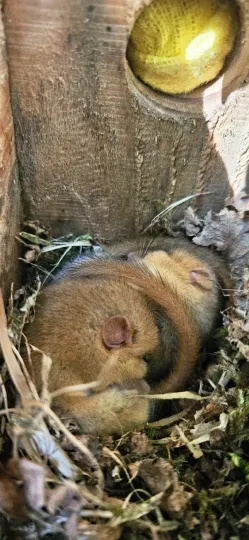
Description
How to identify
The hazel dormouse (Muscardinus avellanarius) is a small rodent belonging to the Gliridae family. It is easily recognized by its golden-orange fur, creamy throat patch, and a long, fully haired tail.
Unlike common mice, the hazel dormouse is strictly arboreal, spending most of its life in the canopy of trees and shrubs. It is primarily nocturnal, making it difficult to spot during daylight hours.
These rodents are exceptionally agile, using their tails for balance as they navigate through thin branches. They are experts at hiding within dense vegetation, rarely coming down to the ground.
They construct intricate, spherical nests woven from grass, leaves, and shredded bark. These nests are typically tucked away in thick foliage, hollow trees, or even bird boxes, providing security from predators.
Their biological cycle is closely tied to woodland habitats, but when orchards are located near forests, they frequently venture into human-managed gardens to exploit the available food sources.
What it damages
The hazel dormouse infests orchards and berry patches, showing a strong preference for hazelnuts, apples, pears, and blackberries. They consume developing fruits at various stages of maturity.
The primary damage occurs when they gnaw holes into ripening nuts or fruits to access the kernels and seeds. This activity directly ruins the quality and yield of the harvest.
In addition to fruit consumption, they can cause significant stress to young trees by gnawing on the bark, sometimes girdling branches, which leads to localized dieback or weakened overall health.
They are not hoarders like some other rodents; instead, they forage for fresh food constantly throughout the season. This habit results in a high volume of damaged produce across a wide area.
Beyond mature fruits, they also feed on flower buds and young shoots in the early spring, which can negatively impact the plant's vegetative growth and lower its productivity for the entire year.
When it appears
The hazel dormouse emerges from hibernation in April, at which point they begin feeding on buds and bark to regain energy after the winter period. This is the start of the primary risk window.
Summer is the peak time for both reproduction and intense feeding. The availability of diverse fruits during this season drives their activity, making them most destructive during the fruit-ripening phase.
As autumn approaches, the dormice must accumulate fat reserves for their winter hibernation. This urgency leads to increased feeding rates, putting the late-season fruit harvest at high risk of damage.
Their life cycle typically includes one or two litters per year, and the abundance of high-energy food in gardens can significantly increase their survival rates and local population density.
Hibernation lasts from approximately October to April. During this interval, the dormice disappear into underground burrows or sheltered spots near the roots, ending their impact on the garden for the winter.
Signs of infestation
A classic sign of dormouse activity is the presence of eaten nuts found under trees, featuring smooth-edged, round holes. These are distinct from the ragged openings caused by squirrels or other rodents.
Apples and pears may show small, clean-cut hollows where the dormouse has fed on the flesh or reached the seeds. These marks are quite specific and indicate the presence of small, sharp incisors.
Finding spherical nests made of tightly woven grass and leaves in the canopy of fruit trees is a definitive sign that a dormouse population is utilizing the orchard as a habitat.
Bark stripped in a ring-like pattern on young twigs during spring is another clear indicator, reflecting their dietary search when fruit resources are not yet available.
Presence can also be confirmed through nighttime observations or the use of footprint tunnels and trail cameras placed along their suspected travel routes within the orchard.
Control measures
Installing smooth, metallic baffles around the trunks of trees is a highly effective, non-lethal method to prevent dormice from climbing into the canopy to access the fruit.
Habitat management is key: reducing excessive dense brush, clearing away dead wood, and maintaining tidy orchard perimeters helps make the garden less attractive for nest building.
Ultrasonic deterrent devices can be employed to create an unfavorable environment for rodents, helping to keep them away from high-value crop areas during the peak ripening season.
In cases where human-dormouse conflict is high, professional live-trapping and relocation (if permitted) can be considered, provided it is conducted in accordance with local animal welfare regulations.
Always verify the legal status of the hazel dormouse in your region, as it is a protected species in many countries, and conservation laws may prohibit certain methods of exclusion or removal.
Taxonomy
- Latin name
- Muscardinus
- Order
- Rodents
- Family
- Gliridae
- EPPO code
- MSCDSP
Discussion
No discussions yet — be the first.