
Black pine sawyer
Monochamus subfasciatus
Description
How to identify
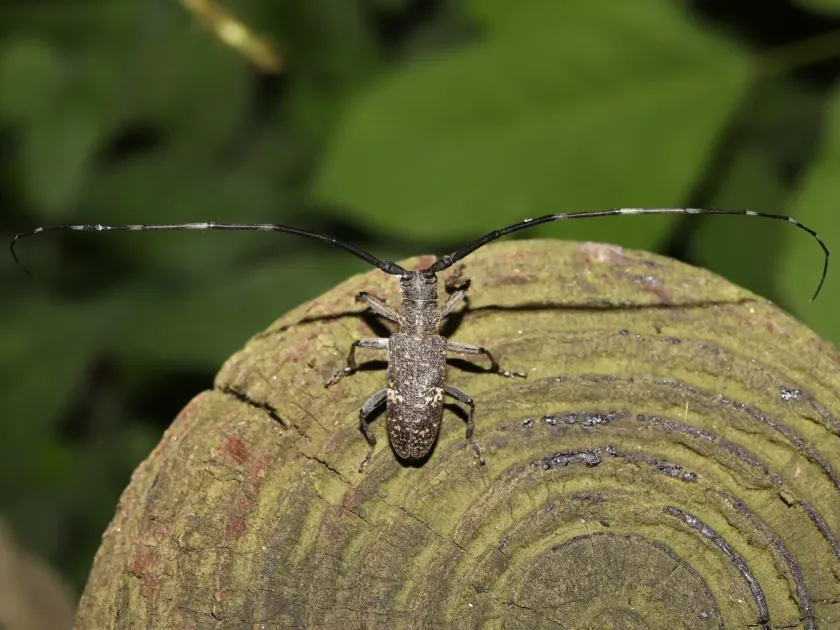
The black pine sawyer (Monochamus subfasciatus) is a wood-boring beetle belonging to the Cerambycidae family. The adult insect is characterized by a dark body, often with brownish or greyish pubescence, and notably long antennae that are a hallmark of the species.
Males are typically distinguished by antennae that are significantly longer than their bodies. These antennae serve as sensory organs, helping the beetle navigate complex forest environments and locate suitable host trees for mating and oviposition.
The larvae are legless, white to yellowish in color, and possess a well-developed, chitinized head with strong mandibles. They are highly specialized for boring into wood, and their growth is directly dependent on the nutrient availability in the host tree.
Pupation occurs within a specific pupal chamber deep inside the wood. This structure is carefully crafted by the mature larva before the transformation process, providing a protective environment for the developing adult beetle.
Identification of the species is vital for forest management. By understanding the distinct morphological features of Monochamus subfasciatus, foresters can distinguish it from other wood-boring insects and apply targeted management practices.
What it damages
This beetle primarily attacks various pine species, though it can also infest fir and spruce trees. It usually targets weakened, stressed, or recently fallen trees, acting as a secondary pest that contributes to the mortality of forest stands.
Larval feeding destroys the cambium and sapwood layers, which prevents the tree from transporting water and nutrients effectively. Once inside, the larvae tunnel deep into the heartwood, significantly compromising the structural integrity of the timber.
The economic impact of this pest is significant, as the tunnels produced by the larvae render the wood unsuitable for construction or lumber processing. Infested trees lose their commercial value and often must be destroyed to prevent the spread of the population.
Black pine sawyers are also vectors for various fungal pathogens and nematodes. These organisms enter the tree through the feeding sites and wounds made by the beetles, leading to rapid decay and systemic failure of the tree's internal tissues.
Large populations of this pest can develop in neglected logging sites where slash and debris are left on the ground. These areas serve as breeding grounds, allowing the beetle to multiply and potentially infest surrounding healthy forests.
When it appears
Adult beetles emerge in late spring and remain active throughout the summer months. They prefer warm, sunny weather, which is ideal for their dispersal and mating flights between host trees.
Females lay eggs in small slits made in the bark of suitable host trees. This precise placement ensures that the hatching larvae have immediate access to the nutrient-rich tissues beneath the bark required for their initial growth.
The larval stage is the most prolonged and destructive phase of the life cycle. They spend months feeding, tunneling deeper into the wood as they develop, and often overwinter inside the tree trunk to survive cold temperatures.
The total duration of the life cycle can range from one to two years, depending on the climate and local conditions. This adaptability allows the species to persist in various environments, even during unfavorable seasons.
Emergence occurs after the insect completes its development. Adult beetles chew circular exit holes to leave the wood. These holes signify the beginning of a new generation and highlight the peak activity window for monitoring programs.
Signs of infestation
One of the earliest signs of infestation is the appearance of resin flow on the bark surface. This is a defensive response by the tree as it tries to seal off the points where the beetles have deposited their eggs.
- Presence of frass, or fine wood dust, accumulating on the bark or at the base of the tree, indicating larval activity inside.
- Circular or oval-shaped exit holes on the trunk, showing where adult beetles have successfully emerged.
- The sound of chewing or grinding coming from inside the trunk, which can sometimes be heard during quiet hours in infested forest areas.
- Foliage symptoms such as yellowing, browning, and premature needle drop, reflecting the disruption of the tree's internal water transport.
- Loose or peeling bark, revealing the intricate patterns of larval galleries and tunnels underneath the protective outer layer.
Control measures
Sanitation harvesting is the most effective control method. By removing and destroying infested trees before the adult beetles emerge, forest managers can significantly reduce the pest population density.
Proper management of logging residues is essential. Leaving fresh pine slash in the forest provides an ideal breeding environment, so cleaning up debris is a critical step in preventing future outbreaks.
Pheromone-baited traps are widely used for monitoring and mass trapping. These tools allow foresters to track population trends and reduce the number of adults, thereby lowering the probability of successful mating and egg-laying.
Promoting natural enemies, such as woodpeckers and specialized parasitoid wasps, helps maintain a balance in the forest ecosystem. Preserving habitat for these beneficial species is a cornerstone of sustainable forest management.
Chemical control via insecticides is typically restricted to high-value areas like seed orchards or lumber storage yards. All applications must be strictly regulated to ensure environmental safety and effectiveness against the target pest.
Taxonomy
- Latin name
- Monochamus subfasciatus
- Order
- Coleoptera (beetles)
- Family
- Cerambycidae
- EPPO code
- MONCSB
Discussion
No discussions yet — be the first.