
White-spotted sawyer
Monochamus scutellatus
Description
How to identify
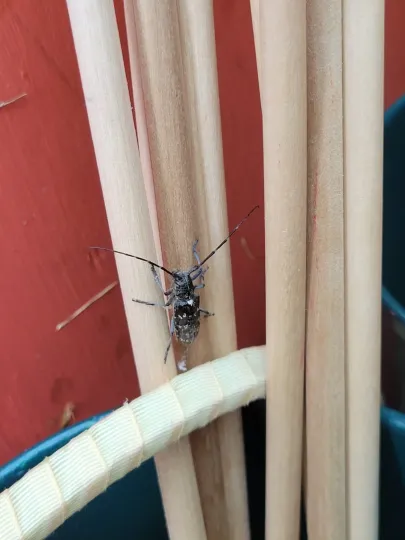
The adult white-spotted sawyer is a wood-boring beetle ranging from 15 to 30 millimeters in length. Its body is primarily black, often exhibiting a metallic luster, with a distinctive white scutellum at the base of the wing covers.
Males possess antennae that are significantly longer than their bodies, while female antennae are about the same length as their bodies. Their strong legs allow them to move quickly over the bark of host trees.
Larvae are legless, white, and possess a robust head with powerful mandibles designed for tunneling through wood. They spend their development phase deep inside the trunk.
Eggs are elongated, creamy-white in color, and are laid in individual niches cut by the female into the bark of weakened or fallen conifers.
Pupation occurs within a specialized chamber carved in the wood, which the larva connects to the surface by a tunnel before its final transformation into an adult.
What it damages
This beetle primarily infests coniferous trees such as spruce, pine, and fir. It favors dying or recently fallen trees but can attack healthy trees if the population is extremely high.
The main damage is caused by larvae tunneling deep into the wood, which creates structural galleries that significantly reduce the quality and market value of the timber.
Beyond physical damage, the beetle is a vector for various wood-decay fungi and nematodes, which can lead to the rapid decline and death of the host tree.
Infested stands are prone to secondary attacks from other forest pests, leading to an accelerated rate of forest degradation if left unmanaged.
For the lumber industry, the presence of these larvae necessitates significant processing efforts to remove damaged sections, leading to economic losses.
When it appears
Adult beetles are most active during the summer months, typically from late spring through early autumn, when they feed on the bark of young twigs.
The lifecycle generally lasts one to two years, depending heavily on regional climate conditions and the quality of the timber available for larval development.
Larvae overwinter deep within the wood, which provides insulation against harsh winter temperatures and allows them to resume feeding as soon as spring returns.
The emergence of new adults coincides with warmer temperatures in late spring, at which point they tunnel out of the wood to find mates and repeat the cycle.
Females begin egg-laying shortly after mating, targeting stressed trees that release specific chemical volatiles, which attract the beetles from a distance.
Signs of infestation
A tell-tale sign of an infestation is the presence of small, characteristic notches on the bark surface where females have deposited their eggs.
Frass, which consists of fine wood shavings and excrement, accumulates at the base of the tree or within bark crevices, indicating active larval feeding inside.
Circular or oval-shaped exit holes, approximately 5–8 millimeters in diameter, indicate that mature beetles have already emerged from the tree.
The foliage of infested trees may begin to show signs of stress, such as yellowing or thinning, as the larval tunnels disrupt the tree's nutrient transport system.
- Audible crunching sounds coming from the trunk during quiet periods.
- Bark loosening or peeling away in sections where larvae have been active.
- Increased woodpecker activity on specific trees, which often signals larvae presence.
Control measures
The primary control method is sanitation: the removal and prompt processing of fallen or dying trees before the adult beetles emerge in spring.
Pheromone traps are effective tools for monitoring beetle populations and can be used to attract adults away from high-value timber stands.
Natural biological control, including the protection of woodpeckers and parasitic wasps, plays a vital role in keeping beetle populations at manageable levels.
At lumber yards, logs should be debarked or treated with approved insecticides to prevent the colonization of timber by adult beetles.
Maintaining forest health through proper silvicultural practices ensures trees remain vigorous and less susceptible to the chemical attractants that draw in the sawyers.
Taxonomy
- Latin name
- Monochamus scutellatus
- Order
- Coleoptera (beetles)
- Family
- Cerambycidae
- EPPO code
- MONCOR
Discussion
No discussions yet — be the first.