
Citrus flatid planthopper
Metcalfa pruinosa
Description
How to identify
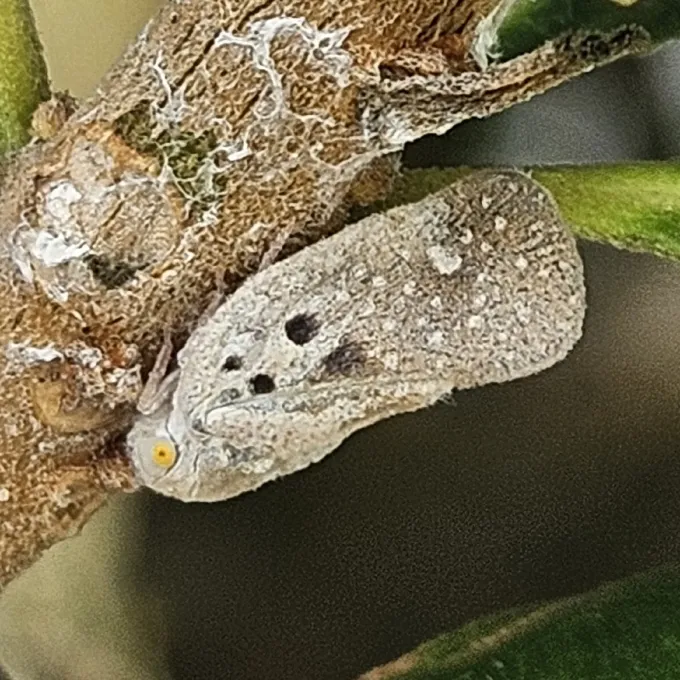
The Citrus flatid planthopper (Metcalfa pruinosa) is a member of the Flatidae family within the order Hemiptera. Adult insects are wedge-shaped, approximately 5–8 mm long, and possess a powdery, white, or grayish wax coating on their wings.
Nymphs are easily recognizable by the dense, white, woolly, or waxy filaments they secrete, which often look like fungal growth or cottony tufts on the stems and leaf undersides.
This species is highly mobile; adults are capable of jumping and flying quickly when disturbed, which complicates manual removal or early detection in large orchards.
The life cycle involves overwintering eggs, usually laid within plant bark or woody tissues, followed by nymphal stages that develop throughout the spring and early summer.
As an invasive species, it is remarkably resilient and adaptable, thriving in diverse environments ranging from Mediterranean climates to temperate garden settings.
What it damages
This polyphagous insect feeds on over 300 plant species, including grapes, citrus fruits, peaches, various vegetables, ornamentals, and numerous trees and shrubs.
Both adults and nymphs feed by inserting their stylets into the plant's phloem to suck out sap, which causes significant stress, leaf deformation, and stunted growth.
A major indirect threat is the production of honeydew, a sticky excretion that coats the foliage and provides a substrate for the growth of sooty mold, which blocks photosynthesis.
Heavy infestations result in flower and fruit drop, leading to substantial yield losses and reducing the overall aesthetic value of ornamental plants.
Furthermore, Metcalfa pruinosa is a known vector for various phytoplasmas and plant viruses, potentially introducing complex diseases that further debilitate the host plants.
When it appears
Egg hatching typically occurs in mid-to-late spring, coinciding with rising temperatures that favor the emergence of first-instar nymphs.
The nymphal stage lasts for approximately 6 to 8 weeks, during which the insects remain concentrated on host plants and are most vulnerable to chemical control measures.
Adults emerge during the mid-summer period, generally from July onwards, and remain active until the onset of cooler autumn temperatures.
Under normal conditions, the species completes one generation per year, though warmer climates may accelerate development or lead to overlapping stages.
The peak activity of the pest is observed during the driest months, when adults migrate frequently between plants to find optimal nutrient sources.
Signs of infestation
The most distinctive visual sign is the presence of white, cottony, wax-like material on leaves and stems, often mistaken for mealybugs or mold.
Shiny, sticky residue on the foliage surface is a clear indicator of honeydew accumulation, suggesting a significant population of planthoppers.
The development of black sooty mold on the leaves or branches indicates that the pest has been present for an extended period, weakening the plant.
Foliar curling, yellowing, and premature senescence of the plant tissue are common symptoms resulting from the insect's intensive sap-feeding activity.
Disturbing the branches often results in the mass dispersal of adult planthoppers, which is a definitive sign of an active infestation in the area.
Control measures
Chemical control involving systemic or contact insecticides is effective, particularly when applied during the early nymphal stages before the insects develop wings.
Cultural practices, such as proper pruning and thinning of the canopy, improve airflow and light penetration, making the environment less hospitable for the pest.
Yellow sticky traps and pheromone-based monitoring tools help in tracking adult population levels and provide a baseline for timely treatment interventions.
Biological control efforts focus on enhancing the presence of natural enemies, such as lady beetles, lacewings, and parasitic wasps that target nymphs and eggs.
- Apply insecticides strictly during the early morning or evening to avoid pollinators.
- Regularly weed the surrounding area to eliminate alternative host plants.
- Monitor plants frequently starting in late spring to catch infestations early.
Taxonomy
- Latin name
- Metcalfa pruinosa
- Order
- Hemiptera (bugs, aphids, leafhoppers)
- Family
- Flatidae
- EPPO code
- METFPR
Discussion
No discussions yet — be the first.