
Citrus flatid planthopper
Metcalfa
Description
How to identify
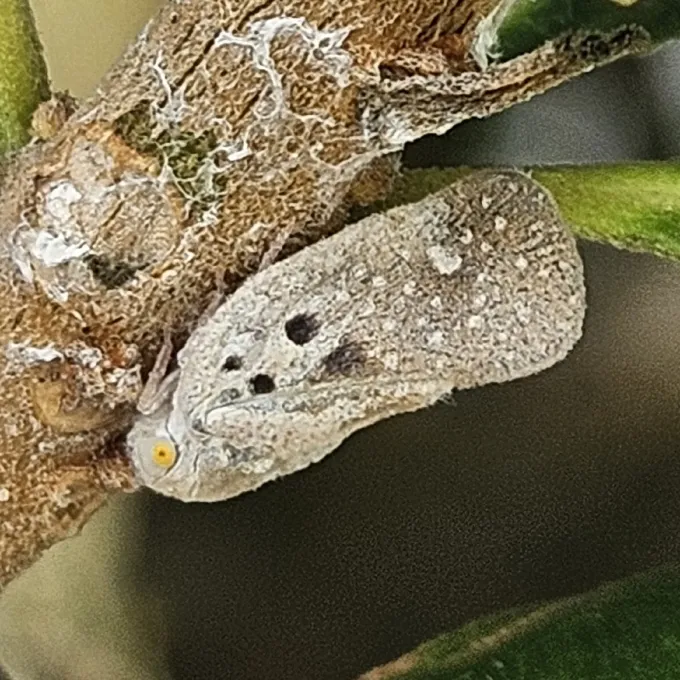
The Citrus flatid planthopper (Metcalfa pruinosa) is a plant-sucking insect belonging to the family Flatidae. Adults are approximately 7–9 mm long, often appearing pale grey or brownish with triangular wings held roof-like over their bodies, giving them a distinct appearance.
Nymphs are easily identified by the presence of dense, white, woolly or waxy filaments that cover their bodies. These secretions act as a protective layer, shielding the nymphs from predators and environmental stressors while they feed on host plant tissues.
The lifecycle involves an egg stage, five nymphal instars, and the adult stage. The species is highly mobile, with adults capable of powerful jumps and short flights, which assists in rapid dispersal across gardens, orchards, and urban landscapes.
Originally from North America, Metcalfa pruinosa has become a major invasive pest in many parts of the world, including Europe. Its ability to adapt to diverse climates and plant species makes it a persistent challenge for commercial and private growers.
There is typically one generation per year. Eggs are laid in the bark of woody plants or plant debris to overwinter. Once spring temperatures rise, nymphs emerge to begin their feeding cycle, eventually developing into winged adults by mid-summer.
What it damages
As a polyphagous insect, the citrus flatid planthopper feeds on over 300 different plant species. It causes significant economic damage to vineyards, citrus orchards, various fruit-bearing trees, shrubs, and many ornamental garden plants.
Both nymphs and adults cause direct damage by inserting their piercing-sucking mouthparts into leaves, petioles, and young shoots. This sap-sucking behavior deprives the plant of essential nutrients, weakening the host and reducing overall growth and crop vigor.
Indirect damage is often more severe due to the excretion of honeydew. This sticky substance coats the leaves and fruit, providing an ideal substrate for the growth of sooty mold, which manifests as a dense black film on the plant surface.
The presence of sooty mold inhibits photosynthesis, leading to leaf yellowing, premature senescence, and fruit drop. In heavy infestations, the plant's health declines significantly, and the quality of ornamental or edible products is completely compromised.
- Vineyards and orchards
- Citrus species
- Ornamental trees and shrubs
- Vegetable crops
- Wild host plants
When it appears
Nymph emergence from overwintering eggs usually occurs in late spring, around May. During this time, they are concentrated on tender shoots and leaf undersides, where they begin to feed and produce their characteristic wax.
Adults typically start appearing from July through August. This is the period of peak infestation, as they are highly active, disperse to new hosts, and focus on mating and egg-laying to ensure the survival of the next generation.
Environmental factors, particularly humidity and temperature, dictate the speed of development. Warm, humid summers accelerate the maturation process, leading to larger populations that can overwhelm smaller or weakened plants rapidly.
As autumn approaches, adult activity declines. The end of the season marks the transition to the egg-laying phase, where females deposit eggs into cracks in tree bark. These eggs remain dormant through winter to restart the cycle the following spring.
Early season monitoring is critical. By identifying the initial nymph colonies in late spring, growers can implement control measures before the population reaches the mobile adult stage, which is much harder to manage with standard sprays.
Signs of infestation
The most prominent sign of infestation is the appearance of white, cottony, wax-like masses on the undersides of leaves and stems. These masses are the protective secretions of the nymphs and are usually the first thing a gardener notices.
Honeydew accumulation makes foliage feel sticky, often attracting ants that forage on the sweet secretions. The presence of ant trails on trees or bushes is a strong indicator of an underlying planthopper infestation that needs closer investigation.
Sooty mold development is another clear sign. The black, powdery film covering leaves and stems indicates that the plant has been under attack for some time and that the honeydew has already promoted fungal growth on the plant surface.
Visual symptoms of stress, such as leaf wilting, stunted growth of new shoots, and yellowing, are common in heavily infested plants. The visual appeal of ornamental plants is often ruined by the wax residue, honeydew, and subsequent sooty mold.
Inspect the tender, succulent parts of the plant, especially near the leaf axils and the growing tips. These areas offer the easiest access to phloem sap, making them the preferred locations for planthopper colonies to establish and feed.
Control measures
Managing the citrus flatid planthopper requires an integrated approach. Because the insects produce protective wax, control efforts must be timed precisely to capture the most vulnerable stages of the insect's life cycle.
Cultural control involves pruning and destroying infested twigs or branches where eggs are suspected to be laid. Keeping the plant canopy open and well-pruned improves airflow and reduces the humidity that the insects prefer, making the environment less favorable for them.
Chemical control is most effective against nymphs. Systemic insecticides are preferred as they penetrate the plant tissues, affecting the insects as they feed. It is essential to use registered products and apply them thoroughly to the undersides of leaves.
Biological control options include the introduction of natural enemies, such as the parasitoid wasp Neodryinus typhlocybae, which specifically targets the planthopper. This is an environmentally friendly alternative suitable for professional orchards and gardens.
When using insecticides, rotate different chemical classes to prevent the development of resistance. Always read and follow label instructions regarding harvest intervals, especially when treating fruit or vegetable crops intended for human consumption.
Taxonomy
- Latin name
- Metcalfa
- Order
- Hemiptera (bugs, aphids, leafhoppers)
- Family
- Flatidae
- EPPO code
- METFSP
Discussion
No discussions yet — be the first.