
Chinese scorpion
Mesobuthus martensi
Description
How to identify
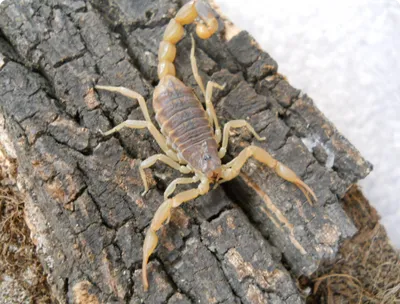
The Chinese scorpion (Mesobuthus martensi) belongs to the order Scorpiones and the family Buthidae. Adults typically measure 5–6 cm in length and feature a yellow-brown coloration with dark dorsal stripes.
Their anatomy consists of a cephalothorax and an abdomen, terminating in a metasoma equipped with a venomous telson. They are well-adapted to arid and semi-arid environments.
This species is characterized by relatively slender pedipalps and a thin tail compared to other family members. They are nocturnal hunters that prefer to stay hidden during the day.
As predators, they inhabit agro-ecosystems primarily to find prey among insect populations, often residing in field borders or rocky crevices.
Identification is aided by observing the specific patterning on the tergites and the overall body structure, which distinguishes them from larger or more robust scorpion species.
What it damages
The Chinese scorpion is not classified as a direct plant pest because it does not feed on any parts of agricultural crops.
The primary concern for farmers is the health risk posed to personnel. The sting is venomous and can lead to significant pain and allergic reactions.
There is no economic damage to crop yields associated with this species, and they do not carry plant pathogens that impact harvest quality.
In very specific cases, their burrowing activities in greenhouses or nurseries could potentially disturb the soil near root systems, though this is rare.
In many instances, their presence is indicative of a healthy soil ecosystem, as they naturally control populations of various field insects.
When it appears
Activity levels are heavily influenced by temperature and humidity, with peak activity occurring from late spring through early autumn.
During winter months, individuals enter a state of dormancy, hiding deep within the soil profile to escape freezing temperatures.
Summer heat cycles trigger nocturnal hunting patterns, as the scorpions emerge when ambient humidity levels rise during the night.
Spring is marked by increased dispersal as juveniles seek new territories, making them more visible during routine field inspections.
As temperatures decline toward the end of the harvest season, the scorpions begin to seek out overwintering sites, reducing their overall surface activity.
Signs of infestation
Evidence of their presence includes small burrow entrances (1–2 cm in diameter) located in soil or under debris near field edges.
Visual inspection under rocks, wood piles, or dense crop residues often reveals individuals sheltering from daylight.
The use of UV lighting at night is the most reliable method for detecting scorpions, as their exoskeleton fluoresces brightly under ultraviolet rays.
Finding discarded exuviae (molted skins) on the ground during soil tillage is a clear indicator of a resident population.
In sandy or fine-textured soils, one might spot unique track patterns during the early morning hours before they retreat underground.
Control measures
Since the Chinese scorpion is not an agricultural pest, direct chemical control measures are not recommended and would be ecologically counterproductive.
Field safety protocols, such as wearing sturdy protective footwear and gloves, are the best defense against accidental stings.
Removing habitat components like piles of rocks, lumber, or plant debris reduces the number of suitable shelters available for the scorpions.
Regular soil cultivation, such as plowing or harrowing, effectively destroys burrows and disrupts the habitat, encouraging migration away from crops.
Promoting natural predator habitats, such as bird boxes or beneficial insect refuges, can help maintain balance without the need for toxic interventions.
Taxonomy
- Latin name
- Mesobuthus martensi
- Family
- Buthidae
- EPPO code
- MESBMA
Discussion
No discussions yet — be the first.