
Buthacus leptochelys scorpion
Buthacus leptochelys
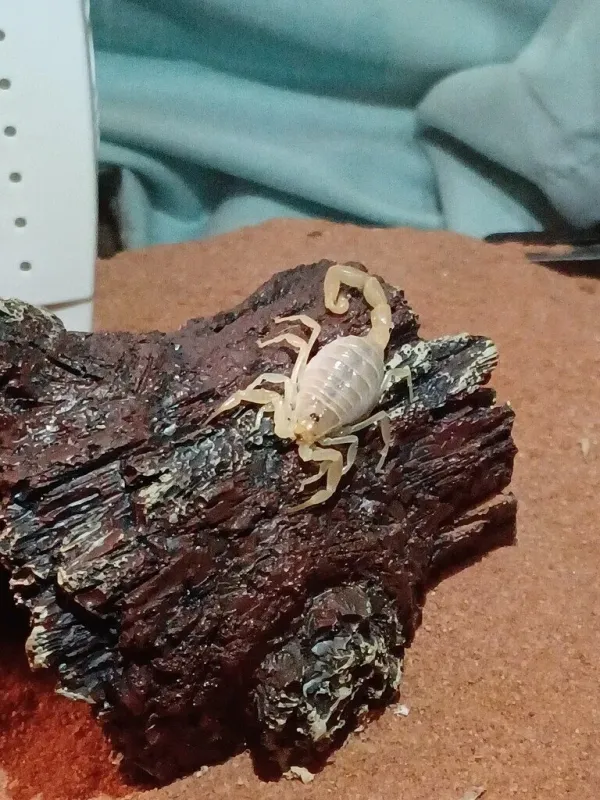
Description
How to identify
The desert scorpion (Buthacus leptochelys) is a highly specialized species adapted to life in sandy desert environments, possessing a distinct pale yellow coloration.
Adult specimens typically reach a body length of 4 to 7 centimeters. Their chitinous exoskeleton is robust, protecting them from the abrasive properties of wind-blown sand.
They possess elongated, slender pedipalps, which are evolutionary adaptations designed for effectively grasping small prey within sparse desert habitats.
These scorpions are equipped with sensitive pectines on their underside, allowing them to detect subtle soil vibrations, making them proficient nocturnal hunters.
Belonging to the family Buthidae, they are biologically significant due to their potential toxicity, which is a critical factor for workers in agricultural settings.
What it damages
The Buthacus leptochelys scorpion is an obligate predator and does not consume crops, seeds, or roots; therefore, it does not cause direct agricultural damage.
However, their habit of digging deep burrows in sandy soil can cause soil instability or localized erosion, which may marginally affect young seedlings or irrigation channels.
The primary concern for the agricultural sector is the occupational hazard posed to farmworkers, as their venomous sting can lead to medical emergencies.
Their presence in large numbers can restrict the execution of manual field tasks, particularly in the evening when these scorpions emerge from their subterranean habitats.
While they provide natural pest control by consuming various insects, this benefit is often overshadowed by the necessity of ensuring the safety of agricultural staff.
When it appears
Their activity patterns are strictly governed by temperature and soil moisture levels, with peak activity occurring during the warmer months of the year.
These scorpions are predominantly nocturnal, which allows them to avoid the extreme heat and arid conditions that prevail during the daytime in desert climates.
During colder months, they enter a period of reduced metabolic activity, retreating into deeper soil layers to avoid desiccation and thermal stress.
Agricultural activities that involve soil moisture modification can inadvertently increase the local density of prey, which may attract higher concentrations of scorpions.
The reproductive cycle is closely tied to seasonal climatic shifts, with the survival of juvenile scorpions depending on the availability of favorable microclimates.
Control measures
Chemical control specifically targeting scorpions is not recommended as they are not pests of crops and play a role in the desert's ecological balance.
The most effective management strategy involves enforcing strict personal protective equipment (PPE) protocols, such as wearing puncture-resistant boots and gloves.
Good field hygiene, including the removal of debris, stones, and litter, significantly reduces the number of suitable shelters available for these scorpions near cultivated areas.
During essential nighttime agricultural operations, the use of ultraviolet (UV) torches is highly recommended, as these scorpions fluoresce under UV light.
- Wear high, puncture-proof boots.
- Clear field perimeters of trash and rocks.
- Use UV lights for night inspections.
- Conduct basic safety training for all farm personnel.
Taxonomy
- Latin name
- Buthacus leptochelys
- Family
- Buthidae
- EPPO code
- BUTCLE
Discussion
No discussions yet — be the first.