
Androctonus amoreuxi
Androctonus amoreuxi
Description
How to identify
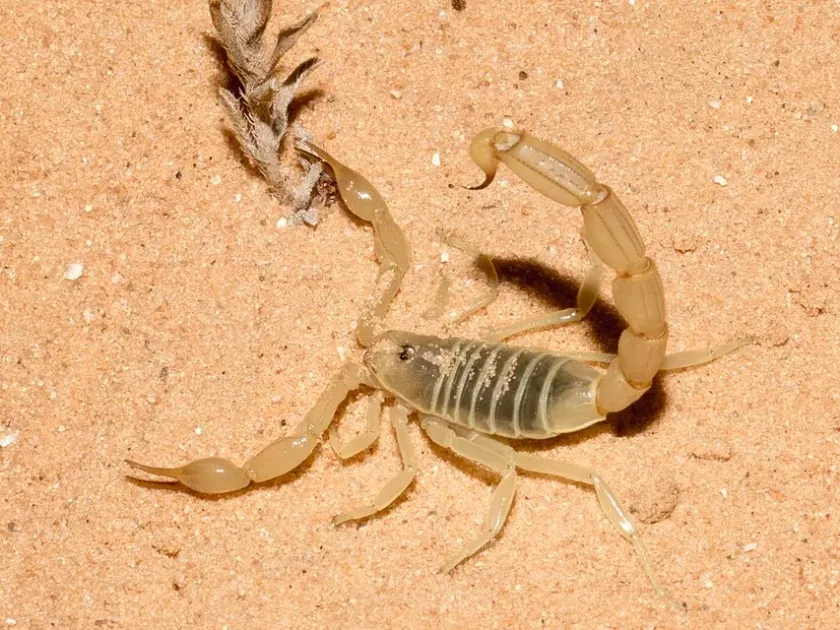
Androctonus amoreuxi is a prominent species of scorpion belonging to the Buthidae family. Typically reaching lengths of 8–10 cm, this species is well-adapted to sandy, desert-like environments.
It possesses thick, robust pedipalps and a powerful, granulated metasoma. Its coloration ranges from light yellow to sandy-tan, providing excellent camouflage against arid soils.
Taxonomically, it belongs to the Scorpiones order. While strictly predatory, it is frequently encountered in agricultural zones developed within desert regions, becoming an occupational hazard.
This species is nocturnal, spending the majority of daylight hours in self-excavated burrows. Its metabolic rate is optimized for extreme heat, allowing it to survive long periods of drought.
Females are viviparous, carrying their young on their backs during the initial stages of development. This maternal behavior contributes to local population clusters in suitable soil patches.
What it damages
Androctonus amoreuxi does not feed on crops directly. However, its presence negatively impacts the local ecosystem by preying on beneficial insects that act as natural pest controllers.
The primary agricultural impact is the disruption of manual labor. The presence of venomous scorpions significantly increases the risk for staff performing weeding or harvesting tasks.
Active burrowing behaviors can disturb the delicate root zones of young crops, particularly in systems where high soil moisture is maintained, potentially leading to plant stress.
The scorpion's presence necessitates extra expenditure on safety training and equipment for field workers. Any injury to staff leads to significant downtime during critical growing cycles.
Furthermore, the physical disturbance of the topsoil layer by burrowing can accelerate moisture evaporation, which is highly detrimental in water-limited agricultural production systems.
When it appears
Activity peaks during the hottest months of the year when nighttime temperatures are most favorable for hunting. During this period, the scorpions are highly mobile across fields.
Irrigation activities often trigger increased surface activity. Increased soil moisture draws out the scorpion's prey, such as crickets and small larvae, which in turn attracts the scorpions.
Winter dormancy is a common strategy. During colder months, the species retreats deep into the subsoil, significantly reducing its presence on the surface until spring warming occurs.
Juvenile activity is most prevalent in the early spring. As the temperature rises, the young scorpions disperse, and the population density in active fields can increase markedly.
Autumnal shifts signal a transition toward hibernation, during which time the scorpions may seek shelter near farm buildings, fence lines, or storage areas adjacent to crop fields.
Signs of infestation
The most reliable sign of an infestation is the presence of semi-circular burrow entrances. These are typically found in slightly compacted soil or near the base of larger vegetation.
Telltale drag marks on sandy soil surfaces, caused by the scorpion's telson trailing as it moves, provide clear evidence of their path and territory size.
Heaps of chitinous exoskeleton fragments from prey items near the burrow entrance indicate a high-density hunting zone and established residency of the scorpion.
Heavy machinery operations often reveal the presence of the species by turning up individuals from the deeper soil layers during tillage or cultivation processes.
UV-light inspections conducted after dusk are the definitive identification method. The scorpion’s exoskeleton exhibits a strong fluorescent glow under ultraviolet light, making detection easy.
Control measures
Mechanical control via frequent inter-row cultivation is the most effective approach. Disrupting the soil structure prevents the establishment of stable burrows and forces migration.
Reducing the availability of prey is a long-term strategy. By managing the population of ground-dwelling insects through IPM (Integrated Pest Management), the food source for scorpions is removed.
Maintaining a clear field perimeter and removing organic debris significantly reduces the habitat suitability, discouraging scorpions from settling near crop production areas.
- Enforcing strict PPE (personal protective equipment) protocols for workers.
- Deep plowing at the end of the harvest season to destroy nesting sites.
- Use of protective barriers or mesh in high-traffic infrastructure.
If population density reaches critical levels, localized application of authorized insecticides targeted at the base of the soil profile may be necessary to displace the pest.
Taxonomy
- Latin name
- Androctonus amoreuxi
- Family
- Buthidae
- EPPO code
- ANDOAM
Discussion
No discussions yet — be the first.