
Arizona bark scorpion
Centruroides exilicauda
Description
How to identify
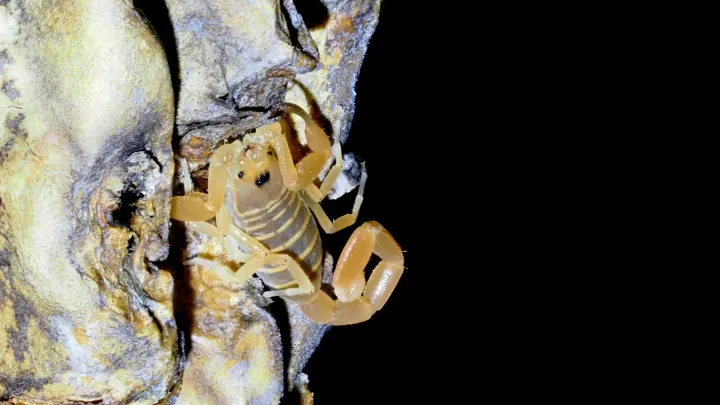
The Arizona bark scorpion, scientifically known as Centruroides exilicauda, belongs to the family Buthidae. This small arachnid usually reaches a length of 5 to 7 centimeters.
It is easily recognized by its yellowish-brown color, which allows it to blend perfectly with tree bark or plant debris. Its tail is notably slender in comparison to its claws, which is a key identifying characteristic for the species.
A vital biological trait of this species is the presence of potent venom glands located in the telson. Being nocturnal, these scorpions are typically inactive during daylight hours, making them difficult to detect.
Systematically, this species belongs to the order Scorpiones. Unlike many other scorpion species, the bark scorpion is capable of climbing vertical surfaces, including tree trunks, fences, and the walls of buildings.
In agricultural settings, they prefer cool, moist, and shaded areas. They are highly adaptable and frequently utilize the bark of trees or stacked organic materials as daytime shelters to avoid extreme heat.
What it damages
There is no direct damage to agricultural crops caused by this species, as it is a predator rather than a plant eater. They feed primarily on small insects and other invertebrates found in the orchard or field.
The primary concern is the significant risk they pose to agricultural workers. Bites from the Arizona bark scorpion are painful and can cause severe health issues, necessitating medical attention and impacting labor safety.
Their presence forces farmers to limit manual labor in infested areas. This leads to increased costs associated with implementing mechanical solutions to avoid human contact with areas where these arachnids congregate.
Their presence also complicates the storage of agricultural products. Scorpions often hide in crates, pallets, or shipping materials, creating a risk that they may be inadvertently transported to distribution centers.
Therefore, the harmfulness of this species is primarily related to occupational safety. Farm management must account for these risks by implementing strict safety protocols for all workers entering the field.
When it appears
The activity of the Arizona bark scorpion is closely tied to ambient temperature. They are most active during the warmer months when nighttime temperatures remain favorable for hunting and foraging.
The spring season, characterized by increased moisture, marks the peak of their reproductive activity. During this time, scorpions become more mobile and may disperse to colonize new areas, including farm buildings.
In the heat of summer, these scorpions adopt a more secretive lifestyle. They retreat into deep crevices under tree bark or deep into the soil to maintain an optimal temperature, making them less visible during field inspections.
As autumn approaches and temperatures drop, they seek secure shelters to overwinter. During this period, the risk of encounter increases near farm structures where they look for protective cracks to survive the winter.
During the winter, they enter a period of lethargy but can quickly become active during sudden warm spells. Ongoing monitoring is essential throughout the year to prevent the establishment of large populations.
Signs of infestation
Detection is most effectively achieved using ultraviolet light at night. The exoskeleton of Centruroides exilicauda glows with a distinct neon green or blue color under UV illumination.
The presence of shed exoskeletons (exuviae) is a clear indicator of a established population. Checking the base of trees, under loose bark, or near debris piles for these shells can reveal their nesting sites.
High concentrations of small insects in sheltered areas may serve as a secondary sign of scorpion presence, as they establish their territory where prey is abundant. Investigating such areas can help locate their hiding spots.
If employees report incidents of stinging or biting by unidentified arthropods, it serves as a strong signal to perform a professional inspection of the territory. Scorpions are territorial and will sting if they feel threatened.
Regular inspections of storage sheds and facility foundations for gaps or wall voids are necessary. Ensuring these areas are well-sealed prevents the establishment of a population near the workspace.
Control measures
The primary management strategy is environmental sanitation. Clearing away plant debris, fallen leaves, and stacked wood denies scorpions the necessary cover and moisture-rich environments they require to thrive.
Sealing all farm structures is crucial. Properly closing cracks in foundations, repairing window screens, and ensuring door seals are tight prevents scorpions from entering offices and storage buildings.
Insecticide use should focus on controlling the prey base (insects). By reducing the population of available food sources through an integrated pest management approach, the overall scorpion population can be indirectly discouraged.
Personal Protective Equipment (PPE) is mandatory for workers. Using heavy-duty gloves, long sleeves, and closed-toe footwear during harvest and maintenance significantly reduces the risk of stings during accidental encounters.
The strategic placement of sticky traps along the perimeter of facilities helps in monitoring population density. This allows for early detection of migration patterns and enables prompt intervention before infestations become severe.
Taxonomy
- Latin name
- Centruroides exilicauda
- Family
- Buthidae
- EPPO code
- CENUEX
Discussion
No discussions yet — be the first.