
Mauritanian fat-tailed scorpion
Androctonus mauretanicus
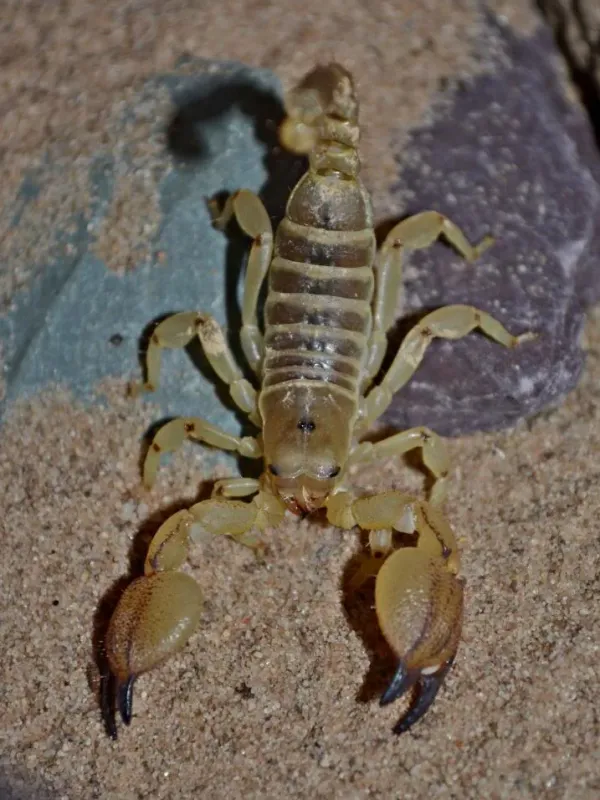
Description
How to identify
Androctonus mauretanicus is a highly venomous species of scorpion belonging to the Buthidae family. Adults can reach lengths of up to 10–12 cm, featuring a distinct, thick metasoma (tail).
Their coloration typically ranges from dark brown to black, providing camouflage in rocky terrains and dry soils. They are characterized by a highly aggressive demeanor and potent neurotoxic venom.
This species is native to arid environments in North Africa. They are nocturnal hunters that spend daylight hours concealed in crevices or underground burrows to escape heat.
Systematically, it is a member of the order Scorpiones. While they do not consume crops, their presence in fields poses a significant threat to agricultural productivity and safety.
Identification is aided by their heavy, stout tail and relatively slender pincers, combined with their characteristic territorial behavior in the wild.
What it damages
It must be noted that Androctonus mauretanicus is not a plant pest and does not cause direct physical damage to crops or foliage.
The primary damage is operational: their presence creates significant health hazards for agricultural workers, complicating manual labor, harvesting, and routine field maintenance.
Fields colonized by these scorpions often face delays in cultivation because workers must follow strict safety protocols, reducing overall labor efficiency.
Scorpions are often attracted to moisture, so they tend to congregate near irrigation channels, potentially interfering with water management systems in large plantations.
Ultimately, the threat is socio-economic; the danger to workers necessitates extra safety measures, increasing the costs of human labor in infested agricultural sectors.
When it appears
Activity is highly temperature-dependent, with peak movement observed during the warm spring and summer months when night temperatures remain stable.
During extreme summer heat, individuals move closer to irrigated zones to escape desiccation, bringing them into closer contact with cultivated land.
In winter or periods of low temperature, they remain dormant in deep burrows, significantly reducing the risk of encounters with personnel.
Activity spikes during twilight hours, as this is when the species emerges from its refuge to hunt small insects residing within the agricultural plot.
Seasonal migrations are frequently tied to irrigation cycles, as moist conditions and the resulting increase in insect populations attract scorpions to the crop areas.
Signs of infestation
Evidence of their presence includes small, slit-like burrow entrances found near the roots of trees or in uncultivated field margins.
The use of UV lighting at night is the most reliable method for detection, as scorpions exhibit a bright, characteristic fluorescence under ultraviolet light.
The accumulation of insect exoskeleton fragments near burrow openings provides a clear indication that a scorpion is using the area for hunting purposes.
Damage to equipment left on the ground, such as bags or tarps, can indicate that the objects have been utilized as temporary shelters by foraging individuals.
Tracks on loose or sandy soil left during the night can also serve as a secondary sign of recent movement across the field.
Control measures
The most effective strategy is the mechanical clearing of debris, rocks, and plant waste that provide essential cover and refuge for the scorpions.
Integrated pest management targeting the scorpions' prey, such as crickets and beetles, can significantly reduce the local scorpion population.
Ensuring that fields are properly drained and avoiding stagnant water helps reduce the attractiveness of the site to this moisture-seeking species.
Personnel training is crucial, including the use of heavy-duty personal protective equipment (PPE) like steel-toed boots and thick gloves when performing ground-level tasks.
- Regular soil tilling to destroy underground burrows.
- Sealing cracks in storage facilities to prevent entry.
- Setting monitoring traps in high-risk zones.
- Prioritizing personal safety protocols during harvest.
Taxonomy
- Latin name
- Androctonus mauretanicus
- Family
- Buthidae
- EPPO code
- ANDOMA
Discussion
No discussions yet — be the first.