
Common merganser
Mergus merganser
Description
How to identify
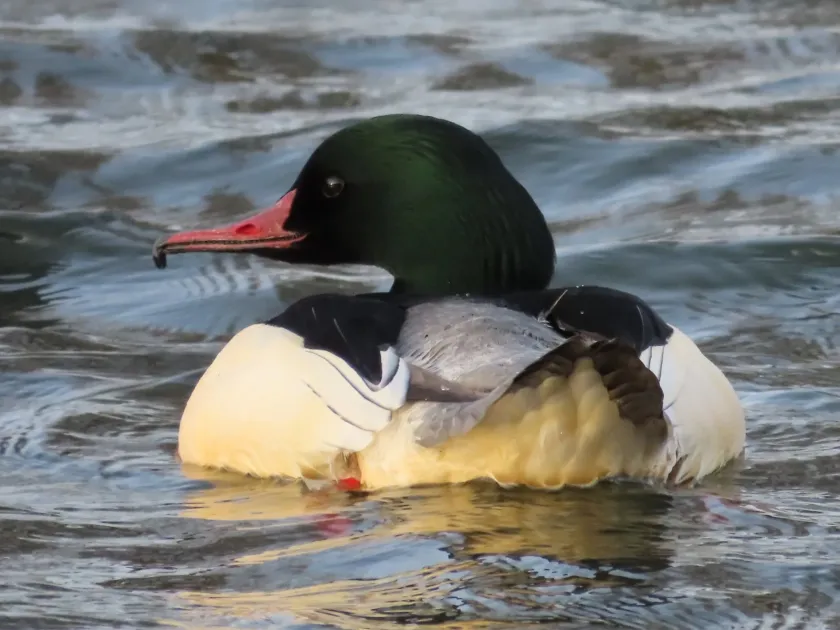
The common merganser (Mergus merganser) is a large, powerful diving duck belonging to the family Anatidae, distinguished by its thin, serrated bill.
Males possess a striking appearance with dark, iridescent green heads, while females are identified by their reddish-brown crests and greyish bodies.
This species is highly adapted to an aquatic lifestyle, primarily foraging in freshwater rivers and lakes by pursuing fish underwater.
Their biology involves nesting in cavities, typically near large bodies of water, which allows for efficient foraging during the rearing season.
They are highly social birds, often found in large groups during the non-breeding season, significantly increasing their pressure on local food resources.
What it damages
In the context of agriculture and fisheries, common mergansers are recognized as significant predators of farmed fish, particularly in hatcheries and ponds.
Their predation on fingerlings and juvenile salmonids or carp can result in severe economic losses for commercial aquaculture operators.
Constant foraging activity causes physical depletion of stocks and induces chronic stress in farmed fish, which leads to reduced growth rates and susceptibility to disease.
The presence of mergansers also compromises water quality through fecal contamination, which can be detrimental in intensive rearing environments.
They act as vectors for various fish parasites and pathogens, potentially spreading diseases between different water basins or pond systems.
When it appears
Pressure from this species peaks during migratory periods in spring and autumn, as they seek productive feeding grounds along their flight paths.
Winter months are critical for fish farms, as common mergansers congregate in large numbers on unfrozen open water, focusing their hunting efforts on available stock.
Signs of infestation
Clear signs of infestation include frequent diving behavior across the pond area and the presence of feathers or bird droppings on banks.
Remnants of partially consumed fish with characteristic puncture marks from the serrated bill indicate active predation by mergansers.
Control measures
Physical exclusion remains the most effective measure, utilizing overhead netting to prevent birds from accessing the water surface in sensitive areas.
Integrated bird management programs often include visual scarecrows, predatory bird silhouettes, and sound-based deterrent systems to discourage nesting and foraging.
Maintaining clear surroundings around ponds helps reduce the attractiveness of the site, preventing birds from settling and creating permanent feeding stations.
Taxonomy
- Latin name
- Mergus merganser
- Family
- Anatidae
- EPPO code
- MERGME
Discussion
No discussions yet — be the first.