
American wigeon
Anas americana
Description
How to identify
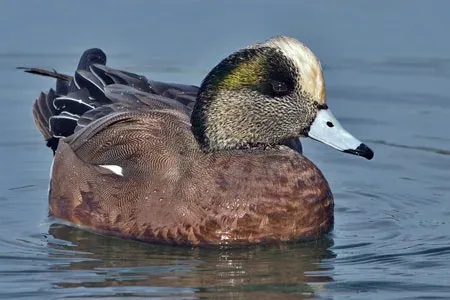
The American wigeon (Anas americana) is a species of dabbling duck belonging to the Anatidae family. It is medium-sized and distinguished by the male's white forehead and green patch behind the eye.
These birds are highly adaptive and capable of long-distance flights, frequently moving between aquatic habitats and nearby agricultural lands to forage.
Unlike many other duck species, the American wigeon spends significant time on land, making it a regular visitor to cereal and vegetable fields.
Their biological structure is well-suited for grazing on plant materials, which allows them to effectively consume both wild and cultivated plant species.
Identification is aided by their distinct whistling call and the tendency to forage in groups, often causing observable changes in field density.
What it damages
American wigeons primarily damage grain crops such as winter wheat, barley, and oats by grazing on young shoots during the early stages of development.
This grazing behavior reduces crop stand density and can lead to significant yield losses if the feeding occurs during critical tillering stages.
The birds also forage on rapeseed and other oilseed crops, often consuming the terminal buds, which stunts growth and reduces overall plant productivity.
During the harvest season, the birds may cause damage by trampling crops and fouling the field with excrement, which reduces the quality and marketability of the produce.
Feeding flocks can cause severe compaction of the soil, especially in damp areas of the field, which negatively affects crop root development.
When it appears
The most significant damage occurs during spring and autumn migration periods, when large flocks settle in areas adjacent to agricultural lands.
In spring, the wigeons target winter cereal fields as they break dormancy, providing a nutrient-rich food source for the birds after their migration.
Autumn feeding poses a high risk to newly emerged winter crops, as flocks can consume large areas of green sprouts within just a few days.
In regions where wintering occurs, the birds may remain on or near fields throughout the winter months, continuing to exert pressure on wintering crops.
Daily activity typically peaks during dawn and dusk, when the ducks make regular movements between resting sites on water and feeding zones on land.
Signs of infestation
Evidence of an American wigeon infestation includes distinct webbed foot tracks on moist soil, especially near edges of fields adjacent to water bodies.
Plants display irregular grazing patterns with torn edges, differing from the clean cuts left by insect larvae or the nibbling of small rodents.
Accumulation of avian droppings within the field is a primary indicator of heavy use by a flock, which also poses a risk for soil-borne pathogens.
The presence of patches of trampled or completely bare ground in a field serves as a visual indicator of where the birds have spent the most time feeding.
Frequent bird activity and a distinct whistling sound during the early morning hours are strong indications that a flock is using the field as a primary food source.
Control measures
Visual deterrents such as reflective tape, motion-activated scarecrows, and predator silhouettes are effective in discouraging ducks from landing in the field.
Acoustic deterrents, including propane cannons or systems that broadcast distress calls, are highly effective in breaking the birds' habit of frequenting a specific area.
Managing the surrounding environment, such as draining small, temporary ponds within or near the fields, reduces the overall appeal of the area to waterfowl.
Strategic planting of decoy strips of non-commercial crops along field edges can help divert the flock's attention away from the primary cash crop.
Regular monitoring during peak migration times allows farmers to deploy deterrents proactively before the wigeons establish a consistent feeding pattern.
Taxonomy
- Latin name
- Anas americana
- Family
- Anatidae
- EPPO code
- ANAXAM
Discussion
No discussions yet — be the first.