
Diamondback moth
Aix
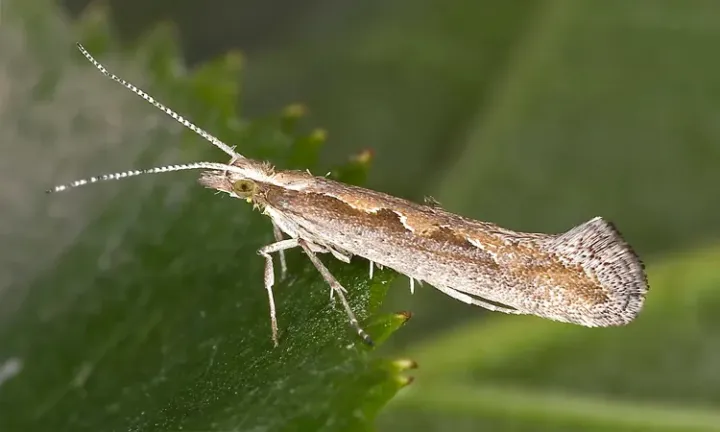
Description
How to identify
The diamondback moth (lat. Plutella xylostella) is a small moth with a wingspan of approximately 14–17 mm. When at rest, the wings are folded in a way that creates a distinct diamond-shaped pattern of light marks along the back.
The eggs are tiny, oval, and pale yellow. They are laid singly or in small clusters of up to five, usually on the underside of the leaves near the main veins.
The larvae progress through four instars. The mature caterpillar is about 12 mm long, spindle-shaped, and pale green, covered with fine, sparse hairs that make it look somewhat fuzzy under magnification.
The pupa is encased in a loose, white or greyish silk cocoon. This cocoon is often found attached to the undersides of leaves or protected within the plant's foliage.
Adult moths are primarily nocturnal, although they can be active during the day if disturbed or when their populations reach very high densities in the field.
What it damages
This pest is a specialist that feeds almost exclusively on Brassicaceae family crops. It causes significant damage to all cabbage varieties, kale, cauliflower, broccoli, Brussels sprouts, and mustard.
Wild cruciferous weeds, such as wild radish and shepherd's purse, serve as vital secondary hosts, allowing the pest population to persist and multiply outside of the main cropping season.
Larvae are responsible for the damage. Early instars mine the leaf tissue, leaving narrow, winding tunnels. As they grow older, they start consuming the entire leaf tissue while leaving the epidermis intact, resulting in a window-like appearance.
Heavy infestations can lead to total defoliation of the crop. When larvae target the growing point or the developing heart of the cabbage, it stops further development and renders the produce unmarketable.
Beyond direct feeding damage, the wounds created by the caterpillars provide entry points for secondary bacterial or fungal infections, which can lead to further crop decay.
When it appears
The diamondback moth is notorious for its short generation time, which allows for multiple generations per year—ranging from 3 to more than 6 depending on the local climate and temperature.
In temperate zones, the first adults typically appear in late spring as temperatures consistently exceed +12°C. These moths are known for their ability to be carried by winds over long distances.
Warmer temperatures significantly accelerate the life cycle. In hot, dry conditions, the time from egg to adult can be as short as 15–20 days, which often triggers rapid, mass outbreaks of the pest.
The moth overwinters in the pupal stage, hidden within plant debris or in the soil surface. In milder regions, it may remain active throughout the winter if suitable host plants are present.
Because generations overlap extensively, all life stages of the moth are often found in the field at the same time, making management and scouting highly complex.
Signs of infestation
Initial signs of infestation are small, translucent spots on the undersides of leaves, caused by early-stage larvae mining the inner tissue before moving to the surface.
As larvae mature, the characteristic "shot-hole" damage becomes evident. Leaves appear riddled with holes, and in severe cases, only the tough leaf veins remain, giving the plant a skeletonized look.
Finding the larvae themselves is a key indicator. They are highly active and will often drop from the plant on a silk thread when they are disturbed by wind or movement.
Small, dark, granular frass (droppings) left by the caterpillars on the leaves is a tell-tale sign that feeding is actively occurring within the canopy.
Stunted growth, failure to form a proper head, or deformed central leaves are clear indications that the pest has attacked the plant's apical meristem.
Control measures
Cultural control is essential. This includes the thorough destruction of all crop residues immediately after harvest to eliminate the overwintering pupal population.
Maintaining a weed-free environment around the fields is critical, as cruciferous weeds provide a continuous food supply and refuge for the moth throughout the year.
Biological control agents, particularly the use of the bacterium Bacillus thuringiensis, are highly effective against younger larvae and are often the preferred choice in integrated pest management programs.
Chemical control requires careful planning. Due to the pest's high ability to develop resistance, rotating insecticides with different modes of action is mandatory to keep populations under control.
- Implement pheromone traps for early detection of adult moth flights.
- Use fine-mesh insect exclusion netting for small-scale plantings.
- Maintain a strict crop rotation cycle to avoid planting brassicas in consecutive years.
Taxonomy
- Latin name
- Aix
- Family
- Anatidae
- EPPO code
- AIXXSP
Discussion
No discussions yet — be the first.