
Egyptian goose
Alopochen
Description
How to identify
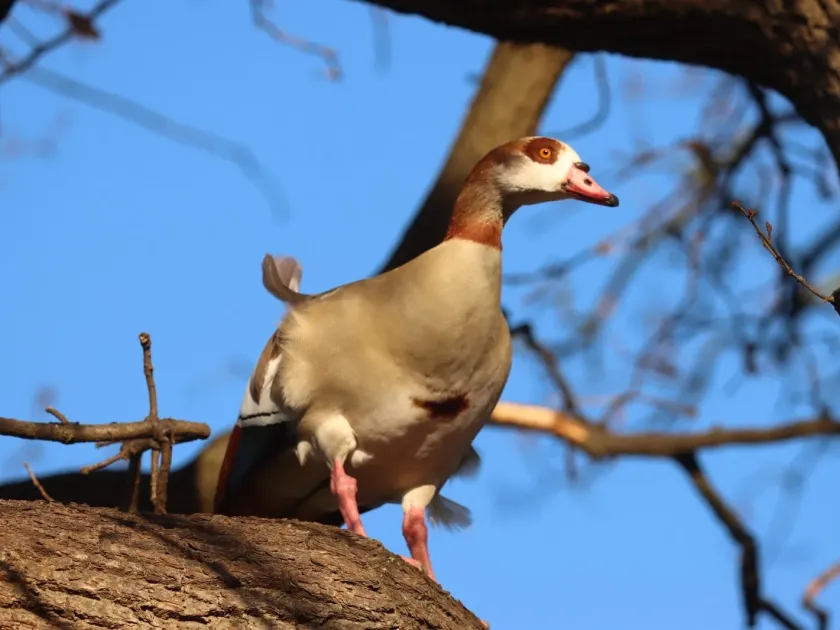
The Egyptian goose (Alopochen aegyptiaca) is a member of the Anatidae family, within the order Anseriformes. It is a large, highly adaptable waterfowl species that has successfully expanded into agricultural regions worldwide.
Physically, they are distinguished by their brown and grey plumage and a prominent dark patch surrounding the eye, which serves as a key identification mark for adults.
The species is intensely territorial, particularly during the breeding season, often occupying spaces near water bodies that are adjacent to high-value agricultural fields.
Their biology is marked by remarkable plasticity, allowing them to thrive in various environments, including farmland, where they find consistent food sources and minimal predators.
With strong legs for walking and a powerful bill for grazing, they are exceptionally effective at exploiting crops both on land and near water margins.
What it damages
Egyptian geese cause significant damage primarily to young winter cereal crops like wheat and barley, where they graze on emerging seedlings, leading to reduced stand density.
Legume crops, including alfalfa and soybeans, are also frequently targeted, as geese can consume large quantities of vegetative biomass, hindering the plant's initial development.
Vegetable production is vulnerable to both feeding and trampling, as geese can quickly devastate leafy green crops like lettuce and cabbage during the early growth stages.
The compaction of soil caused by flocks congregating on the same area negatively affects root aeration, further stressing the plants beyond the physical damage from grazing.
Furthermore, the accumulation of fecal matter on fields poses hygiene risks and can lead to the spread of pathogens that may degrade the quality of the agricultural product.
When it appears
The highest level of crop damage occurs during the germination phase of winter cereals, specifically in the autumn and early spring, when alternative forage is scarce.
Spring is a critical period for agronomists, as the rapid growth of tender seedlings attracts flocks that can destroy large swaths of a field in a matter of days.
During the summer months, geese may switch to pasture grasses and harvest residues, but they continue to be a persistent presence in agricultural zones throughout the season.
Migration periods often overlap with vital planting windows, increasing the risk of mass arrivals that overwhelm standard protection measures on farms.
As this species is capable of breeding throughout the year, there is no true "off-season" for management, making constant vigilance necessary for the protection of yields.
Signs of infestation
Signs of infestation include distinct footprints on soft soil and clear, clipped leaf margins on damaged crops, indicating grazing by the geese's serrated bill.
One of the primary indicators is the formation of bare patches within the field where plants have been consumed entirely, often visible from field margins.
The presence of large amounts of feathers and droppings near water channels or field edges provides clear evidence that the area is being used by the geese for grazing.
Auditory evidence, including their characteristic loud honking, often precedes their arrival and can alert farmers to their presence during the early morning hours.
If perimeter damage is concentrated near ponds or drainage ditches, this strongly suggests that the Egyptian goose is the primary culprit behind the loss of crops.
Control measures
The deployment of bio-acoustic deterrents that broadcast predator calls is a highly effective method for discouraging geese from settling on vulnerable crop areas.
Static scarecrows or predator models should be moved frequently to avoid habituation, as the birds are intelligent enough to learn when a threat is not genuine.
Physical barriers, such as specialized netting or fencing, are recommended for protecting high-value vegetable plots where even minor damage leads to significant economic loss.
Integrated management, which involves maintaining field perimeters to be less hospitable for landing and nesting, can significantly reduce the attractiveness of the site.
- Use of lasers for nighttime deterrents.
- Application of taste-aversion repellents on seeds.
- Scheduled monitoring of local population movements.
Taxonomy
- Latin name
- Alopochen
- Family
- Anatidae
- EPPO code
- ALPCSP
Discussion
No discussions yet — be the first.