
Mandarin duck
Aix galericulata
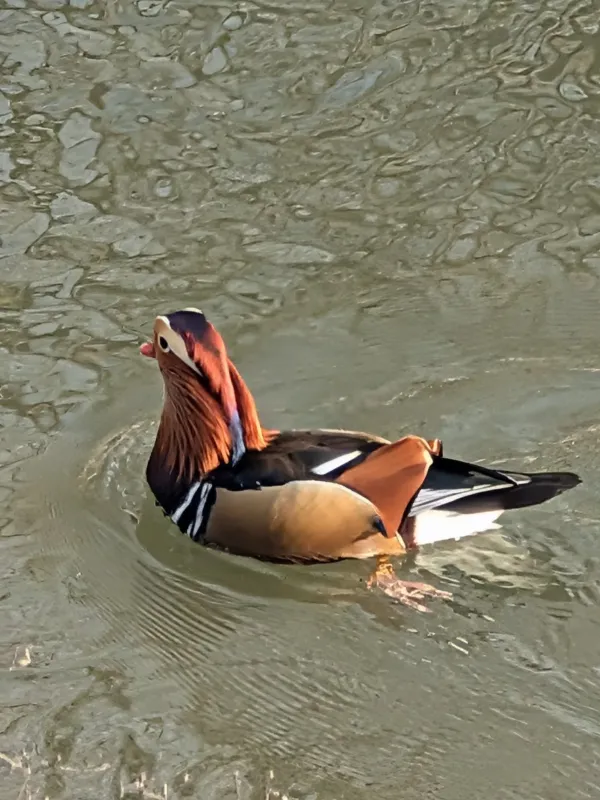
Description
How to identify
The Mandarin duck (Aix galericulata) is a perching duck species belonging to the Anatidae family. While widely recognized for its ornamental value, it is occasionally documented as a nuisance to agricultural production.
Adult males are distinguished by their elaborate, multicolored plumage, while females exhibit a more muted, brownish appearance. Their wing structure is adapted for agile flight, allowing them to navigate dense forest and wetland environments easily.
Systematically, this species belongs to the wood duck genus. They are naturally predisposed to habitats near woodland-fringed water bodies, which frequently brings them into contact with nearby agricultural landscapes.
The birds reach an average size of 40–50 cm. Their activity patterns are diurnal and crepuscular, often leading them to forage in fields during early morning or evening hours, making them difficult to track.
Biological resilience and the ability to travel long distances between nesting sites and feeding areas make them persistent visitors to agricultural plots located in their habitat range.
What it damages
The primary agricultural damage caused by Mandarin ducks occurs in rice paddies and various cereal fields. The birds target newly sown seeds and young, succulent sprouts during the early vegetative stage.
In regions where rice cultivation is intensive and close to water, these ducks can decimate entire sections of a crop by feeding on seeds directly after planting, leading to significant yield losses.
Beyond direct consumption of grain, the ducks cause mechanical damage to plants through trampling, which thins the crop stand and hampers the development of the remaining vegetation.
Their collective foraging behavior can lead to large, localized bare patches in fields, especially when flocks concentrate near water inlets or quiet corners of the farmland.
Economic losses are compounded by the need for re-seeding or corrective measures, which increases overall production costs and delays the harvesting cycle.
When it appears
The most critical risk period for crops occurs during spring, when planting coincides with the germination and early growth of cereals, making them highly attractive to the birds.
During the summer months, the ducks typically shift their diet to aquatic vegetation and wild seeds, which reduces the immediate pressure on crops, though individual incidents may still occur.
Autumn may see a resurgence of activity as ducks return to fields to forage on post-harvest grain residues, which is an important aspect for farmers managing field cleanliness for the next season.
Migratory and daily activity cycles are heavily influenced by temperature and food availability; therefore, understanding local environmental conditions is essential for management.
Agronomists are advised to maintain heightened monitoring during the peak germination phase to implement protective strategies before the birds establish a stable feeding routine.
Signs of infestation
The presence of Mandarin ducks is often first indicated by characteristic webbed footprints in soft, moist soil and the emergence of irregular bare patches in the crop field.
Finding feathers, droppings, and signs of disturbance near the edges of fields or adjacent waterways serves as a clear indicator of the birds' recent activity on the property.
Visual observations during dawn and dusk are the most reliable methods for confirming the presence of the flock, as these are the peak hours for their feeding activity.
Ragged edges on leaves and stems uprooted by the ducks distinguish their feeding habits from those of insects or rodents, which typically leave more precise marks on the plants.
Audible signals, such as the flapping of wings and distinct vocalizations when a flock takes flight upon human approach, are common indicators of their presence.
Control measures
Visual deterrents, such as raptor decoys or reflective tapes, are effective when rotated frequently to prevent the birds from habituating to the static objects.
Bio-acoustic systems that play distress calls or predator sounds have proven highly effective in discouraging the ducks from establishing a feeding zone within the field.
In high-value agricultural zones, physical barriers like netting can be installed to protect young crops, providing a definitive solution against avian intrusions.
Active patrol and disturbance programs, particularly during the critical early growth phases, can force the birds to seek alternative, less protected foraging sites.
- Deployment of propane cannons for periodic noise disruption.
- Effective weed management at field borders to reduce habitat cover.
- Integrated pest management strategies utilizing crop rotation.
Taxonomy
- Latin name
- Aix galericulata
- Family
- Anatidae
- EPPO code
- AIXXGA
Discussion
No discussions yet — be the first.