
Egyptian goose
Alopochen aegyptiacus
Description
How to identify
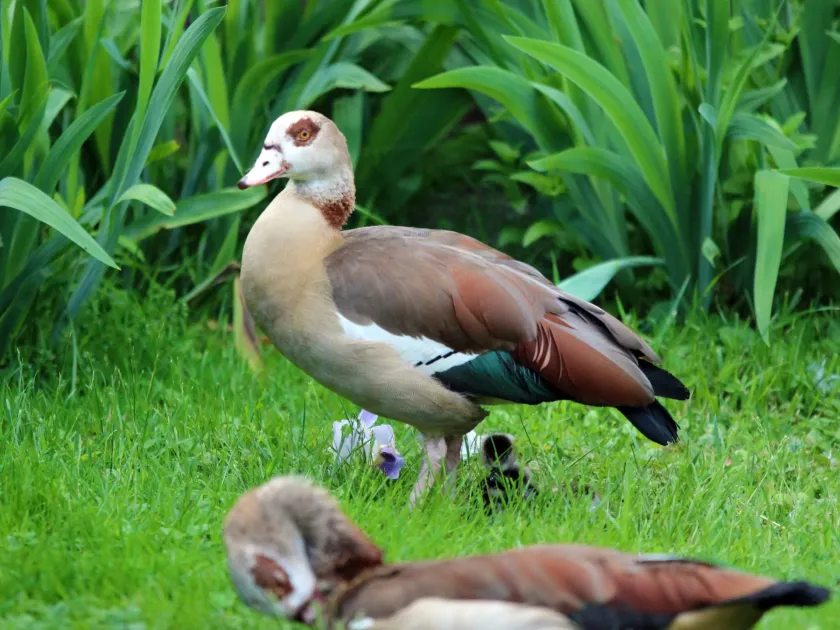
The Egyptian goose (Alopochen aegyptiacus) belongs to the Anatidae family. It is a large, aggressive waterfowl species originally from Africa that has become an invasive pest in many parts of the world.
These birds are identified by their brown plumage, distinct dark eye patches, and bold temperament. They are highly territorial, frequently aggressive towards other bird species and human activities.
The species is exceptionally adaptable to various environments, including farmland, golf courses, and urban parks, which facilitates their spread into cultivated agricultural areas.
Their physical structure, featuring strong legs and wings, allows them to forage efficiently both on land and in water, making them versatile and resilient pests.
Because they do not have significant natural predators in many regions where they have been introduced, their populations often grow rapidly, leading to increased pressure on agriculture.
What it damages
The primary agricultural damage caused by the Egyptian goose involves the consumption of young seedlings of cereals, such as wheat, barley, and maize, often destroying entire patches of crops.
They graze on pasture lands, competing directly with livestock for high-quality forage, which reduces the overall grazing capacity of the fields and farm productivity.
During the grain-filling stage, these birds can cause substantial damage to corn cobs and ripening wheat heads, leading to yield losses and decreased quality of the harvest.
Their droppings can contaminate water sources used for irrigation, leading to potential disease transmission and degradation of the water quality required for farming.
- Cereal crops (wheat, barley, rye).
- Maize (seedlings and mature cobs).
- Forage grasses and legumes.
- Market garden vegetable crops.
When it appears
Egyptian geese are active year-round; however, they pose the highest risk to agricultural crops during the spring planting season when young seedlings emerge.
During the summer, the geese focus on maturing grain crops, causing significant damage through trampling and direct consumption of the developing seeds.
Autumn brings the formation of larger flocks, which can descend on fields in high numbers, leading to extensive damage to winter crops in a short period.
Winter months do not deter the species if open water is available, and they often switch to foraging on winter wheat, which can delay the growth of the crop.
The peak breeding season triggers increased foraging activity as parents seek nutrient-dense food sources for their growing goslings.
Signs of infestation
The most prominent sign is the presence of denuded patches in a field where young crops have been grazed down to the ground, leaving bald spots.
Large accumulations of droppings and footprints in the soft soil surrounding the grazed areas are clear indicators of a large goose flock feeding site.
Direct observation of geese in fields during early morning or late afternoon hours is a strong signal that the flock has established a feeding pattern on the land.
Visible damage to maturing corn cobs, with stripped leaves and missing kernels, confirms the birds' presence and their impact on the crop quality.
Compacted soil caused by the trampling of multiple geese often leaves discernible paths between feeding zones, further degrading the physical structure of the topsoil.
Control measures
Acoustic deterrents, such as propane cannons or recorded distress calls of predators, are effective in discouraging geese from establishing feeding sites on large fields.
Visual aids, including predator decoys (e.g., owl or hawk shapes), reflective tapes, and spinning wind-driven deterrents, help to keep flocks unsettled and away from the crops.
Physical barriers like specialized bird netting can be utilized for high-value vegetable crops, though these are generally too expensive for large-scale grain production.
Strategic timing of planting and cultivation can reduce the vulnerability of crops during the specific times when local goose populations are most active.
Integrated pest management strategies, involving regular monitoring and cooperation with local wildlife authorities, are necessary to mitigate the economic impact of this invasive species.
Taxonomy
- Latin name
- Alopochen aegyptiacus
- Family
- Anatidae
- EPPO code
- ALPCAE
Discussion
No discussions yet — be the first.