
Melormenis basalis
Melormenis basalis
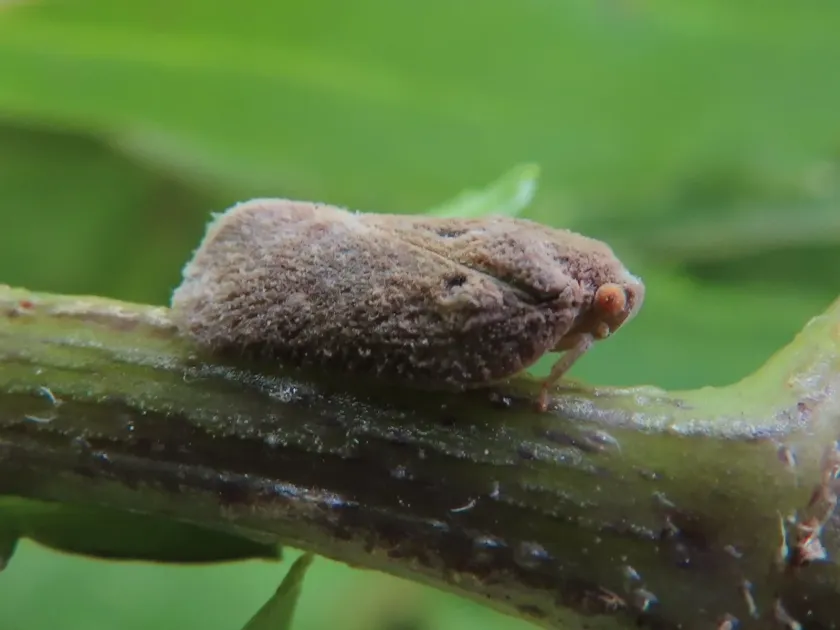
Description
How to identify
Melormenis basalis belongs to the family Flatidae, commonly known as flatid planthoppers. These insects are easily identified by their wedge-shaped appearance when at rest, with wings folded vertically along the sides of their bodies.
Adult planthoppers measure between 8 and 10 millimeters. Their color ranges from pale green to light brown, providing an effective camouflage against foliage and stems of various host plants in the garden or field.
The nymphs are distinct due to the presence of fluffy, white waxy secretions covering their bodies. These waxy filaments serve as a defense mechanism against predators and help the nymphs conserve moisture in hot weather.
Classified under the order Hemiptera, these insects possess piercing-sucking mouthparts. This anatomical feature allows them to penetrate plant tissues effectively to extract sap from the phloem, causing significant plant stress.
These planthoppers are highly mobile and exhibit strong jumping capabilities when disturbed. This behavior makes visual monitoring and manual control difficult for growers, especially in dense plant canopies.
What it damages
Melormenis basalis infests a wide range of plants, including fruit trees, grapevines, and various ornamental species. Young, tender shoots are the primary targets, as they offer the highest concentration of sap for the insects.
By feeding on the sap, the insect siphons off essential nutrients and water from the host plant. This drain causes stunted growth, wilting, and overall decline in the plant's vitality, leading to reduced yield quality.
A major indirect threat is the production of honeydew. This sticky substance covers leaves and serves as a substrate for sooty mold, which creates a dark fungal layer that inhibits photosynthesis and ruins aesthetic value.
Persistent infestations often lead to leaf curling, chlorosis, and premature senescence. In severe cases, the damage to terminal buds results in deformed growth patterns that can impact the productivity of the plant for several seasons.
Furthermore, these insects may act as vectors for various plant pathogens. The wounds created during feeding provide entry points for bacteria and viruses, which can lead to systemic infections within the crop.
When it appears
The life cycle of Melormenis basalis is closely tied to the regional climate. Activity usually begins in early spring, as temperatures rise consistently above 15 degrees Celsius, triggering the emergence of nymphs.
The peak population growth typically occurs during the mid-summer months. Favorable warm conditions allow for rapid maturation of nymphs into adults, leading to massive swarms that can quickly colonize healthy plant sections.
Developmental rates vary based on ambient temperature and host plant quality. In warmer temperate and subtropical zones, the species may undergo multiple overlapping generations throughout a single growing season.
As autumn approaches and temperatures drop, adults lay eggs in protected areas, such as bark crevices or soft stems. These eggs serve as the overwintering stage, ensuring the survival of the population through cold periods.
Effective management requires scouting throughout the season, but special attention should be paid to the early spring emergence to prevent the establishment of the first generation of nymphs.
Signs of infestation
The most reliable sign of an infestation is the presence of white, cotton-like waxy fluff on the undersides of leaves. Observing these white patches is a clear indicator that a colony is active and feeding.
The accumulation of honeydew on the leaves and stems is another obvious symptom. This sticky residue often attracts ants, which may protect the planthoppers from natural predators in exchange for the sugary secretion.
Sooty mold growth, appearing as a thick black coating on leaves, is a secondary sign that indicates a long-term presence of sap-sucking insects that have been excreting honeydew for some time.
Visible leaf deformation, including curling, yellowing, or browning at the edges, points to significant sap loss. Plants may also appear generally lethargic or fail to produce normal foliage during the active season.
Sudden movement of small, winged insects upon brushing against a plant is a classic sign of adult planthoppers being present in the canopy, confirming a widespread infestation.
Control measures
A successful integrated pest management (IPM) strategy for Melormenis basalis involves both physical and chemical interventions. Pruning infested branches can significantly reduce the initial population size.
Cultural practices, such as maintaining proper plant spacing and thinning canopies, improve air circulation. This reduces the humidity levels that the insects and the resulting sooty mold thrive in.
Biological control methods can be employed by encouraging natural enemies like ladybirds, lacewings, and parasitic wasps. These predators can provide effective suppression when environmental conditions are balanced.
If economic thresholds are exceeded, targeted application of contact or systemic insecticides is necessary. Rotation of chemical classes is essential to delay the development of resistance in planthopper populations.
- Deploy yellow sticky traps for monitoring and early detection.
- Regularly inspect the underside of leaves for nymph clusters.
- Use horticultural soaps or oils for small-scale early infestations.
- Maintain weed-free areas to eliminate secondary host reservoirs.
Taxonomy
- Latin name
- Melormenis basalis
- Order
- Hemiptera (bugs, aphids, leafhoppers)
- Family
- Flatidae
- EPPO code
- MLRMAN
Discussion
No discussions yet — be the first.