
Melormenis
Melormenis
Description
How to identify
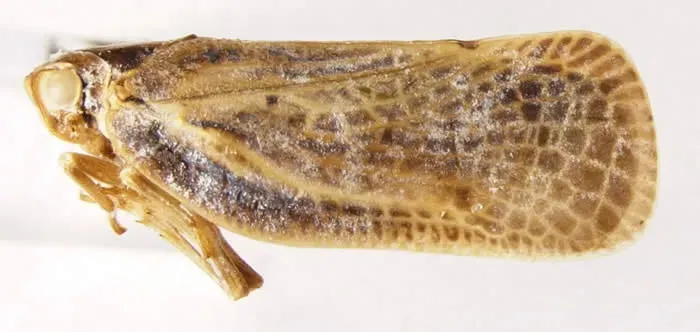
Melormenis is a genus belonging to the order Hemiptera and the family Flatidae (planthoppers). These insects possess a specific body structure typical of the Flatidae family, featuring wings that fold in a tent-like fashion along the body.
Adult specimens are generally small and often exhibit camouflage colors, allowing them to hide effectively within vegetation. While adults may resemble small moths, close inspection reveals their classification within the suborder Auchenorrhyncha.
Nymphs of Melormenis differ from adults by the absence of fully developed wings and the presence of a characteristic waxy secretion on their bodies. This waxy covering serves as a protective layer, shielding the nymphs' soft tissues from desiccation and predators.
The life cycle of the insect includes an egg stage, several nymphal instars, and an adult phase. Development occurs primarily in warm climates, where the pest is capable of establishing stable populations within agricultural ecosystems.
For precise species identification, specialists must examine the morphological features of the genitalia; however, in field conditions, understanding the general characteristics of the Flatidae family is sufficient for initial threat assessment.
What it damages
Melormenis is a polyphagous pest, meaning it has the ability to damage a wide range of agricultural, ornamental, and forest crops. Fruit trees, vineyards, and vegetable plants are particularly susceptible to infestations.
The primary damage is caused by the sucking of cell sap from young shoots, leaves, and flower stalks. The insects pierce the plant epidermis with their piercing-sucking mouthparts, which leads to the depletion of plant tissues.
Necrotic spots often form at the puncture sites, and in cases of heavy infestation, a general stunting of the plant's growth is observed. The disruption of plant metabolism leads to reduced yields and inferior fruit quality.
An additional danger is the secretion of honeydew, which serves as a substrate for the development of sooty mold. This fungus covers the surface of leaves with a black layer, which interferes with the photosynthetic process.
Severe infestations of Melormenis can result in leaf deformation and premature bud drop. The loss of both aesthetic appeal and productivity makes controlling this pest a top priority for farmers.
When it appears
The activity of Melormenis is closely linked to temperature patterns and the plant growing season. Mass appearance of nymphs usually occurs in the second half of spring, when stable high temperatures are established.
Adults are most active during the summer, coinciding with the phase of intensive growth and fruiting of most garden crops. During this time, significant migration of individuals between feeding areas is observed.
The breeding season of the pest can extend over several months, creating a risk of continuous plant infestation. Autumn cooling leads to a decrease in population numbers, although eggs often successfully overwinter in bark or plant tissues.
Monitoring for the presence of the pest should begin at bud break, utilizing yellow sticky traps. Early detection allows for the containment of the population before it reaches the economic threshold of damage.
Agronomists recommend systematic inspection of the undersides of leaves, where the pest prefers to stay during the hot hours of the day to avoid direct sunlight.
Signs of infestation
One of the primary indicators of Melormenis presence is the presence of characteristic white, cotton-like secretions on stems and branches. These secretions are produced by nymphs as a defense mechanism against environmental factors.
Visually, the presence of the pest is indicated by the curling of young leaves and the appearance of yellowish chlorotic spots on them. In advanced stages, plants appear wilted and lose their turgor.
A sticky residue (honeydew) on the leaves, which attracts ants, is another indirect sign of planthopper activity. Ants often guard Melormenis colonies, creating additional difficulties for effective pest control.
The presence of a sooty mold layer, which is easily wiped off with a finger, indicates that the pest population has reached a high level. This condition requires immediate intervention to save the crop.
When shaking the branches of infested shrubs, one may notice a sudden jumping reaction from the adult insects. This behavioral response is a typical survival tactic used by the insects when threatened.
Control measures
Protection measures include agrotechnical methods such as timely pruning and the destruction of heavily infested shoots. Garden sanitation prevents the accumulation of the pest within the site.
Biological control involves the use of natural enemies, such as predatory bugs, ladybirds, and parasitic wasps, which effectively regulate planthopper populations in the natural environment.
Chemical control should be targeted at the nymphal stages, as they are most vulnerable before the formation of a dense waxy shield. Contact and systemic insecticides approved for specific crops are generally employed.
It is recommended to rotate products with different modes of action to prevent the development of resistance in the Melormenis population. Adherence to pre-harvest intervals is mandatory.
An integrated approach, combining regular monitoring, the use of natural enemies, and targeted insecticide application, is the most reliable strategy for managing the spread of this pest.
Taxonomy
- Latin name
- Melormenis
- Order
- Hemiptera (bugs, aphids, leafhoppers)
- Family
- Flatidae
- EPPO code
- MLRMSP
Discussion
No discussions yet — be the first.