
Heath Fritillary
Mellicta athalia
Description
How to identify
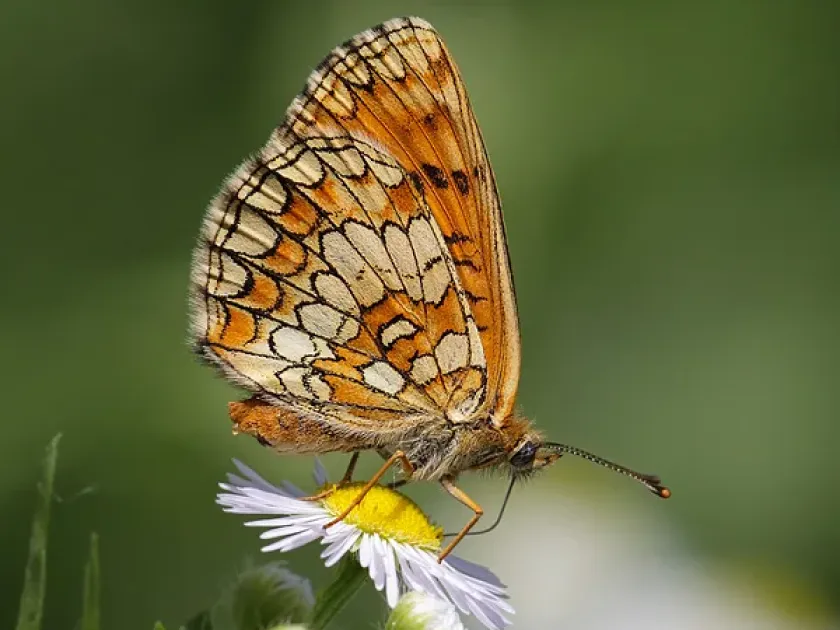
The Heath Fritillary (lat. Mellicta athalia) is a member of the Nymphalidae family within the order Lepidoptera. Adult butterflies exhibit a distinctive orange-brown and black checkered pattern on their wings.
The larvae are approximately 25-30 mm long, featuring a grayish-brown body covered in small tubercles and short, dark spines which provide excellent camouflage in the vegetation layer.
Adults are diurnal and prefer sun-exposed areas. They have a wingspan of about 35–45 mm, with females typically being larger and displaying more vibrant color contrasts compared to males.
The life cycle involves complete metamorphosis: egg, larva, pupa, and adult. The species typically overwinters as larvae, hiding within plant debris to survive the cold months.
Pupation takes place near the host plants or in the ground litter. The pupae are characterized by pale coloration with dark spots, providing a defensive appearance against predators.
What it damages
This pest primarily feeds on various herbaceous perennial plants, including species from the Plantaginaceae, Boraginaceae, and Asteraceae families.
In agricultural settings, the Heath Fritillary may be found on field margins and near forest edges, from where larvae can migrate into surrounding commercial crop fields.
The larvae are the primary source of damage, exhibiting high feeding intensity that can lead to significant defoliation of host plants by skeletonizing the leaves.
Heavy infestations result in a loss of photosynthetic surface area, which weakens the plants and can lead to a decrease in overall crop health and yields.
Damaged plants are more susceptible to opportunistic pathogens, as the feeding damage creates entry points for various fungal and bacterial infections.
When it appears
The adult flight period generally occurs from June to August, depending on regional climatic conditions. Females lay eggs in clusters on the underside of host plant leaves.
Larvae remain secretive after hatching, often feeding in groups. The period of active feeding occurs during late summer and early autumn before entering hibernation.
In spring, following hibernation, larvae resume feeding and grow rapidly, coinciding with the peak vegetative development phase of many field crops.
Pupation occurs in late spring or early summer, followed by the emergence of the next generation of adults after approximately two to three weeks of development.
While the species usually completes one generation per year, localized variations in temperature can influence the duration and timing of the life stages.
Signs of infestation
Initial signs of infestation include small holes or «windows» on leaves where young larvae have grazed the soft tissue, leaving the upper epidermis intact.
As larvae mature, they consume entire leaf portions, resulting in ragged leaf margins and bare stems, which are clear indicators of high pest activity.
The presence of larval frass on leaves and at the base of the stem is a strong indicator that active feeding is taking place within the field margins or crop patches.
Silken webs produced by the larvae for protection or social grouping are visible signs that warrant further investigation for potential control measures.
Observing adult butterflies flying over the crop field during sunny days serves as a warning to monitor for subsequent egg-laying and larval emergence.
Control measures
Effective agrotechnical controls include deep autumn plowing, which disturbs the soil and destroys larvae that are attempting to overwinter in plant debris.
Managing weed populations along field borders and ditches is critical, as these areas serve as primary breeding grounds for the species, reducing the risk of migration to crops.
If economic thresholds are exceeded, biological insecticides based on Bacillus thuringiensis are highly recommended as they provide effective control of young larvae.
Chemical control should be applied judiciously, focusing on spot treatments of infested areas to minimize impact on beneficial insects and pollinators in the surrounding ecosystem.
Regular scouting throughout the growing season allows for early detection and targeted intervention, preventing the spread of the pest across larger areas of the farm.
Taxonomy
- Latin name
- Mellicta athalia
- Order
- Lepidoptera (butterflies)
- Family
- Nymphalidae
- EPPO code
- MLLTAT
Discussion
No discussions yet — be the first.