
Wild turkey
Meleagris gallopavo
Description
How to identify
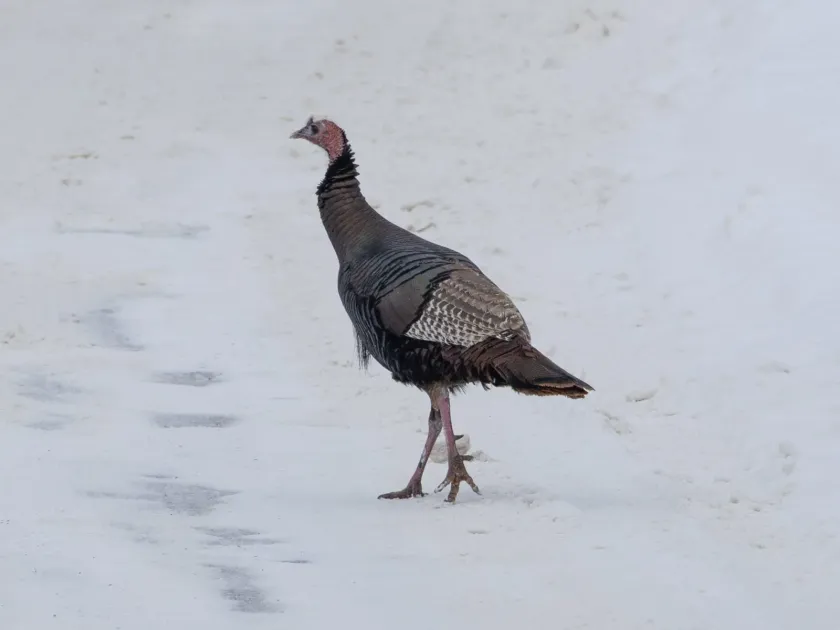
The wild turkey (Meleagris gallopavo) is a large bird of the Phasianidae family, order Galliformes. Adults reach significant sizes, possessing a strong beak and powerful legs adapted for foraging in the soil.
The plumage of the birds is typically dark brown or bronze with a metallic sheen. The male is significantly larger than the female, possessing characteristic fleshy growths (wattles) on the neck and head, as well as a fan-shaped tail that is displayed during the breeding season.
Birds are diurnal and prefer to move in flocks. They possess excellent eyesight, which makes them extremely cautious and complicates the use of traditional scare tactics in agricultural fields.
The biology of the species involves high mobility: turkeys can cover significant distances in search of food. In agricultural landscapes, they adapt to consuming both wild plants and cultivated crops.
Reproduction occurs in the spring, after which broods begin to forage actively in open areas. The increased need for protein and plant-based food by the juveniles leads to increased pressure on agroecosystems during the summer months.
What it damages
Wild turkeys cause the most significant damage to grain crops such as corn, wheat, soybeans, and sunflowers. The birds are capable of digging up germinating seeds, which leads to thinning of the stands and the need for replanting.
During the ripening period, turkeys damage corn cobs by pecking out grains, which opens the way for secondary fungal infections. Plants damaged in this manner often lose a significant portion of their market weight and reduce overall yield.
In addition to grains, their diet includes vegetable and melon crops. Turkeys are capable of trampling crops while moving across the field in large groups, leading to mechanical damage to stems and leaves.
There is also active consumption of young shoots of greens by the birds. In drought years, when wild vegetation withers, the damage to cultivated plantings increases significantly due to the shortage of natural food.
- Corn (pecking seeds and cobs)
- Soybeans (destroying young sprouts)
- Wheat (consuming grain during ripening)
- Vegetable crops (mechanical damage)
When it appears
Turkeys pose the greatest danger in the spring, during the sowing season, when sown seeds become an easily accessible food source. At this time, losses can reach critical levels across large areas.
The summer period is characterized by active field visits by juveniles and adults. Birds concentrate on plots with milk and dough stage grains, making corn and wheat crops particularly vulnerable.
In autumn, pest activity is associated with foraging before the winter period. During this time, they consume remaining harvest residues, often damaging even harvested fields where spilled grain remains, which contributes to the spread of weed seeds.
The occurrence cycle of the pest directly depends on weather conditions. Mild winters contribute to the survival of larger populations, which leads to more intense pressure on agricultural lands in the following season.
Migration of turkeys between forests and fields occurs daily. Morning and evening hours are peak times for field visits, which requires monitoring specifically during these time frames.
Signs of infestation
The main sign of turkey presence in the field is numerous tracks on moist soil. Large footprints clearly indicate the species even in the absence of direct visual observation of the birds.
Characteristic depressions in the soil and dug-up rows of crops indicate a search for germinating seeds. One can often find remains of feathers and specific droppings, which serve as an indicator of high flock density in the given sector.
On corn, signs of damage are scattered or pecked cobs with characteristic peck marks. Sprouts appear plucked or completely destroyed in certain areas, often leaving only empty seed holes.
Damage to soybeans or legumes often looks like bitten cotyledons or completely consumed growth points. Such plants usually do not recover and die, creating gaps in the field.
Aggressive behavior and alarm calls of the birds upon the approach of a person or equipment are a sure sign that the flock is in the field. However, due to their caution, the birds often manage to leave the feeding site before being detected by an agronomist.
Control measures
Visual deterrents are used to protect crops, such as scarecrows of predatory birds, bright reflective tapes, or windmills. The effectiveness of these methods increases with their regular movement around the field.
Acoustic systems that reproduce predator sounds or distress calls of the turkeys themselves show good results. However, birds are prone to habituation, so it is recommended to change sound patterns every few days.
The use of chemical repellents for treating seed material allows for reduced consumption of sprouts at the initial stage. Such compositions make the grain unpalatable, discouraging birds from revisiting the area.
Mechanical fencing of fields with netting is the most reliable but expensive method, used on valuable breeding plots or small farm areas. Planting buffer strips of crops that are not of interest to turkeys is also effective.
Agronomic techniques, such as optimal seed planting depth, reduce food accessibility for the birds. Deep planting makes it difficult to dig up seeds, which forces flocks to move on in search of easier prey.
Taxonomy
- Latin name
- Meleagris gallopavo
- Family
- Phasianidae
- EPPO code
- MLEAGA
Discussion
No discussions yet — be the first.