
Steppe cricket
Melanogryllus desertus
Description
How to identify
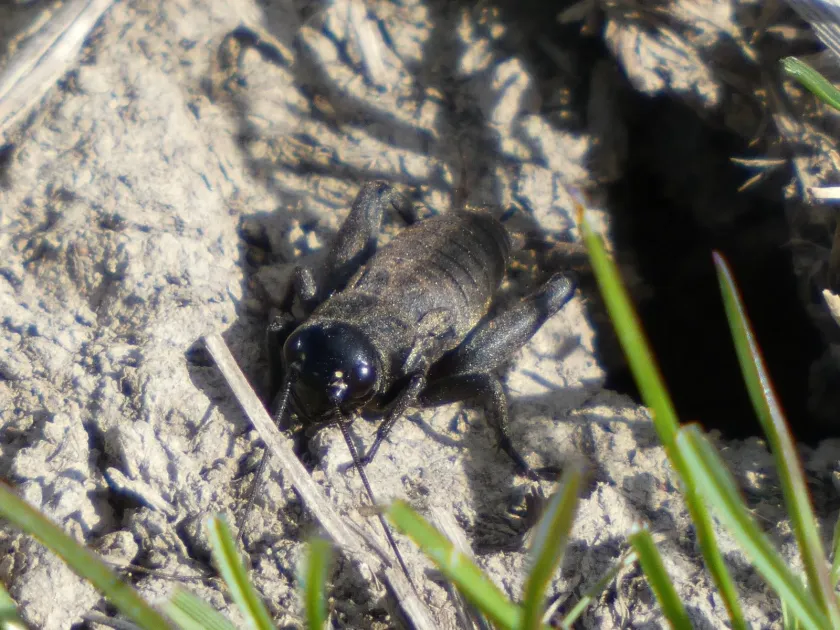
The steppe cricket Melanogryllus desertus belongs to the order Orthoptera and the Gryllidae family. Adult specimens typically measure between 12 and 20 mm in length.
These insects feature a robust, stout body, generally colored black or dark brown. Their large heads are equipped with powerful, chewing mouthparts designed for consuming plant tissues.
The wings of the steppe cricket can vary in development; some individuals possess fully functional wings, while others may have shortened or vestigial ones.
Nymphs resemble smaller versions of the adults, usually lacking wings. They are often dark in color, allowing them to remain hidden in soil cracks and vegetation during the day.
The life cycle involves incomplete metamorphosis. The insects generally pass the winter in the nymph stage, residing in deep burrows within the soil to survive harsh temperatures.
What it damages
As a polyphagous insect, the steppe cricket poses a significant threat to a wide range of agricultural crops, particularly during the early stages of plant development.
Cereal crops like winter wheat and barley are common targets. The crickets chew through the base of the stems of young seedlings, often causing the plants to collapse and die.
Row crops, including sunflowers, corn, and sugar beets, are frequently damaged. Crickets may feed on leaves, cotyledons, and growing points, which can severely stunt or terminate the plant's growth.
Vegetable crops in open fields are also susceptible, especially during dry spells when the crickets migrate from wild grasses to more succulent, irrigated agricultural areas.
Severe infestations can lead to significant thinning of crop stands, often requiring farmers to perform reseeding, which increases production costs and reduces total yield.
When it appears
The activity of overwintering nymphs begins in early spring as soil temperatures rise. This period is the most critical for protecting vulnerable young crop sprouts.
Adults typically emerge in late May and June, followed by a period of mating and oviposition. The females use their ovipositors to insert eggs directly into the soil.
Hot and dry summers often trigger mass migrations of crickets into irrigated agricultural zones, where the availability of moisture and food provides ideal conditions for their survival.
The species is univoltine, meaning it produces only one generation per year. Peak population numbers are usually observed in late summer, coinciding with the hatching of the new generation.
As autumn temperatures drop, nymphs of various stages retreat into deeper soil layers or burrows to hibernate, waiting for the return of favorable spring conditions.
Signs of infestation
The primary indicators of a steppe cricket infestation are the small, characteristic burrows in the soil, which serve as daytime shelters for the insects.
- Unexplained loss of seedlings in patches within the field.
- Irregular, ragged edges on leaves caused by the crickets' chewing.
- Severed plant stems at the base, leading to wilting and death.
- Distinctive chirping sounds heard during evening hours in infested fields.
- Small, dark fecal pellets left behind in feeding areas.
Control measures
Effective control of the steppe cricket requires a combination of preventive agricultural practices and targeted chemical interventions when population thresholds are exceeded.
Deep autumn plowing is a vital cultural practice, as it disturbs the soil burrows and exposes nymphs to freezing temperatures, desiccation, and natural predators.
Maintaining clean field borders by eliminating weeds reduces the primary habitat for the crickets, making the surrounding environment less attractive for their establishment.
When chemical intervention is necessary, insecticides such as pyrethroids should be applied during the evening, when the crickets are most active and feeding.
The use of insecticidal baits made from bran or grain can be highly effective in localized outbreaks, helping to reduce cricket numbers while minimizing the impact on beneficial insects.
Taxonomy
- Latin name
- Melanogryllus desertus
- Order
- Orthoptera (locusts)
- Family
- Gryllidae
- EPPO code
- ACHTDE
Discussion
No discussions yet — be the first.