
Strawberry bug
Megalonotus chiragra
Description
How to identify
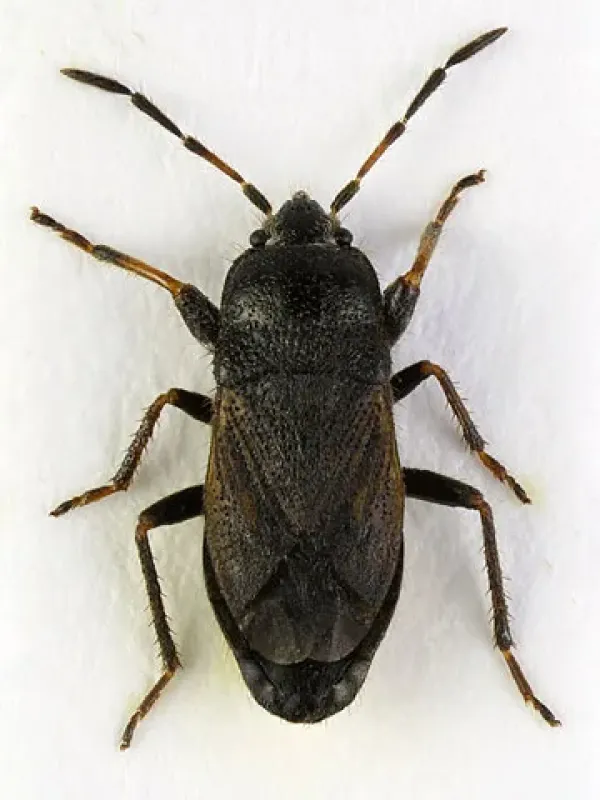
The strawberry bug (Megalonotus chiragra) belongs to the order Hemiptera and the family Rhyparochromidae. These insects are typically 5 to 7 mm long with a dark brown or nearly black coloration.
A distinctive feature of this species is the presence of thickened forefemora with spines, which assist the insect in moving through soil litter and plant debris.
Larvae pass through several developmental stages (instars) before reaching adulthood. They are generally lighter in color, often exhibiting reddish-brown tones on the abdomen.
Adults possess well-developed wings, allowing them to migrate over significant distances in search of suitable food sources or overwintering sites.
Identification is primarily based on the specific shape of the pronotum and the structure of the four-segmented antennae, which are characteristic of this bug family.
What it damages
The primary crops affected by this pest are members of the Rosaceae family, specifically cultivated garden strawberries and wild strawberries.
These bugs feed by extracting sap from seeds and ripening berries, which causes fruit deformation, loss of market value, and occasionally total crop failure.
Beyond cultivated crops, the bug can feed on the seeds of various weed species, allowing it to sustain its population even in the absence of primary berry crops.
The damage caused by the bug is often exacerbated by its potential role in transmitting fungal pathogens into the plant tissue during the feeding process.
Heavy infestations lead to the production of underdeveloped berries with hard, tasteless patches, rendering the produce unsuitable for consumption or sale.
When it appears
Adults overwinter in the soil, under fallen leaves, within dense clumps of weeds, or beneath plant debris located at the edges of fields.
In spring, as soil temperatures rise above 10–12 degrees Celsius, overwintered bugs emerge from their shelters to begin active feeding.
The reproductive period generally coincides with the flowering stage of strawberries, when females lay eggs in the soil or on the lower parts of the plant stems.
The bugs reach their peak activity levels during hot and dry summer conditions, which facilitate the rapid development of larvae to the next stage.
By autumn, as temperatures decline, the bugs migrate back to their hibernation sites, continuing to feed on weed seeds until the arrival of significant frosts.
Signs of infestation
A primary indicator of infestation is the presence of minute puncture marks on strawberries, around which the fruit tissue begins to wither or darken.
Irregular fruit ripening is observed, where parts of the berry remain hard or exhibit premature, discolored patches rather than a uniform red color.
During visual inspections in the early morning or evening, adult bugs can often be found hiding beneath leaves or near the flower stalks of the strawberry plant.
A high density of weeds within the strawberry rows serves as a reliable indicator of an increased risk of harboring a large population of this pest.
In cases of severe damage, the overall yield of the plantation decreases, and berries lose their natural luster and aroma due to disturbed metabolic processes.
Control measures
The first line of defense is the thorough removal of plant debris and fallen leaves, which provide essential shelter for the bugs during winter months.
Regular weeding and removal of vegetation in inter-row spaces eliminate alternative food sources and nesting areas for the pest population.
Implementing crop rotation and maintaining spatial isolation between new strawberry patches and older sites can significantly reduce migration risks.
When infestation levels exceed economic thresholds, contact and systemic insecticides approved for use on berry crops can be employed for management.
- Deep autumn tillage of the soil.
- Use of landscape fabrics to prevent soil access.
- Timely harvesting of ripe berries to avoid feeding on overripe fruit.
Taxonomy
- Latin name
- Megalonotus chiragra
- Order
- Hemiptera (bugs, aphids, leafhoppers)
- Family
- Lygaeidae
- EPPO code
- MGLNCH
Discussion
No discussions yet — be the first.