
13-year periodical cicada
Magicicada tredecim
Description
How to identify
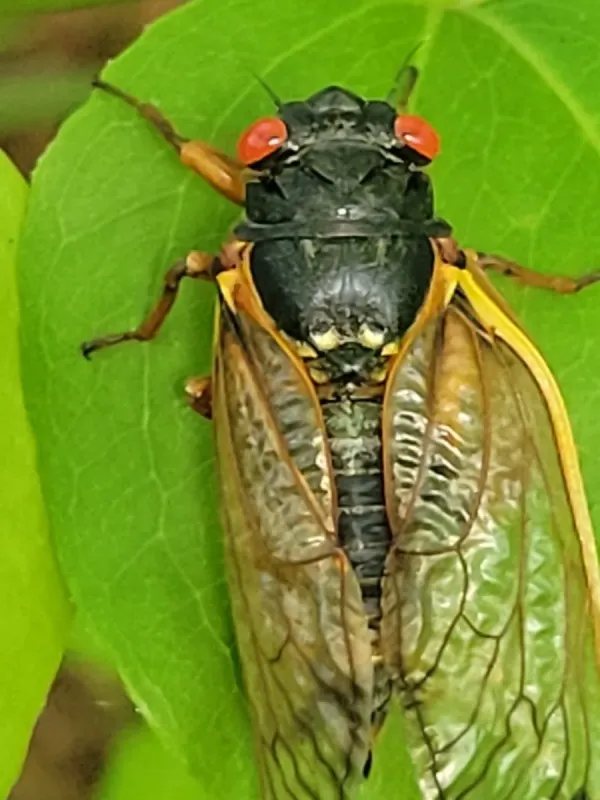
The 13-year periodical cicada (Magicicada tredecim) is a member of the Hemiptera order and the Cicadidae family. Adults are easily recognized by their black bodies, reddish-orange wing veins, and prominent bulging red eyes.
Their most defining characteristic is the long 13-year life cycle. For the vast majority of this time, the insects live underground as nymphs, feeding primarily on the sap from tree roots in a dormant-like state.
Emergence occurs synchronously over large areas, creating massive populations that can overwhelm local ecosystems. They resemble large flies with transparent, veined wings that rest folded over their backs.
Males produce highly characteristic, loud, buzzing songs to attract females. This rhythmic noise is specific to the species and serves as a primary indicator of their presence during the adult stage.
After mating, females utilize a specialized structure called an ovipositor to create incisions in plant stems for egg-laying. This biological necessity is the primary source of their agricultural damage.
What it damages
The periodical cicada primarily targets woody plants, including a wide range of fruit trees. Apples, pears, peaches, and cherries are frequently susceptible to significant injury from these insects.
Beyond orchards, they also infest various deciduous trees such as oaks, maples, and hickories. Damage is mostly concentrated on young branches and twigs representing the current year's growth.
The core damage stems from the oviposition process. By cutting into the wood to deposit eggs, females cause structural weakness, often leading to terminal branch dieback and breakage.
Young trees and nursery stock are at the highest risk, as heavy infestation can stunt their development or lead to complete mortality. Large trees may lose significant foliage but typically survive.
Open wounds left by the ovipositor also serve as entry points for various pathogens. Fungal and bacterial infections often take hold in these areas, causing further long-term damage to the plant tissue.
When it appears
Their life cycle lasts exactly 13 years, during which nymphs progress through five instars while remaining below the soil surface. The emergence window is highly predictable based on environmental cues.
Adults emerge when the soil temperature at a depth of about 20 centimeters (8 inches) consistently reaches approximately 18 degrees Celsius (64 degrees Fahrenheit). This typically occurs in late spring or early summer.
The adult phase above ground is relatively short, lasting only four to six weeks. During this time, the primary objectives are to mate and deposit eggs before the adults die off.
Once the eggs hatch, the first-instar nymphs drop to the ground and burrow into the soil to begin the next long developmental cycle. The interval between these emergence years is devoid of above-ground activity.
Historical data on specific "broods" allow scientists and agronomists to predict emergence years with high accuracy. Farmers can therefore plan horticultural activities around these known cycles.
Signs of infestation
The most immediate sign of an infestation is the deafening, continuous chorus of male cicadas. The intensity and volume of this sound are unique and impossible to miss in a garden setting.
Visual inspection of young branches often reveals characteristic longitudinal slits or scarred bark. These are the direct result of female ovipositor activity during the egg-laying process.
A common symptom known as "flagging" occurs when the tips of branches yellow, wilt, and die after being damaged. These branches often break off, leaving the tree looking ragged.
The presence of large numbers of empty nymphal exoskeletons on tree trunks and the ground is a clear sign that emergence has occurred. These are most commonly seen during the early hours of the day.
Heavy clustering of adults on the branches is another obvious indicator. During peak years, the density of insects can be so high that they blanket the bark, causing visual alarm to orchard owners.
Control measures
The most effective strategy for protecting young or vulnerable trees is the use of fine-mesh netting. The netting must be applied before emergence and secured tightly to the trunk to prevent access.
Chemical control can be difficult given the enormous numbers of insects. While broad-spectrum insecticides might reduce populations, their efficacy is often limited by the sheer volume of emerging adults.
Strategic planting is highly recommended. It is best to avoid planting new orchards in the years immediately preceding an expected 13-year emergence cycle to ensure young trees are not decimated.
Pruning is a useful post-emergence management tool. Removing and destroying damaged branch tips immediately after egg-laying can help reduce the population of nymphs dropping back into the soil.
Maintaining optimal tree vigor is essential for recovery. Well-irrigated and properly fertilized trees possess the resilience required to heal minor wounds and recover their foliage faster after an attack.
Taxonomy
- Latin name
- Magicicada tredecim
- Order
- Hemiptera (bugs, aphids, leafhoppers)
- Family
- Cicadidae
- EPPO code
- TIBCTR
Discussion
No discussions yet — be the first.