
Periodical cicada
Magicicada
Description
How to identify
The periodical cicada (Magicicada) belongs to the order Hemiptera and the family Cicadidae. These insects are famous for their remarkable life cycles, which last either 13 or 17 years, depending on the specific brood.
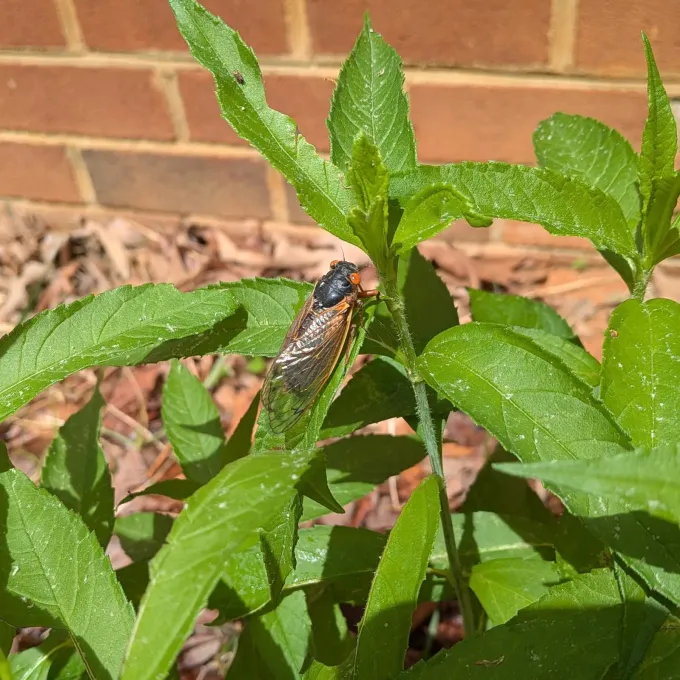
Adult periodical cicadas are easily identified by their black bodies, prominent red eyes, and clear wings with distinct orange veins. They typically measure between 2 and 3 centimeters in length.
The male cicadas are known for their incredibly loud mating songs produced by tymbal organs. During massive emergence events, the collective sound of a brood can be deafening and constant throughout the day.
Most of their life is spent underground, where nymphs live as soil-dwelling insects, feeding on the xylem fluid of tree roots. This subterranean stage is crucial for their long-term development.
Once the nymphs mature, they emerge from the soil in massive, synchronized numbers, undergo their final molt into adulthood, and focus entirely on reproduction before completing their short life span.
What it damages
The damage caused by periodical cicadas is primarily linked to their reproductive behavior rather than feeding. Females possess a sharp ovipositor used to cut slits into young twigs to deposit their eggs.
This species targets a wide variety of deciduous trees, including fruit species like apple, peach, and pear, as well as oaks and maples. Young saplings are particularly susceptible to severe structural damage.
The incisions made by females weaken the stems, often causing the terminal ends of branches to wilt, turn brown, and break off. This condition is frequently referred to by growers as "flagging."
When high densities of cicadas emerge, they can cause significant stress to mature trees and severe deformity or death to younger ones, potentially impacting the fruit harvest for several seasons.
While the root-feeding nymphs can sap some vigor from trees, the physical damage to the canopy caused by egg-laying is the most economically significant concern for orchard managers and gardeners.
Signs of infestation
The most obvious sign of a periodical cicada emergence is the intense, high-pitched buzzing sound emanating from the trees. This activity is most pronounced during warm, sunny days.
Upon closer inspection of twigs, one can identify characteristic longitudinal rows of scarred or roughened bark where females have inserted their eggs. These lines are often 2 to 5 centimeters long.
Another indicator is the presence of numerous empty brown skins (exuviae) left behind on trunks, leaves, and nearby structures, marking the transition of nymphs into the winged adult stage.
The "flagging" of branch tips is a late-stage visual indicator of damage. Seeing clusters of dead, brown leaves hanging from otherwise green canopy sections confirms that egg-laying occurred earlier in the season.
Presence of the insects themselves is unmistakable. During a mass emergence, thousands of cicadas can be seen resting on bark, leaving behind sticky honeydew and evidence of their short, intense life cycle.
Control measures
The most effective strategy for protecting young or vulnerable trees is the use of fine-mesh netting. By covering the entire canopy, gardeners can prevent females from reaching the twigs to lay eggs.
It is strongly advised to avoid planting new trees during the year of a scheduled emergence. Postponing planting until the following year ensures that young trees do not face the initial pressure of the brood.
Chemical control is generally difficult and often ineffective due to the sheer volume of emerging cicadas. Insecticides should be reserved for high-value crops and applied only when necessary under professional guidance.
Pruning damaged branches is a recommended mechanical control. If egg-laying slits are detected, trimming the affected branch tips before the eggs hatch can help reduce the population of nymphs entering the soil.
Maintaining tree health through proper fertilization and irrigation is vital. Healthy, vigorous trees are far more capable of recovering from the mechanical damage and systemic stress caused by a mass cicada event.
Taxonomy
- Latin name
- Magicicada
- Order
- Hemiptera (bugs, aphids, leafhoppers)
- Family
- Cicadidae
- EPPO code
- MAGISP
Discussion
No discussions yet — be the first.