
Alcon Blue
Maculinea rebeli
Description
How to identify
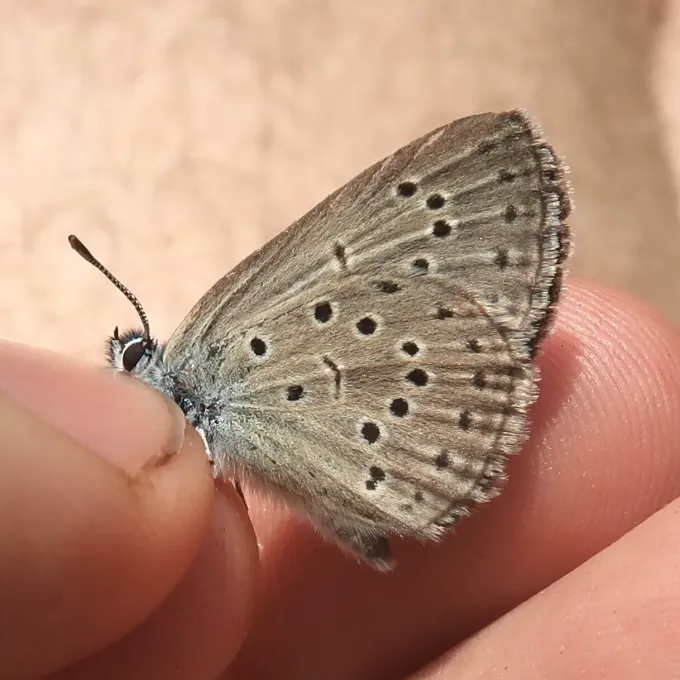
The Alcon Blue (Maculinea rebeli) is a species of butterfly in the Lycaenidae family. Adult butterflies typically have a wingspan of 30 to 40 mm, with males displaying a brilliant blue upper side and females exhibiting a more muted, darker blue or brown appearance.
The species is taxonomically categorized within the order Lepidoptera, family Lycaenidae, and genus Maculinea (sometimes classified as Phengaris).
It is easily identified by its specific association with Gentiana cruciata, the cross gentian, which serves as the primary host plant for its larval stage.
Adult butterflies are typically seen flying in open grasslands where the host plant is present, showcasing a distinctive fluttering movement.
Morphologically, the caterpillars change significantly throughout their development, transitioning from plant-feeders to social parasites within ant colonies.
What it damages
The Alcon Blue is not considered a significant agricultural pest; however, it can impact specialized seed production fields where host gentians are cultivated.
Caterpillars consume the reproductive parts of Gentiana cruciata, specifically the flowers and developing ovaries, which reduces the plant's seed production.
Beyond plant damage, the species acts as a brood parasite of Myrmica ants, which may have secondary ecological impacts on the local ant population.
The caterpillar utilizes chemical mimicry to infiltrate ant nests, releasing pheromones that trick the ants into caring for the intruder as if it were their own larva.
Once inside the nest, the caterpillar shifts its diet to prey on ant larvae, potentially causing localized decline in ant colony health.
When it appears
The adult flight period typically occurs between mid-June and early August, depending on the climatic conditions of the region.
Eggs are laid on the flower buds of the host plant, and the larval stage begins shortly after hatching as they feed on the plant tissues.
By late summer, the caterpillars drop to the ground and secrete pheromones to attract Myrmica ants, which then transport them into their nests.
The winter is passed in the larval stage deep inside the ant colony, where the caterpillar continues to grow by feeding on the brood.
Pupation takes place within the ant nest, and the adult butterfly emerges in early summer to complete the annual biological cycle.
Signs of infestation
Evidence of infestation includes visible holes or withered appearance in the flower buds of Gentiana cruciata during the early summer months.
The presence of larval frass on the stalks of the host plant provides a clear indication that caterpillars are feeding nearby.
Active nests of Myrmica ants located near the base of the gentian plants are a significant indicator of potential habitat suitability for the species.
A noticeable decrease in the number of flowers or seeds on cultivated gentian plots can serve as an indirect sign of larval activity.
Visual observation of adults during the flight season is the most accurate method to confirm the presence and density of the local population.
Control measures
As Maculinea rebeli is a protected and endangered species in many jurisdictions, control measures should be limited to non-destructive actions.
On small plots, hand-picking caterpillars from the host flowers is the most effective and eco-friendly way to manage individual infestations.
The use of broad-spectrum insecticides must be avoided, as these chemicals are highly toxic to the environment and the beneficial ant species involved.
Implementing physical barriers around host plant patches can help discourage ants from moving the caterpillars into nests near sensitive cultivation areas.
Maintaining high biodiversity in the surrounding landscape helps regulate populations naturally, ensuring that both plants and beneficial insects are protected.
Taxonomy
- Latin name
- Maculinea rebeli
- Order
- Lepidoptera (butterflies)
- Family
- Lycaenidae
- EPPO code
- MCLARE
Discussion
No discussions yet — be the first.