
Large blue
Maculinea arion
Description
How to identify
The Large Blue (lat. Phengaris arion, formerly Maculinea arion) is a rare butterfly from the Lycaenidae family. It has a wingspan ranging from 35 to 50 mm. Its wings are bright blue on the upper side with a dark, broad border and distinct black spots.
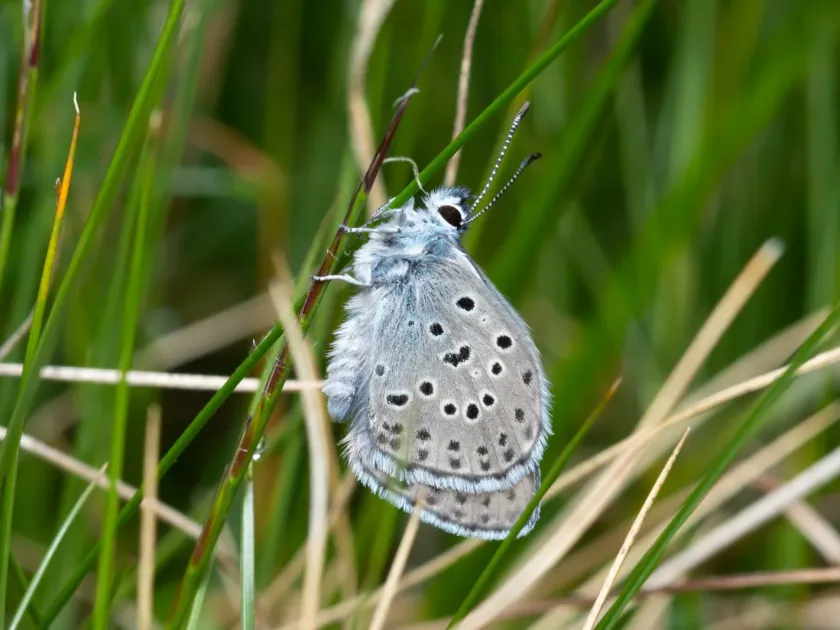
Males and females appear similar, though females are generally larger in size. The underside of the wings is greyish-brown with various black spots surrounded by white, which serves as camouflage within the grassland habitat.
This species is highly specialized, known for its complex parasitic life cycle that involves a mandatory developmental stage within the nests of Myrmica ants.
The larva begins its life feeding on the flowers of wild thyme or marjoram. Later, it adopts a parasitic strategy, mimicking ant larvae to be carried into the ant colony, where it feeds on the ants' brood.
The Large Blue is a protected species in many countries. It is not considered an agricultural pest; rather, it is a flagship species for grassland conservation efforts.
What it damages
The Large Blue butterfly causes no economic damage to agricultural crops. Its larval food plants are limited to specific wild herbs that are not part of commercial cropping systems.
The interaction with agricultural land is minimal and non-destructive. Any incidental presence of the larvae on local herbs has zero impact on yield or the health of field crops.
Because the larvae are obligate parasites of ant colonies, they do not damage the foliage of agricultural crops. Their impact on the ecosystem is restricted to localized predatory behavior towards specific ant populations.
There is no record of this species acting as a pest, and therefore, no loss-assessment models exist for this insect in agronomy.
Large Blues are considered environmental indicators. Their presence suggests a healthy and stable grassland ecosystem, which is often beneficial for overall biodiversity in farming regions.
When it appears
The flight period for the Large Blue butterfly occurs during the summer months, typically between June and July, depending on local weather conditions.
The larvae hatch in mid-summer and start feeding on plant buds before transitioning to their parasitic phase inside an ant colony by late August.
The insect spends the winter in the larval stage, deep underground within the safety of the host ant nest, protected from surface frost and predation.
Pupation takes place inside the ant nest during the following spring, leading to the emergence of adults in early summer.
This lifecycle is perfectly synchronized with the phenology of Myrmica ants, which are essential for the survival of the larvae through the winter and spring periods.
Control measures
No pest control measures are required or recommended for the Large Blue butterfly. Given its protected status, destruction of its habitat or the species itself is strictly prohibited in most jurisdictions.
Agronomists are encouraged to support the conservation of natural grasslands that host this species. Maintaining the correct height of grass and soil moisture is critical for both the host plants and the ant colonies.
Chemical control programs involving broad-spectrum insecticides should be avoided near known butterfly habitats, as these chemicals are lethal to both the butterflies and the essential ant hosts.
Sustainable land management, such as controlled grazing patterns, helps maintain the delicate balance required for the species to survive.
- Maintain patches of natural grassland.
- Avoid over-spraying herbicides on meadow edges.
- Preserve the habitat of native Myrmica ants.
Taxonomy
- Latin name
- Maculinea arion
- Order
- Lepidoptera (butterflies)
- Family
- Lycaenidae
- EPPO code
- MCLAAR
Discussion
No discussions yet — be the first.