
Chalkhill blue
Lysandra coridon
Description
How to identify
The chalkhill blue Lysandra coridon is a butterfly belonging to the Lycaenidae family, widely distributed across various grasslands and open fields.
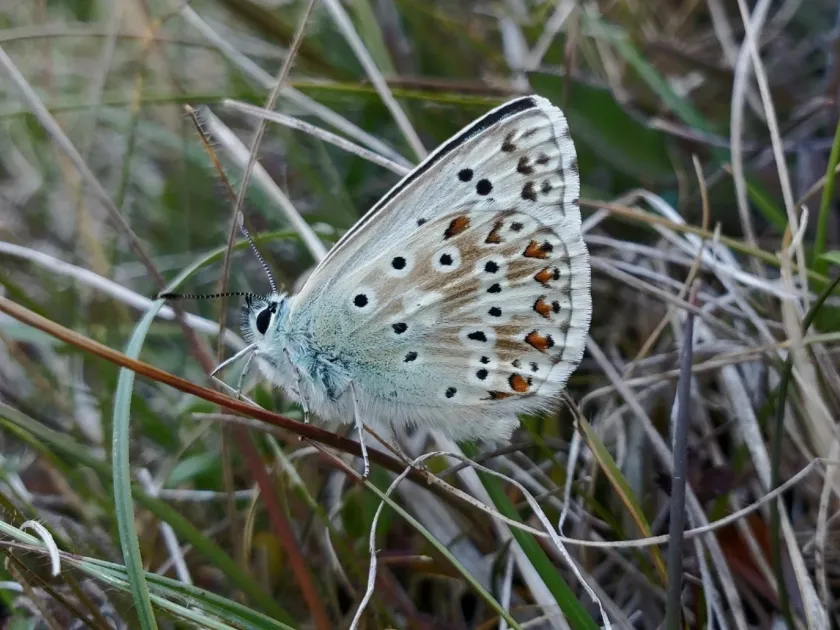
Adult males are distinguished by their bright, silver-blue wing coloration with a distinct dark border, while females are dark brown with faint markings.
The wingspan of the imago typically ranges between 30 and 40 millimeters, with the undersides featuring a complex pattern of black spots and white margins.
Larvae are slug-like in appearance, typically green in color with lighter longitudinal stripes, providing excellent camouflage on host plants.
The life cycle includes a complete metamorphosis, with the species overwintering as an egg laid on the stems or leaves of host plants.
What it damages
The primary hosts for the larvae of this species are leguminous plants, particularly various types of clover and related forage crops.
Damage is caused by larvae feeding on the foliage, which can reduce the total leaf area and photosynthetic capacity of the affected plants.
In cases of high population density, the feeding activity can lead to noticeable defoliation and weakened plant health in legume-heavy fields.
While often considered a minor pest, persistent feeding can decrease the overall biomass production of forage crops, impacting livestock feed availability.
The wounds created by feeding larvae may also facilitate the entry of secondary pathogens, such as fungal infections, into the plant tissue.
When it appears
The adult flight period of the chalkhill blue usually occurs in late summer, specifically from July through early September, depending on local weather.
Females lay eggs individually on host plants, where they remain in diapause throughout the winter until conditions become favorable in the spring.
Larvae emerge in the spring, typically around April or May, and begin feeding on the young, tender growth of legume crops.
Pupation takes place mid-summer, either in the soil litter or among dense vegetation, with the adult butterfly emerging after a few weeks.
The species is univoltine, meaning it produces only one generation per year, limiting the duration of the impact on agricultural crops.
Signs of infestation
Signs of an infestation include irregularly shaped notches or holes eaten into the leaves of host plants, which are characteristic of lepidopteran larvae.
One can identify the presence of larvae by carefully inspecting the underside of leaves and stems, especially during the early stages of the growing season.
The active flight of adult butterflies over legume fields in late summer is a clear indicator that egg-laying is occurring for the next season.
Small dark droppings found on the leaf surfaces are a reliable indicator of active larval feeding and their recent presence on the plants.
General wilting or sparse appearance of legume patches can indicate significant larval pressure when combined with obvious leaf tissue consumption.
Control measures
Effective management includes regular monitoring of crop fields to determine the extent of the infestation before reaching economic thresholds.
Maintaining clean field borders by controlling wild legumes and weeds can significantly reduce the habitat available for the butterfly's reproduction.
Biocontrol methods, such as the application of Bacillus thuringiensis-based products, offer an effective and eco-friendly way to target larvae.
When chemical intervention is necessary, insecticides targeting lepidopteran pests should be applied at the correct growth stage to minimize impact.
Promoting natural biodiversity, including beneficial insects that prey on larvae, helps maintain the chalkhill blue population at non-damaging levels.
Taxonomy
- Latin name
- Lysandra coridon
- Order
- Lepidoptera (butterflies)
- Family
- Lycaenidae
- EPPO code
- LYSNCO
Discussion
No discussions yet — be the first.