
Adonis Blue
Lysandra bellargus
Description
How to identify
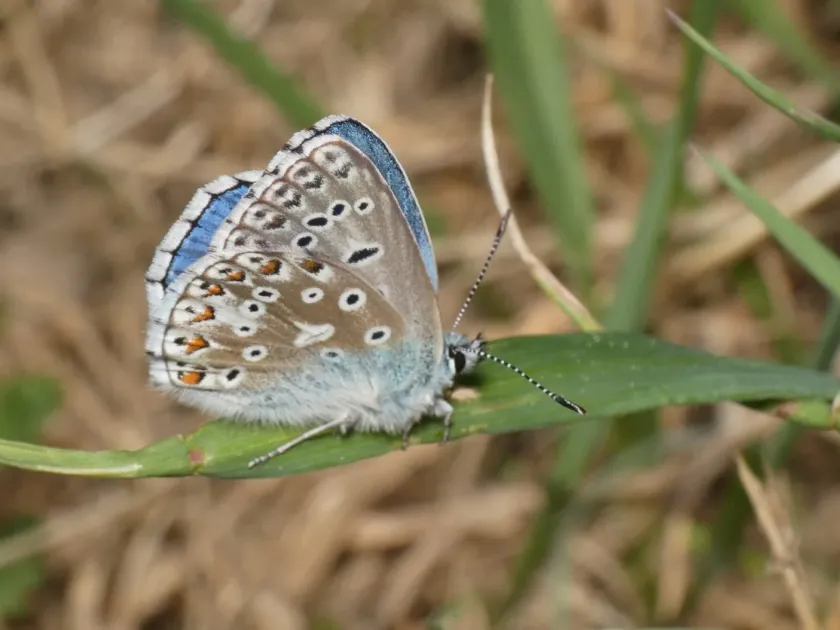
The Adonis Blue (Lysandra bellargus) is a butterfly species within the Lycaenidae family. Males are easily recognized by their vibrant, iridescent blue wings with narrow black borders and white fringes.
The larvae are specialized, woodlouse-shaped caterpillars with a bright green body marked by yellow dorsal and lateral lines. Their physical structure and coloration provide excellent camouflage on their host plants.
A fascinating aspect of this species' biology is its symbiotic relationship with ants. The caterpillars possess specialized glands that secrete sugary solutions, which attract ants, providing the larvae with protection against predators.
The species typically undergoes two generations per year, depending on the climatic conditions. The life cycle consists of egg, larva, pupa, and adult, with the pupal stage often occurring near the host plant at the soil surface.
While often found in chalk grassland habitats, the Adonis Blue can potentially impact legumes in agricultural settings, especially where native vegetation borders cultivated fields.
What it damages
The larvae feed primarily on members of the Fabaceae (legume) family, including common vetches and various types of clover. Their feeding activity can be detrimental to both forage and grain legumes.
In high densities, the caterpillars consume significant amounts of foliage, which leads to reduced photosynthetic capacity of the plants. This stress can stunt overall growth and reduce the plant's ability to store energy.
Feeding often targets the tender leaves and younger shoots of the plants. The resulting damage ranges from small perforations to complete leaf skeletonization, depending on the larval stage and density.
Crop health is compromised when multiple larvae congregate on a single plant, leading to accelerated loss of leaf area and potentially interfering with flower development and pod set in legumes.
The damage is particularly noticeable during warm, dry spring and summer months when the larval development rates are highest and the insects are most active across agricultural landscapes.
Signs of infestation
Early warning signs of infestation include visible holes and irregular edges on legume leaves. As the larvae grow, the amount of missing leaf tissue increases significantly.
The presence of fine, dark granular frass (excrement) on the leaves or the soil surface surrounding the host plant is a reliable indicator of active caterpillar feeding.
Close inspection of the underside of the foliage is necessary to locate the well-camouflaged larvae, which are most active during the daylight hours when feeding on the host plant tissue.
High ant activity around legume plants can also serve as a biological indicator, as ants are frequently attracted to the secretions produced by the larvae during their feeding sessions.
Stunted plant growth and localized yellowing of leaves in patches across the field can be symptomatic of heavy feeding pressure, especially during the peak larval development periods.
Control measures
Cultural control through the management of field margins is highly effective. Regular mowing of surrounding wild vegetation reduces the available habitat for larvae and limits their migration into crops.
Integrating diverse crop rotations that include non-leguminous plants helps disrupt the life cycle of the pest, making it harder for the population to establish in a specific area year-over-year.
Biological control using microbial insecticides based on Bacillus thuringiensis is an excellent option for managing populations while preserving the surrounding ecosystem and beneficial insects.
Chemical intervention should be reserved as a last resort. If the economic threshold of damage is reached, selective, low-persistence insecticides can be applied to target the larvae during their most active feeding phase.
Continuous monitoring programs and scouting are essential for the early detection of larvae. Proactive identification prevents population outbreaks and reduces the need for large-scale insecticide applications.
Taxonomy
- Latin name
- Lysandra bellargus
- Order
- Lepidoptera (butterflies)
- Family
- Lycaenidae
- EPPO code
- LYSNBE
Discussion
No discussions yet — be the first.