
Small milkweed bug
Lygaeus kalmii
Description
How to identify
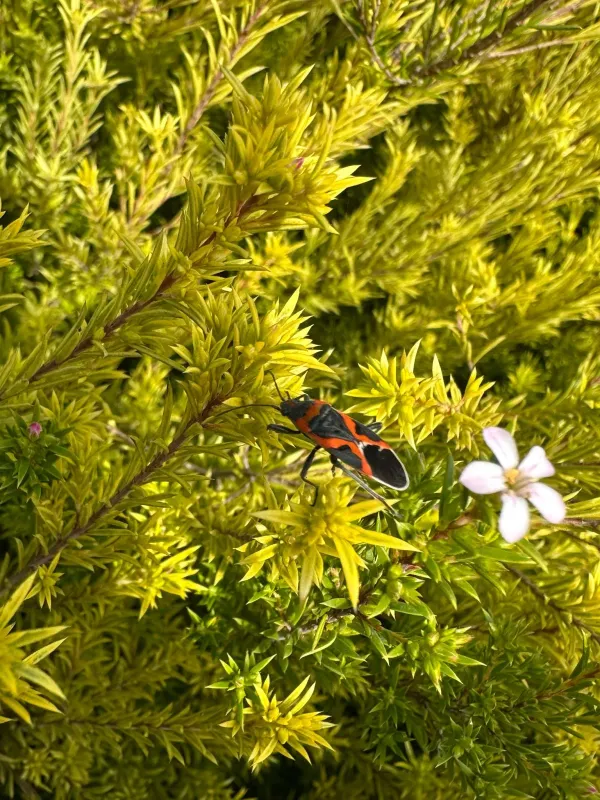
The Small milkweed bug (Lygaeus kalmii) belongs to the family Lygaeidae in the order Hemiptera. Adults are easily recognized by their striking black and red coloration, featuring a distinct heart-shaped or X-shaped pattern on their backs.
Adult insects reach a length of 10 to 12 millimeters. The head, pronotum, and legs are covered with dense dark hairs, which serves as a key diagnostic feature for this species.
They possess well-developed wings, allowing for high mobility when searching for food sources. Their vivid coloration serves as a warning signal to predators, indicating their chemical defense mechanisms.
Nymphs resemble the adults but are smaller in size and lack the fully developed wing pattern. Through several instars, they gradually develop their characteristic red and black markings.
In the field, it is often confused with other Lygaeus species, but the Small milkweed bug has specific morphological traits in its abdominal segments that differentiate it.
What it damages
The primary food source for this bug is the seeds of plants in the Apocynaceae family, particularly various species of milkweed (Asclepias).
In agricultural settings, the pest may switch to other crops if its primary food source is scarce. They pierce the seed coat and extract nutrients, which results in reduced germination rates.
While this bug rarely causes significant damage to staple cereal crops, it can impact ornamental plantings and technical crop seed production.
Damage to seeds leads to shriveling and discoloration, rendering the seed material unsuitable for planting purposes.
Mass infestations on flower stalks can weaken the plant's overall development, leading to premature shedding of buds and blossoms.
When it appears
The active life cycle begins in the spring when soil temperatures reach optimal levels for adults to emerge from their overwintering sites.
Peak population levels typically occur in mid-summer, coinciding with the active maturation phase of host plant seeds.
During the autumn, insects actively migrate in search of protected areas for hibernation, preferring plant debris, leaf litter, and loose soil.
The development cycle includes a full generation change within one warm season, with potential for two generations in southern regions.
Environmental conditions, such as prolonged heavy rainfall or sharp temperature drops, can significantly hinder reproduction rates and total population density.
Signs of infestation
The first indicator of the pest's presence is the visual detection of adult bugs on flower heads or seed pods of host plants.
The presence of hollowed-out seed shells with characteristic puncture marks serves as evidence of an active feeding phase.
Accumulation of excrement on the surface of leaves and stems in areas where bugs congregate indicates a high level of infestation.
Wilting of individual flower stalks or deformation of developing fruits can also serve as indirect signs of heavy bug infestation.
Plant tissues often show yellowing or browning at feeding sites due to the introduction of salivary enzymes during the piercing process.
Control measures
Agrotechnical methods include the regular removal of milkweed weeds, which act as primary reservoirs for these bugs.
Autumn soil cultivation and the clearing of plant debris significantly reduce the chances of the pest successfully overwintering.
The application of broad-spectrum insecticides is justified only when the pest population reaches the economic injury level in commercial crops.
The use of biological control agents, such as fungal-based products, can be an effective way to manage populations in smaller home garden settings.
- Monitoring population density with adhesive traps.
- Manual collection of insects in small-scale garden plots.
- Implementing crop rotation to disrupt the insect's life cycle.
Taxonomy
- Latin name
- Lygaeus kalmii
- Order
- Hemiptera (bugs, aphids, leafhoppers)
- Family
- Lygaeidae
- EPPO code
- LYGAKA
Discussion
No discussions yet — be the first.