
Olive lanternfly
Lycorma olivacea
Description
How to identify
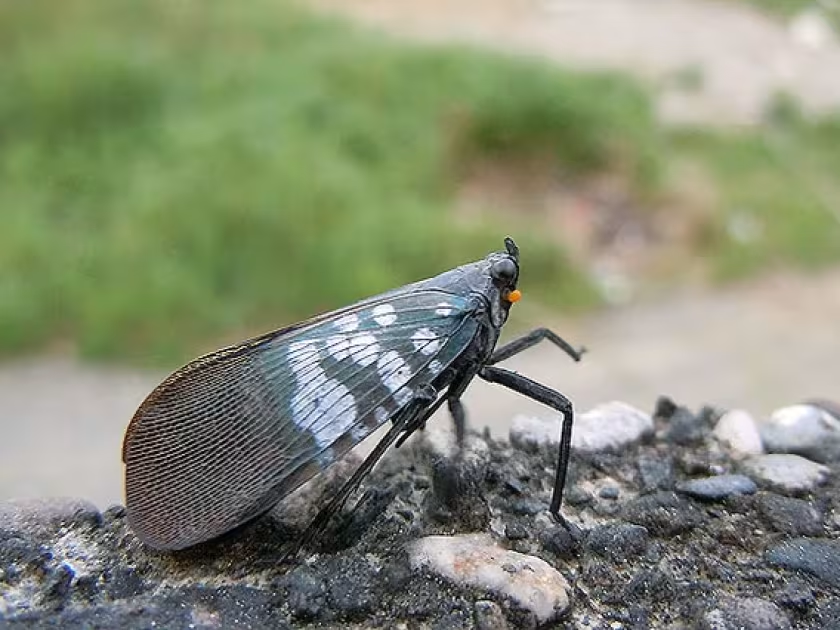
The olive lanternfly (Lycorma olivacea) belongs to the order Hemiptera and the family Fulgoridae. These insects are characterized by their distinct appearance, with adults featuring large forewings that have an olive-brown hue and a specific vein pattern.
The adult body reaches significant sizes, making them easily detectable during their mass flight period. Larval stages undergo several instars, gradually developing the coloration typical of mature individuals.
This species is closely associated with specific host trees where it completes its entire life cycle. Identification can be challenging due to the cryptic nature of young nymphs living within dense foliage.
Morphologically, this species is similar to other members of the Lycorma genus but differs in its specific wing pigmentation. For precise field diagnosis, agronomists utilize entomological nets and visual inspections of tree bark.
Sexually mature females deposit eggs, covering them with a protective secretion that hardens over time, ensuring the survival of the egg masses throughout the winter season.
What it damages
The olive lanternfly is a polyphagous pest capable of damaging a wide range of cultivated plants, including fruit trees and grapevines. Significant losses are recorded in stone and pome fruit orchards.
The pest feeds primarily on plant sap by piercing the epidermis of young shoots and leaves with its proboscis. As a result of intensive nutrient extraction, the plant begins to weaken.
Beyond direct mechanical damage, the insect triggers the development of secondary diseases, as the puncture wounds serve as entry points for pathogenic fungi and bacteria.
The pest's excrement, known as "honeydew," poses a significant threat. Sooty mold grows actively on this sticky substance, covering the leaf surface and severely inhibiting the photosynthetic process.
Heavy infestation of plantations by lanternflies leads to reduced yields, decreased fruit quality, and overall stunted growth of perennial crops.
When it appears
The life cycle of the olive lanternfly is closely linked to the phenological stages of its host plants. They overwinter as eggs laid on tree trunks or other smooth surfaces.
Nymphs emerge from eggs in the spring, typically during bud break, which coincides with the onset of active sap flow. The nymphs begin feeding intensively and grow rapidly in size.
Adult flight occurs during the summer months, marking the peak of their population density. During this period, the pests actively migrate between plants in search of the most suitable food sources.
By autumn, adults begin mating. Females deposit eggs that remain throughout the winter, ensuring population survival despite harsh climatic conditions.
It is crucial for agronomists to monitor the appearance of the first nymphs, as control measures are most effective and require fewer pesticides during this early developmental stage.
Signs of infestation
The first sign of infestation is the presence of a sticky honeydew residue on the undersides of leaves and branches. Over time, this residue turns black due to the growth of sooty mold fungi.
When inspecting tree trunks, one may find characteristic egg masses covered with a brownish, wax-like secretion. These are often located in protected areas of the bark.
Visually apparent signs include leaf chlorosis and premature defoliation caused by plant exhaustion. Shoots may exhibit twisting or slowed growth patterns.
Insect presence is often accompanied by swarms of ants that feed on the honeydew secreted by the lanternflies. A high concentration of ants on a tree is a strong indicator that the canopy requires inspection.
During the evening or early morning, adult insects can be observed on trunks; they typically respond to perceived threats by jumping suddenly.
Control measures
Protection strategies include agronomic practices such as timely pruning and the removal of heavily infested branches. Maintaining overall orchard health is a primary preventative measure.
Mechanical control involves scrubbing egg masses from tree trunks and destroying them. This significantly reduces the potential pest population for the following season.
Chemical control relies on the application of systemic insecticides during the period of mass nymph emergence. The chosen preparations must provide effective contact and systemic action.
The use of biological control agents, such as entomopathogenic fungi, helps suppress population growth without causing severe disruption to the orchard ecosystem.
- Monitoring population density using sticky traps.
- Adherence to quarantine protocols when transporting nursery stock.
- Insecticide application during early nymphal development stages.
- Sanitary clearing of orchards to remove plant debris.
Taxonomy
- Latin name
- Lycorma olivacea
- Order
- Hemiptera (bugs, aphids, leafhoppers)
- Family
- Fulgoridae
- EPPO code
- LYCMOL
Discussion
No discussions yet — be the first.