
Small copper
Lycaena phlaeas
Description
How to identify
The Small Copper (Lycaena phlaeas) is a small butterfly belonging to the Lycaenidae family. It is widely distributed across temperate regions and is easily recognized by its distinctive appearance.
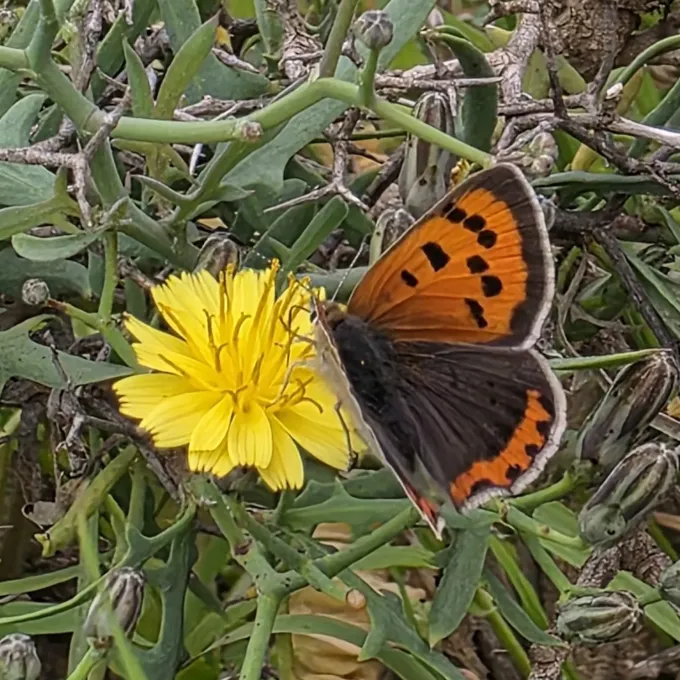
The upper side of the forewings is a vibrant copper-red color with black spots and a dark border. The hindwings are dark brown, often featuring a reddish-orange band along the outer edge.
The larvae are small, slug-shaped, and usually green, sometimes with a red stripe along the back. They are well-camouflaged, blending perfectly with the leaves of their host plants.
The pupae are typically brownish and are found near the base of the food plants, often hidden in soil crevices or leaf litter. The insect undergoes complete metamorphosis.
This species prefers open habitats such as meadows, road verges, and agricultural borders. While not a primary pest, it can be present in gardens where host plants grow.
What it damages
The primary host plants for the larvae are members of the Polygonaceae family, most notably species of dock (Rumex) and knotweed (Polygonum).
Damage occurs when larvae feed on the foliage, chewing irregular holes in the leaves. This can affect the aesthetic and commercial value of leafy greens, particularly garden sorrel.
While the Small Copper is rarely a major agricultural pest, severe infestations on small garden plots can result in reduced leaf production and stunted growth of young plants.
Feeding damage creates entry points for secondary pathogens, such as fungal or bacterial infections, which may further compromise the health of the host plants.
Because the population densities of this species are generally low, the economic impact on large-scale commercial farming is usually considered negligible.
When it appears
The flight period of adult butterflies spans from April through September. Depending on the local climate, the species typically produces two to three generations per year.
Eggs are laid singly on the underside of host plant leaves. Development is highly dependent on temperature, with the larval stage lasting several weeks during the summer.
The most active feeding period for the larvae is during the warm summer months. This is when growers are most likely to notice the presence of the pest on their crops.
Pupation takes place in sheltered areas at the base of the plant or in the soil. The insect typically overwinters in the larval or pupal stage.
Increased temperature leads to faster development cycles, potentially resulting in higher population numbers by late summer if conditions remain favorable.
Signs of infestation
The most obvious sign of an infestation is the presence of irregular "windowing" or holes in the leaves of dock or sorrel plants, caused by larval feeding.
A closer inspection of the undersides of leaves often reveals the small, green larvae. Due to their excellent camouflage, they can be difficult to spot without careful searching.
Frass, which appears as small dark granules on the leaf surface or soil, is a clear indicator that larvae have been actively feeding in the vicinity.
Stunted plant growth or wilting in specific areas of the crop, coinciding with visible foliage damage, suggests that larval populations may be high enough to cause concern.
Frequent sightings of adult butterflies around the vegetable garden during sunny days are a preliminary indicator that eggs may have been laid on suitable host plants.
Control measures
Good agricultural practices are the most effective control measure. Regularly weeding out wild dock and knotweed reduces the available breeding habitat for the butterfly.
Manual removal of larvae and egg clusters from the underside of leaves is highly effective for small-scale garden plots where the use of chemicals is discouraged.
Deep cultivation of the soil between rows after the growing season can help destroy pupating insects, reducing the number of adults that emerge in the following spring.
Chemical control is rarely necessary for the Small Copper. If required, biological products containing Bacillus thuringiensis are generally sufficient and environmentally friendly.
Promoting a healthy garden ecosystem by encouraging natural predators such as birds and parasitic wasps helps maintain the pest population at a naturally low, manageable level.
Taxonomy
- Latin name
- Lycaena phlaeas
- Order
- Lepidoptera (butterflies)
- Family
- Lycaenidae
- EPPO code
- LYCZPH
Discussion
No discussions yet — be the first.