
Idas Blue
Lycaeides idas
Description
How to identify
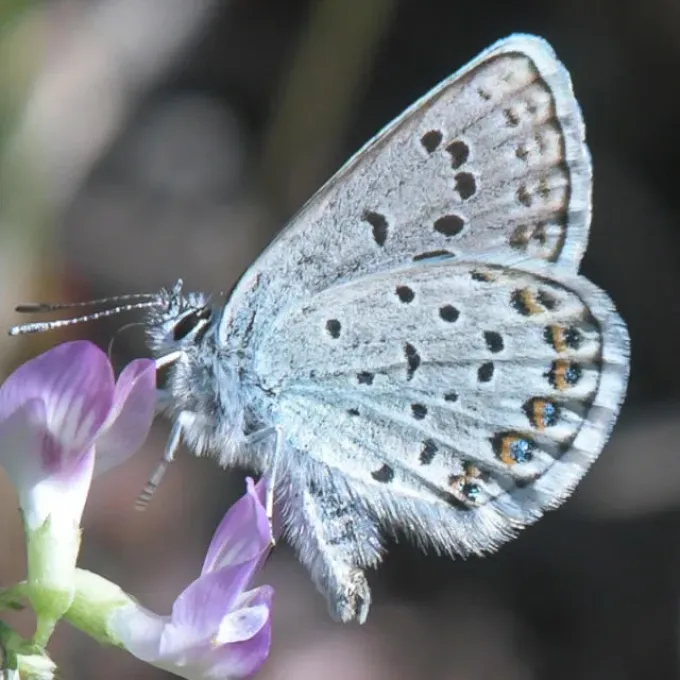
The Idas Blue (Lycaeides idas) belongs to the Lycaenidae family within the order Lepidoptera. Adult butterflies are small, typically having a wingspan of 25–30 mm.
Male wings display a vibrant blue coloration with dark borders, while females are more muted, exhibiting brownish tones with blue dusting near the wing bases.
The larvae, or caterpillars, have a distinct flat, woodlouse-like shape covered in fine hairs, providing excellent camouflage against the foliage of their host plants.
A notable biological trait is their mutualistic relationship with ants, which protect the caterpillars in exchange for honeydew secretions, enhancing their survival rates.
This species is widely distributed in temperate zones and favors open habitats, including field edges, meadows, and areas adjacent to agricultural lands.
What it damages
The primary damage is caused by caterpillars feeding on the vegetative parts of various plants within the Fabaceae family, affecting both wild and cultivated species.
In agricultural settings, crops such as alfalfa, clover, peas, and other fodder legumes can be targeted, leading to reduced overall biomass and forage quality.
Larvae consume leaf tissue, often causing window-paning or skeletonizing leaves, which limits the plant's photosynthetic capacity and weakens its vigor.
In high population densities, the caterpillars may also feed on developing buds and flowers, directly impacting seed set and reducing potential yields for farmers.
Infected plants may suffer from stunted growth and become increasingly susceptible to secondary pathogens that enter through feeding wounds in the plant tissue.
When it appears
The life cycle typically spans one or two generations per year, with timing heavily dependent on local climatic conditions and the duration of the growing season.
The species overwinters primarily in the egg stage, with eggs laid by females in the autumn on host plant stems or soil near the roots.
Larval emergence occurs in the spring when temperatures consistently rise, aligning with the active growth phase of perennial legumes in the field.
Adult flight occurs throughout the summer months, during which mating takes place to initiate the next generation or prepare for the overwintering period.
Peak feeding activity for larvae often occurs during June and July, making this the critical monitoring window for producers managing legume-based crops.
Signs of infestation
Visual identification of an infestation involves inspecting foliage for characteristic feeding patterns, such as irregular holes or consumed leaf edges.
Caterpillars can often be found by searching near the leaf midribs or among the stipules where they tend to remain hidden during daylight hours.
The presence of ants actively patrolling the stems of legume plants is a strong indicator that caterpillars, which ants protect, are present on the host plant.
Frass, or small dark pellets of caterpillar excrement found on leaves or at the plant base, serves as a confirmation of recent feeding activity.
- Windowed or skeletonized leaves.
- Consumed flower buds and young pods.
- Ant activity on stems and leaves.
- Dark granular frass on foliage.
- Visible caterpillars matching plant color.
Control measures
Implementing crop rotation is a fundamental agronomic practice that disrupts the life cycle of the Idas Blue and prevents population build-up over time.
Maintaining weed-free field margins and nearby ditches reduces the availability of host plants for the butterflies, lowering the pressure on main crops.
Biological control agents, such as Bacillus thuringiensis, offer an effective and environmentally friendly solution for managing young larval populations.
If economic injury thresholds are exceeded, targeted applications of approved insecticides may be necessary to mitigate damage during the peak feeding period.
Regular field scouting throughout the growing season, particularly during butterfly flight periods, is essential for early detection and timely intervention.
Taxonomy
- Latin name
- Lycaeides idas
- Order
- Lepidoptera (butterflies)
- Family
- Lycaenidae
- EPPO code
- LYCAID
Discussion
No discussions yet — be the first.