
Reverdine's Blue
Lycaeides argyrognomon
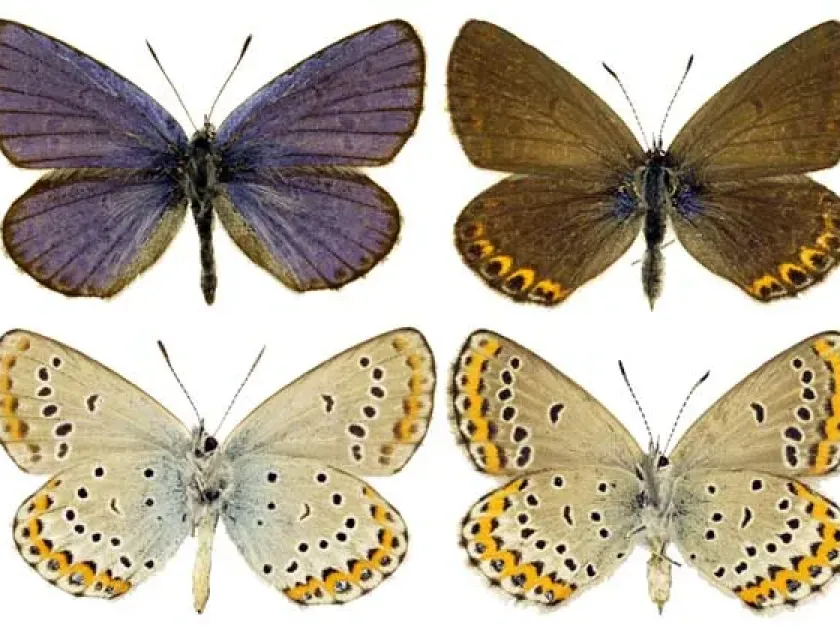
Description
How to identify
Reverdine's Blue (Lycaeides argyrognomon) is a butterfly species belonging to the Lycaenidae family. In agricultural contexts, it is identified as a potential pest of leguminous crops.
Adult butterflies have a wingspan of approximately 25–30 mm. Males exhibit vibrant blue or violet upper wing surfaces with dark borders, while females appear duller, usually brown or grey-brown.
The larvae, or caterpillars, are small and have a typical "slug-like" appearance. They are predominantly green, matching the foliage of their host plants, and are sparsely covered with fine hairs.
Pupae are usually found attached to the stems or the undersides of leaves. Their smooth, green-to-brown appearance serves as effective camouflage against environmental predators.
This species is widely distributed in meadow and steppe ecosystems, thriving in habitats where wild or cultivated legumes are abundant.
What it damages
The primary hosts of Reverdine's Blue are various legumes, including alfalfa (lucerne), clover, vetch, and other related forage crops that serve as vital agricultural resources.
Damage is caused by the larval stage. Caterpillars feed on the leaf tissue, creating irregular holes or skeletonizing the leaves by consuming all tissue except the major veins.
In cases of high population density, these larvae can significantly reduce the biomass of forage crops, leading to decreased yields for hay or green fodder production.
Besides leaf damage, caterpillars may occasionally feed on flower buds or developing seeds, which negatively impacts seed production in specialized nurseries.
Weakened plants are more susceptible to secondary stressors, including drought and pathogenic infections, potentially leading to stand thinning over several seasons.
When it appears
The lifecycle of Reverdine's Blue typically consists of two generations per year. The first generation of adults usually emerges in late spring, around May or June.
Females deposit eggs singly or in small groups on the host plant foliage. The development from egg to larva is highly temperature-dependent, usually taking about two weeks.
The second generation of adults is active during July and August. Larvae from this generation are responsible for the most significant damage as they feed and prepare for overwintering.
The species overwinters in the egg or early larval stage, often sheltered in the base of the plants or within surface debris to survive colder temperatures.
Warm summers with adequate moisture promote the successful development and population growth of this butterfly, increasing the risk to leguminous plantations.
Signs of infestation
The most visible signs of infestation are ragged leaf edges and holes in the foliage. As the caterpillars grow, the "skeletonizing" effect becomes more apparent.
Close inspection of the underside of leaves or the lower stem areas, especially during the early morning hours, often reveals the camouflaged caterpillars.
The presence of adult butterflies fluttering low over the field in sunny weather serves as a primary warning to initiate field scouting and monitoring.
Infested areas of the field may display uneven growth or discoloration, reflecting the physiological stress caused by significant leaf mass loss.
The presence of ants associated with the caterpillars can be a tell-tale sign, as they often gather to consume the sugar-rich honeydew secreted by the larvae.
Control measures
Effective crop management starts with proper crop rotation and the removal of adjacent weedy areas that serve as natural reservoirs for the pest population.
Deep plowing or mechanical cultivation post-harvest is a highly effective method to destroy overwintering eggs and larvae, disrupting the lifecycle of the pest.
Biological control agents, such as Bacillus thuringiensis-based insecticides, can be applied to manage caterpillar populations while minimizing impact on beneficial insects.
Chemical intervention should be reserved for instances where the economic injury level is exceeded, focusing on selective insecticides to preserve natural enemies.
- Regular monitoring of larval density during the growing season.
- Destruction of host plant residues along field margins.
- Timing applications with the early larval instars for maximum efficacy.
Taxonomy
- Latin name
- Lycaeides argyrognomon
- Order
- Lepidoptera (butterflies)
- Family
- Lycaenidae
- EPPO code
- LYCAAR
Discussion
No discussions yet — be the first.