
Italian firefly
Luciola italica
Description
How to identify
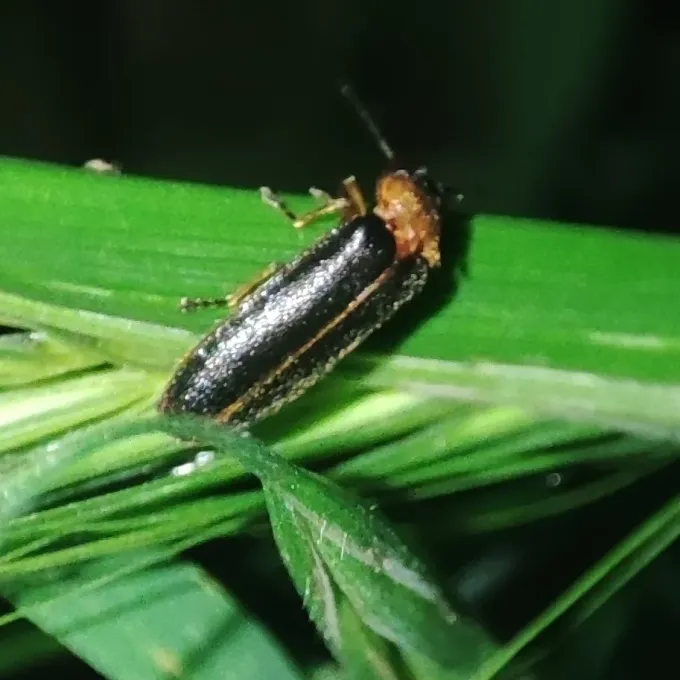
The Italian firefly (Luciola italica) is a beetle belonging to the Lampyridae family, within the order Coleoptera. This species is world-renowned for its bioluminescent signaling.
Adults possess an elongated, dark-colored body, typically measuring about 10 millimeters in length. They are characterized by a light-emitting organ located on the ventral side of their abdomen.
Larvae are terrestrial, showing a flattened, segmented body adapted for crawling beneath organic debris, stones, and within moist soil layers.
The life cycle encompasses a complete metamorphosis, including egg, larva, pupa, and adult stages, which are strictly regulated by environmental seasonal cues.
Identifying this species is straightforward during the night due to the distinct yellowish-green light pulses emitted by males during their mating flights.
What it damages
The Italian firefly is not an agricultural pest; it does not consume crops, seeds, or roots. In fact, it is considered a beneficial insect within the garden ecosystem.
The larvae are specialized predators that feed primarily on terrestrial mollusks, such as slugs and snails, which are notorious for destroying seedlings.
By preying on these gastropods, Luciola italica acts as a natural biological control agent, assisting farmers in managing slug populations without chemicals.
Adult beetles do not cause mechanical damage to plant tissues, as their nutritional requirements are minimal, often relying on nectar or not feeding at all during the mating phase.
Therefore, farmers should avoid conflating this insect with plant-damaging beetles, as its presence is an indicator of a balanced and healthy agro-environment.
When it appears
The flight season of adult fireflies is concentrated in early to mid-summer, specifically peaking during the warm nights of June and July.
Larvae are active during the warmer months, beginning their cycle in spring as soil temperatures rise, providing favorable conditions for their development.
Throughout the day, larvae remain hidden in moist microhabitats to avoid desiccation and predators, emerging primarily at night to forage.
Overwintering occurs in the larval stage, where they retreat deeper into the soil or under dense vegetation cover to survive the colder winter months.
The emergence of adults is highly sensitive to humidity levels, making them excellent indicators of local moisture and soil health within the cultivated field.
Signs of infestation
The primary sign of their presence is the bioluminescent flickering occurring in fields or gardens during late evening hours, which is purely for mating communication.
The absence of typical herbivorous feeding patterns, such as skeletonized leaves or bored stems, confirms that the species is not damaging the crops.
Observation of small, slug-like predatory larvae under rocks or mulch is a clear sign of their activity as biological pest controllers.
There are no specific "signs of infestation" because this species does not reach the high population densities typical of agricultural pests.
If gardeners observe a decline in the slug population without applying molluscicides, it may be partially attributed to the presence of these predatory firefly larvae.
Control measures
No chemical or physical control measures are necessary for the Italian firefly, as it is a beneficial organism that supports sustainable agriculture.
The application of broad-spectrum insecticides is highly discouraged, as these chemicals can wipe out firefly populations and disrupt natural pest management services.
To conserve fireflies, it is recommended to maintain "wild" corners with leaf litter and stones, which serve as essential nesting and overwintering habitats.
Minimizing night-time light pollution is also crucial, as artificial lighting disrupts the mating signals of adult fireflies, potentially leading to local population declines.
- Avoid the use of toxic pesticides in larval habitats.
- Maintain soil moisture and organic mulch layers.
- Implement dark-sky practices to protect mating behaviors.
Taxonomy
- Latin name
- Luciola italica
- Order
- Coleoptera (beetles)
- Family
- Lampyridae
- EPPO code
- LUCLIT
Discussion
No discussions yet — be the first.