
Rice water weevil
Lissorhoptrus oryzophilus
Description
How to identify
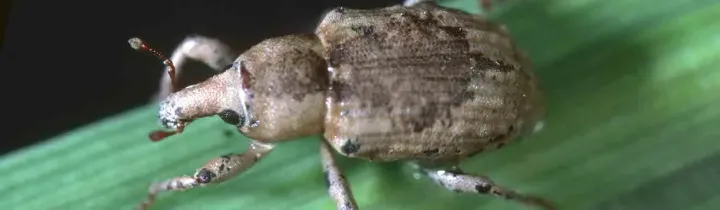
The Rice water weevil (Lissorhoptrus oryzophilus) is a significant beetle pest belonging to the Curculionidae family. Adult beetles are small, approximately 3 mm long, with grayish-brown scales that provide excellent camouflage against the soil and plant debris.
The larval stage is uniquely adapted to an aquatic environment. Larvae are slender, white, and legless, possessing specialized hooks on their dorsal side that allow them to pierce rice roots and extract oxygen from the plant tissue.
The life cycle is complex, involving four developmental stages: egg, larva, pupa, and adult. The insect typically undergoes one or two generations per year, depending on the climatic conditions and the duration of the irrigation season in rice fields.
Adults overwinter in protected areas such as grass bunches or forest litter. During spring, they migrate to flooded rice fields, often arriving just as the crop is being established, which triggers the onset of infestation.
Their ability to fly enables rapid dispersal across different plots, making local infestations a concern for entire agricultural zones if left unmonitored during the early growth stages.
What it damages
The Rice water weevil inflicts damage through two distinct phases of its life cycle. Adult beetles feed on the leaves, leaving characteristic longitudinal scars, which typically do not kill the plant but reduce photosynthetic efficiency.
Larval feeding is far more destructive as they consume the roots of the rice plant. This severe root damage leads to nutrient and water uptake failure, causing the plants to become stunted and yellowed.
Stunted plants often show reduced tillering and, in severe cases, the entire stand may lodge or fail to mature properly, resulting in a significant decrease in the final yield per hectare.
Younger plants are particularly vulnerable. Heavy larval pressure can lead to plant death and thin stands, forcing farmers to consider replanting or expensive emergency interventions.
Furthermore, the physical injury to roots caused by the larvae makes the plants more susceptible to pathogens and waterborne diseases that can further compromise the health of the crop.
Signs of infestation
The most visible sign of an adult weevil presence is the appearance of narrow, white longitudinal streaks on the leaves. These "scars" are caused by the adults scraping the leaf surface.
Yellowing, stunted growth, and a generally sickly appearance of the rice plants are the primary indicators of larval root damage. Such symptoms are often clustered in specific areas of the field where the population density is high.
If you suspect an infestation, try pulling up a plant; if the root system is severely compromised or the roots are missing, it is a strong indicator of heavy larval activity.
Presence of adult weevils swimming in the water or climbing the stems in the evening hours is another key sign for farmers conducting field inspections.
Uneven development within the paddy field, where affected patches lag behind the rest of the crop, is a classic visual identifier of a localized weevil outbreak.
Control measures
Effective management of the rice water weevil involves integrated pest management strategies. Seed treatment with systemic insecticides is widely considered the most effective way to protect plants during the early, most vulnerable stage of development.
Water management is a practical cultural control tool. Draining the rice fields for short periods can disrupt the larval development cycle, as the larvae are strictly dependent on flooded conditions for survival.
Application of insecticides should be strictly timed based on field monitoring. Farmers should aim to control the population before oviposition occurs to prevent larvae from damaging the root systems.
Biological control research, focusing on natural predators and entomopathogenic fungi, provides hope for more sustainable management, although chemical solutions remain the standard for current agricultural practice.
- Utilize certified pest-free seeds to prevent early introduction.
- Monitor adult populations using floating traps or light traps.
- Maintain clean field borders to eliminate overwintering sites for adults.
- Follow strict insecticide application guidelines to avoid resistance.
Taxonomy
- Latin name
- Lissorhoptrus oryzophilus
- Order
- Coleoptera (beetles)
- Family
- Brachyceridae
- EPPO code
- LISSOR
Discussion
No discussions yet — be the first.