
Rice water weevil
Lissorhoptrus
Description
How to identify
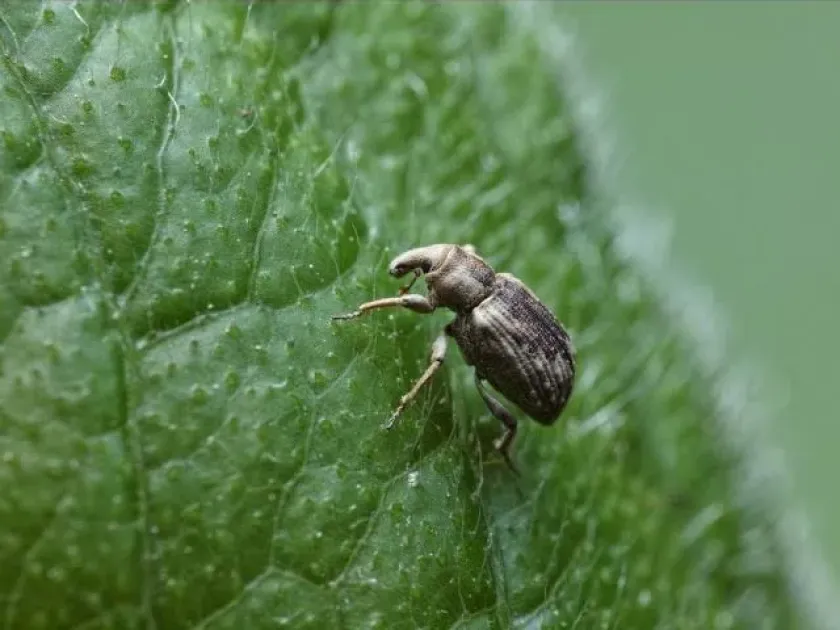
The rice water weevil (Lissorhoptrus oryzophilus) is a member of the Curculionidae family. It is a small beetle, typically about 3 mm long, with a greyish-brown color and distinct scales on its body.
Adults are recognized by their characteristic elongated snouts. The larvae are small, legless, and white, resembling tiny grubs, and they measure approximately 5–8 mm in length.
These larvae possess specialized dorsal hooks that allow them to extract oxygen directly from the roots of the rice plant while remaining submerged in the flooded field.
Adult beetles are strong flyers, capable of migrating long distances from their overwintering sites to newly planted rice fields as soon as the weather warms up.
Overwintering occurs primarily in the adult stage within plant debris, leaf litter, or along the grassy margins of fields and irrigation channels.
What it damages
The rice water weevil specifically targets rice (Oryza sativa). Both adults and larvae contribute to crop damage, though they affect the plant in different ways.
Adults feed on the leaves, creating narrow longitudinal scars or slits. While these aesthetic leaf marks are noticeable, they rarely cause severe damage to the plant's health.
The larvae are the most destructive stage, feeding exclusively on the root system. By pruning the roots, they significantly impair the plant's ability to uptake water and nutrients.
Heavily infested plants become stunted and weak, leading to reduced tillering, delayed maturation, and poor grain filling, which can result in severe yield losses.
In extreme cases of infestation, the root damage can cause the plants to lodge or die, leading to significant gaps and reduced stand density in the paddy field.
When it appears
Adults emerge from overwintering sites in the spring, typically when water temperatures reach 15–20°C, and move immediately into the newly flooded rice fields.
The peak egg-laying period occurs during the vegetative growth stage of rice. Females deposit eggs into the leaf sheaths or roots, where larvae emerge and drop into the soil.
The life cycle from egg to adult takes approximately 30 to 45 days, allowing for one or two generations per season depending on the climatic region and water temperature.
As the rice crop nears maturity, adults move towards the edges of the fields, seeking protected areas to prepare for the upcoming winter dormancy.
Population density is highly influenced by water management; maintaining consistent water levels and temperature is critical to the survival and multiplication of this pest.
Signs of infestation
The first sign of an infestation is the appearance of narrow, light-colored feeding scars on the leaves, caused by adult weevils chewing parallel to the leaf veins.
Infected fields often show patchy, stunted growth. Plants in these areas appear yellow or weak compared to healthy sections of the crop, often signaling root stress.
If you suspect an infestation, gently pulling up a rice plant will often reveal a damaged or pruned root system with larvae visible in the soil or mud.
Poor anchorage is a key sign; heavily damaged plants are easily pulled from the soil, as their root systems are largely consumed by the larvae.
Observing a sudden reduction in plant vigor during the early tillering stage is a reliable indicator that larval feeding has reached a threshold requiring intervention.
Control measures
Effective management begins with strict field sanitation, including the removal of weeds around paddies that serve as alternative hosts during the off-season.
Draining the paddy field for a short period can be an effective non-chemical control method, as larvae require a flooded environment to survive and develop.
Seed treatment with systemic insecticides is the standard preventative measure, providing early-season protection against larval establishment in the root zone.
For active infestations, foliar applications of registered insecticides may be necessary, provided that economic thresholds are met and label guidelines are followed.
Continuous monitoring, including scouting for leaf scarring and inspecting roots in representative areas, is essential for timing insecticide applications for maximum efficacy.
Taxonomy
- Latin name
- Lissorhoptrus
- Order
- Coleoptera (beetles)
- Family
- Brachyceridae
- EPPO code
- LISSSP
Discussion
No discussions yet — be the first.