
Giant African snail
Lissachatina fulica
Description
How to identify
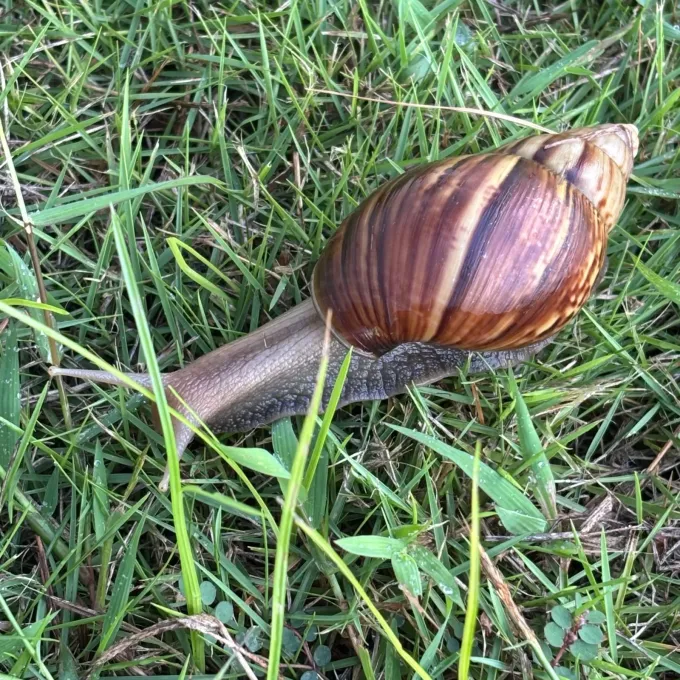
The Giant African snail (Lissachatina fulica) belongs to the family Achatinidae, order Stylommatophora. It is one of the largest land mollusks, with a shell that can reach 20–25 centimeters in length.
The body of the mollusk is usually colored in shades of brown or yellowish, while the shell has a conical shape with characteristic stripes. The color and patterns can vary significantly depending on the diet and environmental conditions.
This species is a hermaphrodite, which ensures high reproductive capacity of the population. A single individual is sufficient for reproduction, with a fertility of up to 500 eggs per clutch.
It prefers humid and warm biotopes and is often found near agricultural lands, gardens, and forest areas. It is an invasive species capable of rapidly adapting to new climatic conditions.
In its natural environment, the African snail is active primarily at night, which makes it difficult to visually detect during daylight hours without special traps or searching shelters.
What it damages
The pest attacks over 500 species of plants, including vegetables, fruits, and ornamental crops. It poses the greatest danger to young seedlings, transplants, and the tender leaves of various vegetables.
Under agro-ecosystem conditions, the snail is capable of destroying crops of cucumbers, zucchini, tomatoes, beans, and cabbage. It also feeds on tree bark, flowers, and even agricultural cereals.
Damage occurs by scraping plant tissues using the radula, leading to the appearance of large holes and complete defoliation of the plant in a short time.
In addition to physical destruction of tissues, the mollusk is an intermediate host for various parasites dangerous to humans and domestic animals, as well as a vector for phytopathogens.
High population density of giant snails can lead to the loss of up to 80-90% of the crop in limited areas, making them extremely dangerous for commercial farming.
When it appears
The activity of the mollusk depends directly on the level of humidity and ambient temperature, so in tropical conditions, it occurs all year round.
During periods of drought or sudden cold, the snail enters diapause, burrowing into the soil or hiding in thick vegetation where the necessary microclimate is maintained.
Peak activity occurs during the rainy seasons, when intensive reproduction and migration of individuals lead to a sharp increase in the number of pests in cultivated fields.
The nocturnal lifestyle determines the time of maximum crop damage, as snails emerge from their shelters to feed actively once it gets dark.
Presence on the site can be noticed by the dynamics of green mass destruction: the intensity of damage progresses with each rainy evening.
Signs of infestation
The main sign of the presence of the African snail is characteristic eaten leaf edges and large holes in the leaf blade, often accompanied by consumption of growth points.
Traces of dried mucus are visible on the surface of damaged plants and soil, leaving a noticeable silvery, shiny coating when it dries.
In the soil, under mulch, or garden tools, egg clutches can often be found — these are round objects of yellowish or whitish color collected in compact groups.
The presence of feces in the form of elongated excrements on leaves and stems also serves as an indicator of high pest population activity at night.
During the day, pests can be found under boards, stones, plant residues, or in deep layers of moist soil near plant roots.
Control measures
To combat this pest, a comprehensive approach combining agrotechnical, mechanical, and chemical methods is most effective.
- Regular weeding and removal of weeds that provide shelter for snails.
- Collection and manual destruction of individuals in the morning or evening hours.
- Use of traps with baits based on fermented liquids (beer, sugar syrups).
- Creating barriers made of quicklime, sand, or coarse wood chips around garden beds.
The use of molluscicides based on metaldehyde is a standard chemical method, but it requires strict adherence to dosages to prevent soil contamination.
An important element of biological control is attracting natural enemies, such as birds, hedgehogs, or predatory mollusk species that control population density.
Quarantine measures when moving soil, organic fertilizers, and planting material help prevent the spread of this invasive species to new territories.
Taxonomy
- Latin name
- Lissachatina fulica
- Order
- Molluscs
- Family
- Achatinidae
- EPPO code
- ACHAFU
Discussion
No discussions yet — be the first.