
Deer ked
Lipoptena
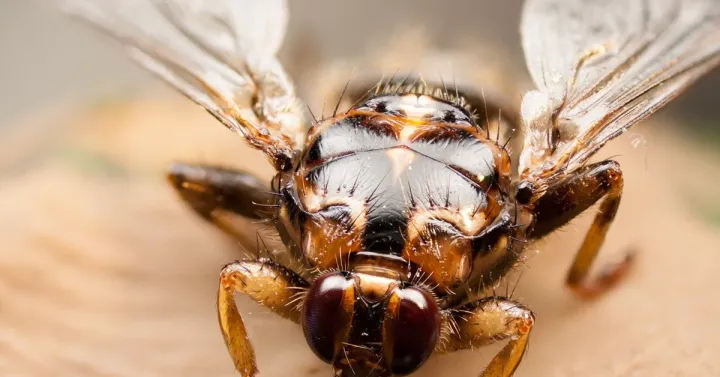
Description
How to identify
The deer ked (Latin Lipoptena cervi) belongs to the order Diptera, family Hippoboscidae. It is an ectoparasite that, in its adult stage, feeds exclusively on the blood of mammals.
Physically, the insect resembles a tick or a wingless fly, having a flattened brown body about 3–5 mm long. Once it lands on a host, the insect sheds its wings and begins an active parasitic life cycle.
The life cycle is characterized by viviparity: the female deposits a prepupa, which falls to the ground and turns into a pupa. The development of the pupa depends on ambient temperatures, which determines the timing of adult emergence.
It is important to understand that this insect is not a phytophage. It does not damage plant tissues, crops, or fruits, as its digestive system is adapted exclusively for blood consumption.
The misclassification of the deer ked as a plant pest is often linked to its mass presence in forest areas and adjacent agro-ecosystems where it disturbs livestock grazing in fields.
What it damages
The deer ked does not cause damage to agricultural crops or forest plantations. It does not eat leaves, suck plant sap, or affect roots, as it is an obligate hematophagous parasite.
The main harm caused by this insect manifests in the negative impact on livestock productivity. Cattle, horses, and sheep grazing near wooded areas are subjected to mass attacks by these parasites.
The constant presence of deer keds causes significant stress, itching, and restlessness in animals, which directly leads to weight loss and a reduction in milk yields in dairy herds.
During mass attacks, the insects can provoke dermatitis and allergic reactions in livestock, requiring additional veterinary intervention and costs for treating skin lesions.
In an agronomic context, the presence of this species in a field is merely an indicator of nearby forests and does not require phytosanitary treatment of crops with chemical pesticides.
When it appears
The activity of adult deer keds begins at the end of summer, usually in August, and lasts until October or November, depending on the climatic conditions of the region.
The maximum concentration of insects is observed during warm, windless days when they actively search for a warm-blooded host for feeding and reproduction on the host's body.
During the winter, adult insects that are not on a host die due to low temperatures, meaning the parasite's cycle has a distinct seasonal pattern in temperate climates.
Pupae residing in forest litter are capable of surviving winter frosts, which ensures the preservation of the population and its annual resurgence in the spring and summer.
Agronomists should consider these peak activity periods when scheduling livestock grazing on lands bordering forest edges to minimize stress on the animals.
Control measures
Since the deer ked is not a plant pest, the use of insecticides in fields and gardens against it is unnecessary and economically unjustified.
To protect agricultural animals from this parasite, only veterinary-grade repellents and insecticidal treatments applied directly to the animal's skin or fur are used.
An effective method to reduce animal contact with the insect is to organize grazing away from forest edges, where the majority of the ked population is concentrated.
If grazing near forests is necessary, the use of protective blankets for animals or automated spraying systems in holding pens is recommended.
Management practices also include the sanitary clearing of adjacent areas to remove deadwood and forest litter, where pupation occurs, although this method has limited effectiveness.
Taxonomy
- Latin name
- Lipoptena
- Order
- Diptera (flies)
- Family
- Hippoboscidae
- EPPO code
- LIPPSP
Discussion
No discussions yet — be the first.