
Alpine swift louse fly
Crataerina melbae
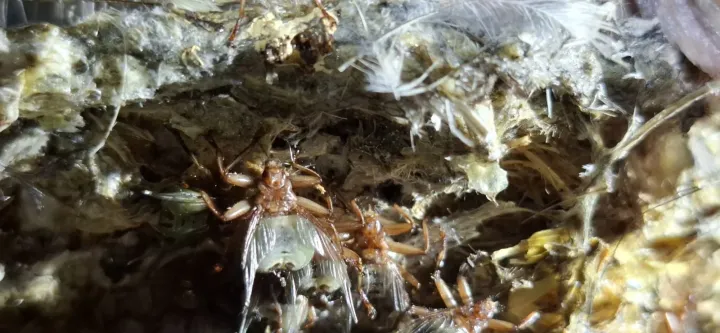
Description
How to identify
The Alpine swift louse fly (Crataerina melbae) belongs to the family Hippoboscidae, order Diptera. It is a highly specialized ectoparasite that lives exclusively on birds, particularly the Alpine swift.
Morphologically, these insects are adapted to life within feathers: they possess a flattened body and strong claws, allowing them to cling firmly to the host.
While winged, these flies are not efficient fliers; they spend almost their entire adult life crawling through the plumage of the birds they parasitize.
The mouthparts are specialized for blood-feeding, piercing the skin of the host to obtain nutrients required for survival and reproduction.
They are generally 5–8 mm in length, with a coloration that provides camouflage against the skin and feather shafts of their bird hosts.
What it damages
The Alpine swift louse fly is not an agricultural pest. It has no impact on crops, orchards, gardens, or any form of commercial vegetation.
The species does not consume plant matter, nor does it cause any damage to vegetation through its life cycle, nesting, or feeding habits.
Its economic importance is strictly limited to ornithology and avian health, as the parasite can affect the welfare of specific bird populations.
Agronomists and farmers do not need to monitor for this insect, as it will never be found on agricultural crops or in soil-based production environments.
Applying pest control measures for this species in a farming context is entirely unnecessary and ineffective.
When it appears
The activity of Crataerina melbae is strictly dictated by the breeding cycle of their bird hosts, occurring during the spring and summer months.
Females produce larvae that pupate soon after being deposited within the nest, ensuring the next generation is ready for the returning birds.
During the winter, when swifts migrate to warmer climates, the louse flies remain in the nest or on the hosts, slowing their metabolism to survive.
The population peaks during the nesting period when adult birds and their chicks provide a consistent and stable food source for the parasites.
Their life cycle is highly synchronized with the host, ensuring that the parasite remains in close proximity to the birds throughout their breeding season.
Signs of infestation
The presence of the louse fly is primarily detected through the examination of bird nests, where adult flies or dark, barrel-shaped puparia can be found.
Ornithologists may observe the flies on the birds themselves during capture and banding activities, which is a common way to study the species.
There are no signs of infection or damage to look for on plants, as the insect has no association with the botanical world.
Identification is mainly performed by entomologists or bird researchers to track parasite load in bird populations.
- Adult flies found within bird nests.
- Puparia shells left behind in nesting debris.
Control measures
No agricultural control measures exist or are required for Crataerina melbae, as it does not pose a threat to plant-based production.
In avian veterinary practice, sanitation and the removal of old nest material are the most effective ways to manage parasite populations.
If management is required in specific bird-rearing facilities, only products registered for avian or veterinary use should be employed, following strict safety protocols.
Agricultural pesticides should never be used against this species, as they would be harmful to the birds and the surrounding ecosystem without providing any agronomic benefit.
General integrated pest management programs in agriculture should focus on true plant pests, ignoring non-agricultural organisms like bird louse flies.
Taxonomy
- Latin name
- Crataerina melbae
- Order
- Diptera (flies)
- Family
- Hippoboscidae
- EPPO code
- CRTRME
Discussion
No discussions yet — be the first.