
Swift louse fly
Crataerina pallida
Description
How to identify
The swift louse fly (Crataerina pallida) belongs to the family Hippoboscidae, commonly known as louse flies. It is a highly specialized ectoparasite that has evolved exclusively to live within the nests of common swifts.
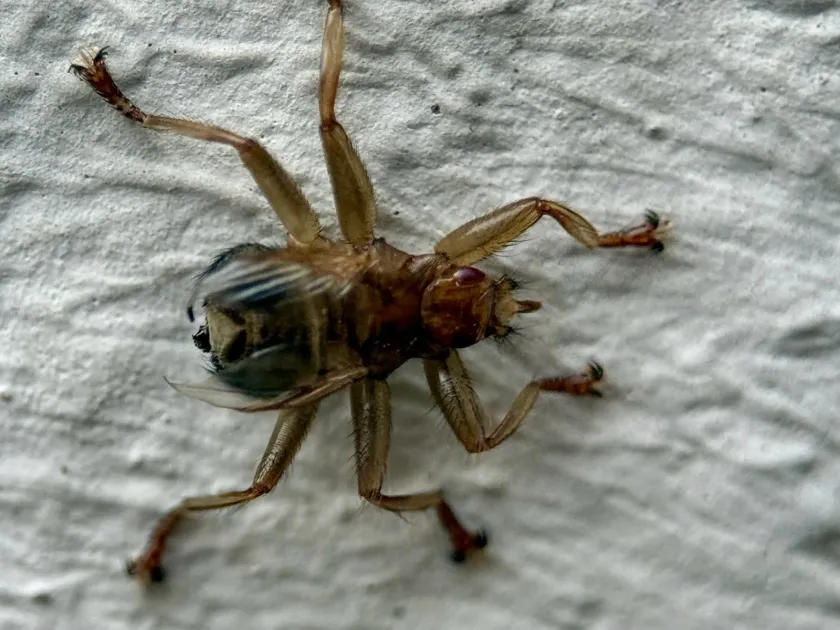
Adult flies have a flattened, leathery body, brownish in color, measuring about 7–8 millimeters in length. They possess strong legs equipped with hooked claws, enabling them to cling firmly to the feathers of their avian host during flight.
A distinctive feature of this species is its vestigial wings, which appear as small, non-functional plates. As a result, the flies have lost the ability to fly and rely entirely on crawling to move between hosts or within the nesting environment.
The mouthparts are specialized for piercing the skin and feeding on the blood of their host. Being an obligate parasite, it spends most of its life cycle on the bird or hidden within the nest material.
The reproduction is characterized by viviparity, where the female produces a single fully developed larva that pupates immediately. These pupae are capable of overwintering in the nest debris until the birds return.
What it damages
It is essential to clarify that the swift louse fly is not an agricultural pest. It does not cause any damage to vegetable crops, orchards, grain fields, or any ornamental plants.
The sole targets of this parasite are swifts. By feeding on the blood of the birds, the flies cause minor irritation and can potentially lead to physical weakness in nestlings if the infestation level in a colony is high.
The parasite does not cause any economic loss to the agricultural sector, and its presence does not warrant any form of phytosanitary intervention or chemical control measures.
In very rare instances, the flies may accidentally enter human habitations if a house is located near a colony of nesting swifts, causing temporary nuisance for the residents.
Overall, this species is considered a commensal or natural parasite of birds rather than a threat to human property or agricultural production.
When it appears
The activity of the swift louse fly is strictly synchronized with the migration and nesting cycle of swifts. The adults emerge from their overwintering pupae when the birds return to their nesting sites in late spring.
Throughout the summer months, the parasite reproduces within the nest, taking advantage of the warm environment provided by the brooding birds and growing nestlings.
As soon as the swifts leave their nests at the end of the breeding season, the adult flies die, and the species persists through the winter in the pupal stage, waiting for the following year.
This strict synchronization ensures that the flies are present only when their hosts are available, which is a critical evolutionary strategy for a wingless parasite.
Outside of the breeding season and the specific nesting environment, the chances of encountering active adults are virtually non-existent, as they cannot survive for long away from their hosts.
Signs of infestation
Signs of infestation include restless behavior in the swifts, as they frequently preen themselves to reduce the number of parasites. Empty pupal cases can often be found in the nest material.
When inspecting the nests, the flies move very rapidly, attempting to hide in crevices or deep within the nesting debris, making them difficult to spot at low population densities.
In residential areas, the only sign of their presence is an accidental sighting of an adult fly crawling on walls or windows near the nesting site, which often causes unnecessary concern.
Identification is straightforward when using a magnifying glass: look for a flattened, brownish insect with strong legs and a lack of functional wings.
There are no signs of plant damage, such as necrotic spots, wilting, or tissue destruction, associated with this species, as it has no biological interaction with flora.
Control measures
No control measures are necessary for the swift louse fly within an agricultural or gardening context, as it poses no threat to any plant life.
In cases where the insects enter homes near bird colonies, the best approach is to prevent the entry of birds into attics or ventilation shafts through physical barriers such as mesh or netting.
The use of insecticides is strongly discouraged as it would unnecessarily harm the environment and potentially affect beneficial insects, providing no benefit to agriculture or health.
Sanitation of attics and nesting spaces after the birds have migrated away for the winter can help reduce the population of overwintering pupae by removing the nesting substrate.
Ultimately, these insects are part of the natural avian ecosystem, and active eradication efforts are generally considered unnecessary and environmentally unsound.
Taxonomy
- Latin name
- Crataerina pallida
- Order
- Diptera (flies)
- Family
- Hippoboscidae
- EPPO code
- CRTRPA
Discussion
No discussions yet — be the first.