
Swift louse fly
Crataerina
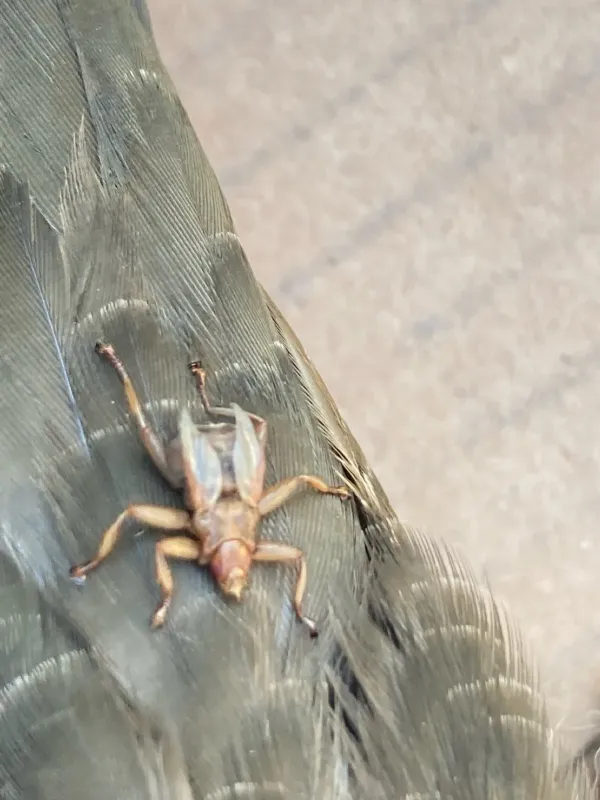
Description
How to identify
The swift louse fly (Crataerina pallida) is a highly specialized ectoparasite belonging to the family Hippoboscidae within the order Diptera.
Adult flies possess a flattened, leathery body structure, which is a perfect adaptation for maneuvering through dense bird feathers.
They have strong legs equipped with hooked claws, enabling them to cling tightly to their host's skin or feathers, making them very difficult to dislodge.
Most individuals have reduced or shortened wings, which limits their flight ability, causing them to rely on rapid crawling to move between hosts.
Their coloration is typically brownish, serving as an effective camouflage against the bird's plumage or within the debris of a nest.
What it damages
These parasites inflict significant stress on birds by causing constant itching, skin irritation, and the development of dermatitis due to frequent bites.
Constant blood loss leads to anemia and emaciation, which is particularly detrimental to young birds and nestlings during their growth phase.
The infestation causes birds to exhibit restless behavior, often resulting in them abandoning their nests, which compromises successful breeding.
Parasitized birds often suffer from poor feather condition and weakened health, making them more susceptible to secondary infections.
In addition to physical harm, louse flies can serve as vectors for various avian pathogens, facilitating the spread of diseases within a colony or flock.
When it appears
The seasonal activity of the swift louse fly is strictly synchronized with the nesting period of its host birds, primarily occurring in spring and summer.
Wintering occurs primarily in the pupal stage, with these pupae remaining dormant in old nesting materials until the temperature rises.
Adult flies emerge just as the birds return to their nesting sites, immediately seeking hosts to feed on and commence their reproductive cycle.
Populations tend to reach their peak in mid-summer when nesting activity is at its highest, providing a steady supply of hosts for the flies.
Once the breeding season concludes and the nests are abandoned, the fly population enters its dormant pupal stage to survive until the following year.
Signs of infestation
A primary indicator of infestation is the persistent restlessness of birds, frequently manifested by excessive preening or pecking at their plumage.
Visual detection is possible by inspecting nesting materials, where adult flies may be found darting away when disturbed.
The presence of dried, brown, hard pupal cases in nesting boxes or birdhouses is a definitive sign of an established infestation.
Young birds showing signs of weakness, stunted growth, or poor physical condition may indicate a heavy burden of ectoparasites.
Close examination of the birds' skin, particularly around the wings and tail, often reveals the presence of adult louse flies clinging to the host.
Control measures
Effective management begins with strict sanitation, specifically the removal and destruction of old nesting materials after the breeding season ends.
Applying registered insecticides to poultry houses or bird nesting structures can significantly reduce the number of emerging adult flies.
Maintaining high hygiene standards in poultry facilities prevents the accumulation of waste that provides suitable wintering spots for pupae.
- Regular removal of old nest materials.
- Sanitization and disinfection of bird housing.
- Monitoring of bird colonies for parasite presence.
- Use of appropriate insecticidal treatments.
Strategic control measures, coupled with early detection, are essential to preventing population explosions and protecting the health of the bird population.
Taxonomy
- Latin name
- Crataerina
- Order
- Diptera (flies)
- Family
- Hippoboscidae
- EPPO code
- CRTRSP
Discussion
No discussions yet — be the first.