
Rutherglen bug
Liorhyssus hyalinus
Description
How to identify
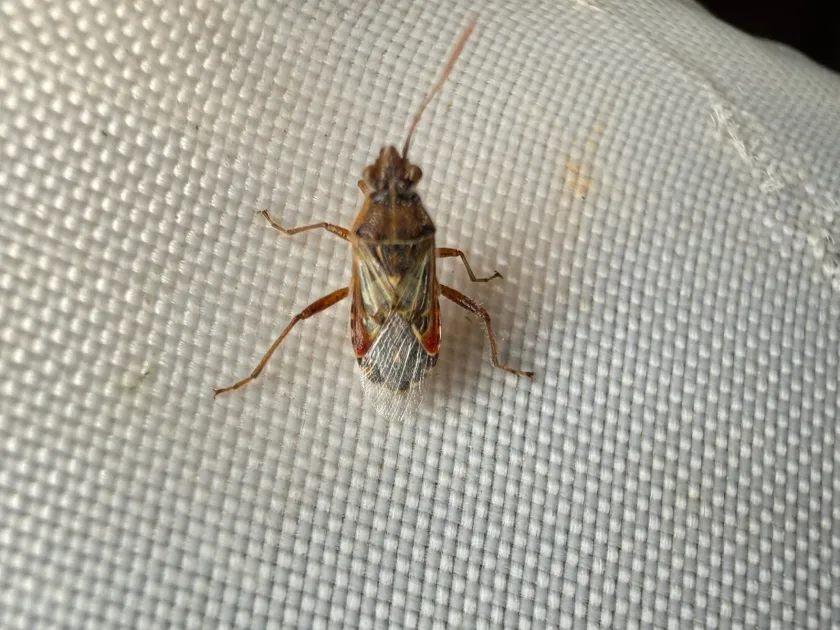
The Rutherglen bug (Liorhyssus hyalinus) belongs to the family Rhopalidae within the order Hemiptera. These insects are relatively small, typically measuring between 5 to 7 millimeters in length.
Adult bugs are characterized by a yellowish-brown or reddish coloration, often featuring a distinct translucent pattern on their wings. The head and pronotum may bear dark markings.
The common name "scentless plant bug" or the family classification of "rhopalid bug" is related to their morphology, specifically their distinct club-shaped antennae.
Their bodies are oval and slightly flattened dorsoventrally, which allows them to hide effectively in crevices or between plant foliage when threatened or during periods of rest.
Nymphs resemble smaller, wingless versions of the adults, often displaying a lighter, greenish-yellow tint, which helps them camouflage against the host plants they feed on.
What it damages
This bug is a highly polyphagous insect, capable of feeding on a wide range of host plants, including various broadleaf weeds and important agricultural crops.
Major crops prone to damage include sunflower, cotton, and various legumes. They utilize their piercing-sucking mouthparts to extract plant sap from seeds and stems.
By injecting salivary enzymes during the feeding process, they cause tissue necrosis, which disrupts the plant's vascular system and metabolic processes.
Feeding on seeds often results in reduced germination rates and lower market quality, particularly in oilseed crops where oil content and weight can be severely impacted.
Mass infestations are particularly devastating as they can cause significant yield losses over a short period, especially during the grain or seed-filling stages.
When it appears
The life cycle of the Rutherglen bug is heavily influenced by temperature, with warm and dry weather conditions promoting rapid population growth and multiple generations.
Adults overwinter in protected environments, such as crop debris, leaf litter, or deep within dense weeds, emerging as soon as the weather begins to warm in the spring.
As weed hosts dry out, these bugs tend to migrate in large swarms toward lush, irrigated, or maturing agricultural crops to find fresh food sources.
The peak of their activity usually coincides with the late growth stages of crops, making them particularly dangerous during the sensitive phases of seed development.
They are known to be highly mobile, with migration patterns that can span long distances depending on wind conditions and the availability of suitable host vegetation.
Signs of infestation
Visible signs of damage include stunted growth, wilting of terminal shoots, and the shriveling of seed pods or flower heads due to heavy sap extraction.
Close inspection of affected plants often reveals small, dark, necrotic spots where the bugs have pierced the plant tissue with their stylets.
Premature abscission (dropping) of flowers and immature pods is a frequent indicator of high population pressure within a field.
The presence of large numbers of bugs on the inflorescences or stems, particularly during early morning or late afternoon, is the primary sign of an active infestation.
- Stunted plant development due to nutrient depletion.
- Secondary fungal infections entering through puncture wounds.
- Uneven ripening and lower weight of harvested seeds.
Control measures
Effective management begins with strict weed control, as maintaining clean fallows and field edges eliminates the primary breeding grounds for the bug.
Deep cultivation of the soil after harvest helps to bury or destroy overwintering sites, significantly reducing the initial population that emerges the following season.
Establishing spatial barriers or monitoring field borders allows farmers to detect migration events before the insects spread throughout the entire crop.
When economic thresholds are exceeded, the use of registered systemic or contact insecticides is necessary to protect the yield from further feeding damage.
Integrated pest management (IPM) practices should be employed, focusing on crop rotation and the preservation of natural predators to keep population levels in check.
Taxonomy
- Latin name
- Liorhyssus hyalinus
- Order
- Hemiptera (bugs, aphids, leafhoppers)
- Family
- Rhopalidae
- EPPO code
- LIORHY
Discussion
No discussions yet — be the first.