
Chorosoma
Chorosoma
Description
How to identify
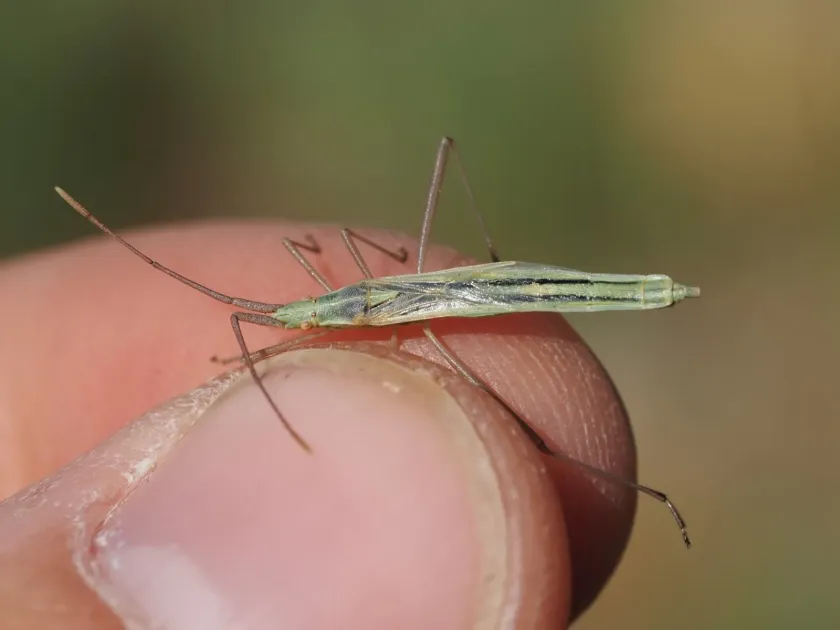
Chorosoma is a genus of insects belonging to the family Rhopalidae in the order Hemiptera. These insects have a characteristic elongated, slender body, measuring 10–15 mm in length, which allows them to effectively camouflage themselves among grass stems.
The body color ranges from light yellow to brown, providing excellent mimicry against the background of dry or ripening grasses. The head is elongated, and the antennae consist of four segments, which is a key morphological feature for identifying the species.
The wings of these bugs often feature transparent or semi-transparent membranes. The legs are well-developed, allowing the insect to move quickly along host plants and perform short flights when threatened.
In the field, adults are typically found in the lower parts of plants, where they prefer to hide during the morning and evening hours. Nymphs resemble adults but differ in the lack of fully developed wings and their smaller size.
The insect undergoes incomplete metamorphosis. Its life cycle includes the egg stage, five nymphal instars, and the adult stage, which is typical for members of this suborder.
What it damages
This pest primarily attacks various species of cereal grasses, both wild and cultivated. Its primary targets include wheat, barley, oats, and certain meadow grasses.
Feeding occurs through piercing stems and leaves, followed by sucking out plant sap. This process disrupts the plant's metabolism and depletes its vital resources.
The most significant damage occurs during the crop's active growth phase, when the plant invests maximum energy into forming biomass. Damage during the stem-elongation phase is particularly critical for crop yield.
Necrotic areas often develop at the puncture sites, eventually spreading across large parts of the leaf. This leads to the yellowing of leaf blades and their premature death, negatively impacting photosynthesis.
Under conditions of mass infestation, a decrease in total grain yield, a decline in grain quality, and weakened immunity against secondary diseases are commonly observed.
When it appears
The life cycle of Chorosoma is closely linked to the growing season of cereal crops. Adults overwinter in leaf litter, dry grass, haystacks, or crop residues.
With the arrival of spring warmth, usually in late April or May, the bugs emerge from their overwintering sites and begin to colonize fields with cereal crops. Initial feeding is essential for them to regain strength before the breeding season.
Eggs are laid on the stems or leaves of plants in late spring. Nymphs of the first instar appear in early summer and begin feeding actively, growing rapidly through successive molts.
The most intense activity of this pest occurs in June and July, coinciding with the rapid growth and grain-filling phases of most cereal crops.
By late summer or early autumn, the new generation of adults completes its development. After a period of intense feeding, young individuals seek suitable sites for successful overwintering, which reduces their activity in the fields.
Signs of infestation
The first sign of the pest's presence in a field is the appearance of characteristic punctures and spots on cereal leaves. Upon careful inspection of the leaf undersides, one can detect the insects or their nymphs.
Affected plant areas often look like discolored or yellowish dots, which gradually merge into larger damaged zones. Plants may appear stunted or weakened.
- Yellowing of leaf tips.
- Presence of tiny puncture marks.
- Stunted growth and delayed stem development.
- Presence of characteristic nymphs in leaf axils.
- Weakened stem integrity at feeding sites.
In cases of heavy infestation, the pest can cause premature wilting of specific plant parts, visually highlighting the infection hotspots against the rest of the green field.
To confirm the presence of Chorosoma, agronomists typically use a sweep net or perform visual inspections in the early morning when the insects are less active.
Control measures
The protection strategy against this pest is based on strictly following agronomic practices designed to reduce population density before the period of active field colonization.
The most important measure is the elimination of weeds, especially wild grasses, which serve as a reservoir for bug reproduction in the spring. Cleaning field margins and edges is critically important.
Crop rotation and optimal sowing dates allow the crop to pass through its most vulnerable developmental stages before the mass emergence of Chorosoma adults.
If the economic threshold of damage is exceeded, the use of registered systemic or contact-stomach insecticides, known to be effective against Hemiptera, is recommended.
Biological control plays a significant role, involving the creation of favorable conditions for natural entomophages, such as predatory insects and parasites that feed on the eggs and nymphs of these bugs.
Taxonomy
- Latin name
- Chorosoma
- Order
- Hemiptera (bugs, aphids, leafhoppers)
- Family
- Rhopalidae
- EPPO code
- KHORSP
Discussion
No discussions yet — be the first.