
Liorhyssus
Liorhyssus
Description
How to identify
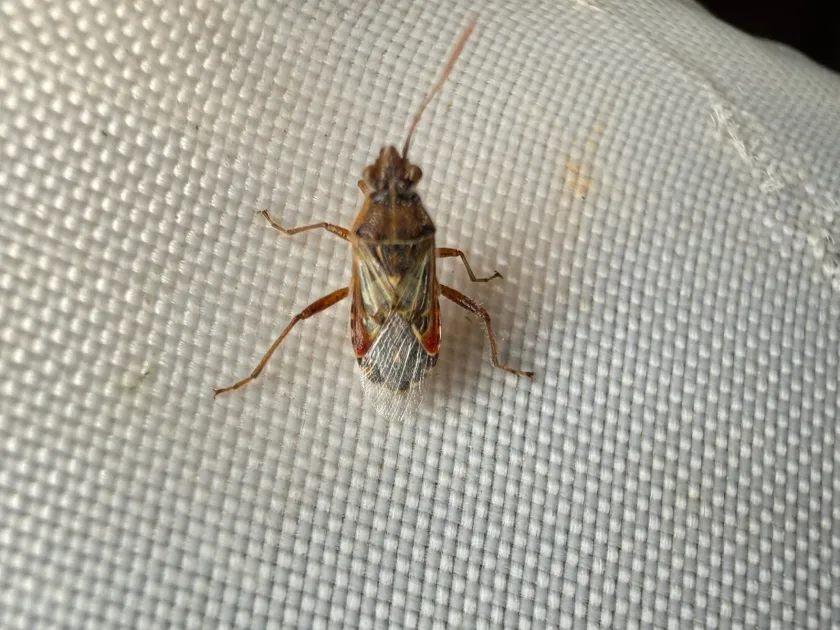
Liorhyssus (predominantly the species Liorhyssus hyalinus) belongs to the Rhopalidae family of the order Hemiptera. This insect has a body length ranging from 5 to 8 millimeters and is colored in yellowish-brown or reddish-brown tones.
A distinctive feature of the adult is the presence of translucent membranous wings, which make it resemble other species of scentless plant bugs. The head and pronotum are covered with dense, fine punctures, creating a specific surface texture.
Larvae pass through five instars during development, gradually acquiring a coloration similar to adults, but differing in the absence of fully developed wings. They are very active and prefer to hide in inflorescences or leaf axils.
This pest possesses high ecological plasticity, which allows it to thrive in various climatic conditions. It is frequently encountered in open spaces, fields, and home gardens.
Species identification in field conditions is difficult due to external resemblance to other bugs, so it is recommended to use magnifying devices for precise diagnosis and pay attention to the shape of the scutellum and the color of the abdomen.
What it damages
The main crops susceptible to Liorhyssus damage include cotton, cereal crops, legumes, and certain technical plants. The bug feeds on the sap of the plant's vegetative and generative organs.
The pest shows a particular interest in young ovaries and buds, sucking out nutrients. This leads to significant weakening of the plant and a decrease in photosynthetic intensity in the affected tissues.
Under mass reproduction, the insect is capable of causing substantial damage to seeds, reducing their germination rate and vigor. Damaged plant tissues often become entry points for secondary infections.
In cotton, Liorhyssus often causes the shedding of buds and ovaries, which directly affects the final fiber yield. Production losses can be significant if monitoring is absent.
In addition to agricultural fields, the pest often inhabits wild Asteraceae plants, which serve as natural reservoirs and a food base during the off-season.
When it appears
Liorhyssus activity begins in the spring when stable positive temperatures are established. Adults emerge from overwintering sites and begin an active search for host plants.
The population peak usually occurs in mid-summer when most agricultural crops are in their active growth phase. During this period, overlapping generations are often observed.
Females lay eggs primarily on the leaves or stems of host plants, choosing the most succulent parts. The development of one generation takes from three to five weeks depending on the temperature regime.
In the autumn, with falling temperatures and the fading of the food base, the insects begin searching for overwintering sites. They prefer to hide in plant debris, forest belts, or under fallen leaves.
Depending on the region, Liorhyssus can produce from two to several generations per season, significantly increasing the risk of mass outbreaks under favorable conditions.
Signs of infestation
The main sign of crop infestation is the presence of numerous small necrotic spots on the leaves. In areas pierced by the proboscis, the tissue often loses color or dries out.
Visual inspection of the plants can reveal clusters of larvae in inflorescences or at the tips of stems. They reveal their presence through characteristic movement when the plant is lightly shaken.
Signs of deformation are observed on generative organs: underdeveloped cotton bolls or shriveled cereal grains. This is the result of disrupted seed feeding on the parent plant's sap.
- Yellowing and curling of young leaves.
- Shedding of buds and premature seed ripening.
- Presence of excrement as dark spots on the surface of damaged organs.
General stunting of plant growth alongside visible tissue damage is a reliable indicator that a pest colony is actively feeding in the field.
Control measures
Agrotechnical control methods include high-quality tillage and the destruction of weed vegetation along the field edges. This deprives the pest of sites for shelter and reproduction.
Adherence to crop rotation and spatial isolation of fields from wild plant reservoirs reduce the risk of bug migration to cultivated crops. Timely harvesting is essential.
Chemical control is justified when the economic threshold is exceeded. Insecticides from the organophosphate or pyrethroid groups are used according to the regulations for specific crops.
The biological method involves preserving natural entomophages — predatory bugs and parasitoid wasps that parasitize Liorhyssus eggs and larvae.
Regular field monitoring using light traps or sweeping with an entomological net allows for the timely detection of infestation beginnings and the implementation of immediate measures.
Taxonomy
- Latin name
- Liorhyssus
- Order
- Hemiptera (bugs, aphids, leafhoppers)
- Family
- Rhopalidae
- EPPO code
- LIORSP
Discussion
No discussions yet — be the first.